Reinette Simirenko
From the Simirenko orchards near Mliiv, origin unknown; Ukraine's public orchards held about 10 million trees in 1989
History
Reinette Simirenko (Ренет Симиренка) is of unknown origin2,3. It grew in the orchards of the sugar manufacturer Platon Simirenko at Platoniv Khutir, near the village of Mliiv in the Cherkasy region of present-day Ukraine2,3. In 1890 a long-serving worker there recalled seeing its mother trees some forty years earlier, and from the 1850s the nurseries of Platon, who died in 1863, and of his relative Oleksii Khropal were raising it2. Other nurseries spread it under other names, among them Reinette Verte Incomparable and, around Kherson and Melitopol, Renet Filibera1,2.
Platon’s son Lev, a pomologist, came home in 1887 from eight years of political exile in Siberia2. That autumn he showed the fruit at an exhibition in Kharkiv as P. F. Simirenko’s Green Reinette, after his father; he later wrote that he could not say whether it was an old western variety long forgotten or a seedling from his father’s garden2. He sent it to the Pomological Society of France, which described it in 18952. By 1932 his son Volodymyr counted it among the main apples of the southern Soviet Union and a successful export, especially to Sweden2. Russia admitted it to its state register in 19473, and at Ukraine’s orchard census of 1989 the public sector held about 10 million trees2. SNP data show it to be a parent of Kachovskoe and, with Pepin Shafranny, of Junnaja Sonata4.
The fruit
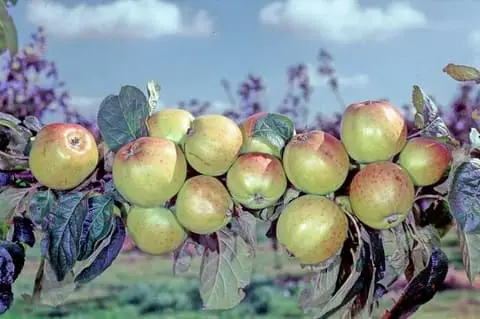
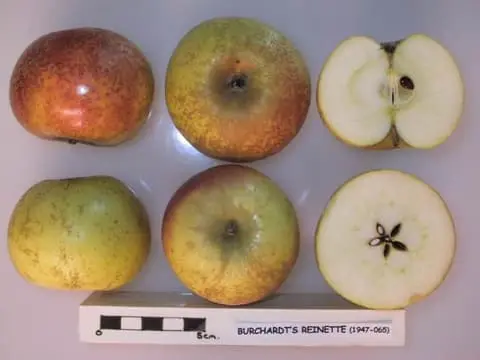
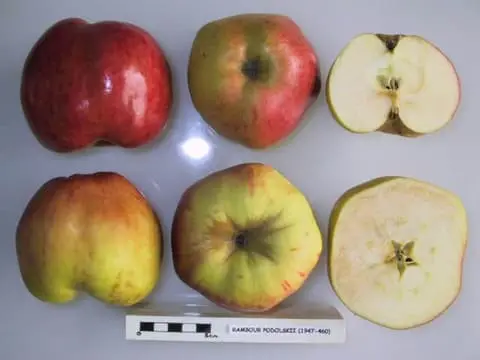
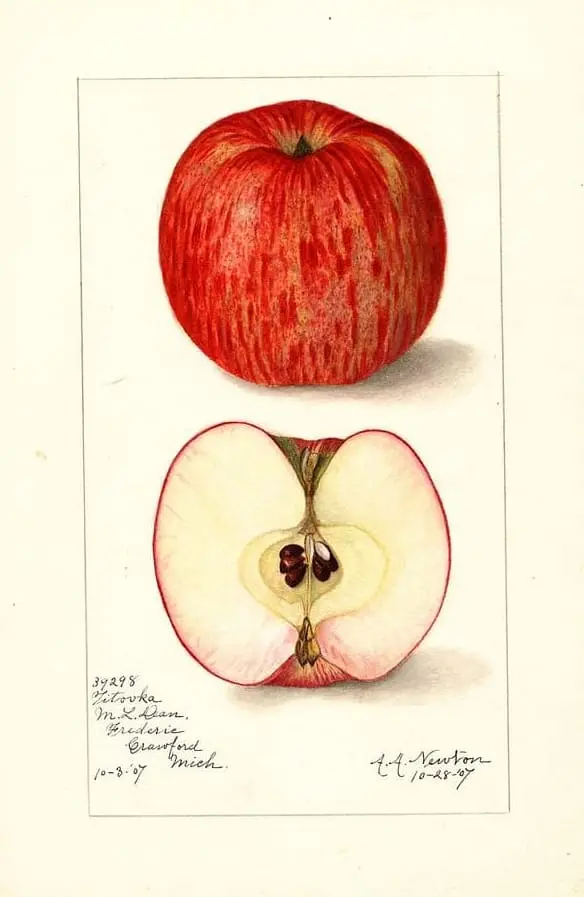
The fruit weighs 140–150 grams, up to 200, and is flat to tall round-conical3, often with one side larger than the other2; its short, thick stalk holds it firmly on the tree3. The National Fruit Collection gives a width of 60–70 mm1. The dense skin is bright green at picking and yellowish green later, with many pale dots and rarely a faint orange flush, and turns greasy and aromatic in store3. The flesh is white to greenish yellow, fine-grained, tender and very juicy, sweet and vinous with a strong spicy aroma2,3; the National Fruit Collection calls it greenish white and subacid1.
In Ukraine it was picked in late September and kept in a cellar until April or May2; the Russian register gives June3. At Brogdale in Kent it starts to flower around 5 May and is picked in mid-October1.
Growing
The tree is medium-sized, with a broad, dense crown3. It crops heavily but irregularly, resists drought, and is attacked by scab and powdery mildew3. Its young wood suffers from frost in low, damp sites, where scab is also worse2, and in the winter of 1928–29 trees were damaged where temperatures fell to between −32 and −37 °C2. It is practically self-sterile, though a good pollinator of other varieties2, and diploid4.
Uses
It is a dessert apple1 that travels well and was exported2; a 1999 atlas quoted by Volvach also recommends it for fresh juice2.
Where the sources disagree
- Where it arose. The National Fruit Collection says it is thought to have originated in Russia1; the Russian register and the Ukrainian accounts place it near Mliiv2,3.
- Wood’s Greening. The National Fruit Collection lists Wood’s Greening and Wood’s Grunling among its names1; Downing described Wood’s Greening as a native of New Jersey5. In the 1880s the head gardener of the Nikitsky Botanical Garden took fruit sent to him for Wood’s Greening, but Lev Simirenko found that true Wood’s Greening from Reutlingen ripened earlier, never turned yellow and lacked the aroma2, and the Russian register says the two look alike but Reinette Simirenko tastes far better3. Volvach writes that the Soviet authorities imposed the name after Volodymyr Simirenko’s arrest in 19332. The two names are not listed here among its own.
- First description. The National Fruit Collection gives 18951, the year of the French description2; an atlas of 1999 quoted by Volvach gives 18802.
- Early bearing. Lev Simirenko found it early to crop2; the Russian register rates its precocity below average3.
Sources
- Reinette Simirenko (accession 1950-114), National Fruit Collection, Brogdale, Kent (Defra). Supports: "Thought to have originated in Russia. Found in the garden of P.F. Simirenko in the Ukraine. Described in 1895"; tender, crisp, greenish white flesh with a subacid flavour; a dessert apple; the other names, among them Reinette Verte Incomparable, Renet Filibera, Wood's Greening and Wood's Grunling; fruit 60–70 mm wide (National Apple Register, Smith, 1971); 10% flowering on 5 May and picking in mid-October at the collection.
- The Ukrainian apple: on the history of the origin and spread of the variety Reinette Simirenko (in Ukrainian), Petro Volvach, Proceedings of the Shevchenko Scientific Society, vol. XII, pp. 369–398; National Academy of Sciences of Ukraine library repository, 2003. Supports: the Ukrainian name; the orchards of the sugar manufacturer Platon Simirenko at Platoniv Khutir near Mliiv; a worker's account in 1890 of mother trees seen about forty years earlier; propagation in the nurseries of Platon Simirenko and Oleksii Khropal from the 1850s; Platon's death in 1863; the names under which nurseries spread it (Reinette Verte Incomparable; Renet Filibera in the Kherson and Melitopol districts); Lev Simirenko's eight years of exile and his showing of the fruit at Kharkiv in autumn 1887 as P. F. Simirenko's Green Reinette; the Wood's Greening dispute (the Nikitsky head gardener's identification; Lev Simirenko's comparison with true Wood's Greening from Reutlingen) and the claim that Soviet authorities imposed the name after Volodymyr Simirenko's arrest in 1933; about 10 million trees in Ukraine's public sector at the 1989 orchard census; and, reproduced in translation, the descriptions by L. P. Simirenko (1912 and his Pomology: origin uncertain; description by the Pomological Society of France in 1895; fruit often with one half larger than the other; early, heavy cropping; frost-tender young wood and scab in low, damp sites; white, juicy, vinous-sweet, spicy flesh), by V. L. Simirenko (1932: one of the main apples of the southern Soviet Union; picking in late September; keeping until April–May; frost damage at −32 to −37 °C in 1928–29; practically self-sterile but a good pollinator; export success especially in Sweden) and by V. Ya. Chupruniuk (1999: described in 1880; for fresh fruit and fresh juice).
- State Register of Breeding Achievements Approved for Use: Renet Simirenko, apple (in Russian), State Commission of the Russian Federation for Testing and Protection of Breeding Achievements (Gossortkomissiya). Supports: "genetic origin unknown"; found by P. F. Simirenko in his orchards at Platonov Khutor near Mliiv, Cherkasy region; outwardly like Wood's Greening but far better in taste; keeping until June; high drought resistance; scab and powdery mildew; very high but irregular yields; precocity below average; a medium-sized tree with a broad, dense crown; fruit 140–150 g (up to 200 g), flat to tall round-conical, often lopsided, on a thick, short, firmly attached stalk; dense skin, bright green at picking and later yellowish green, with many whitish dots and rarely a faint orange tan, greasy and aromatic in store; fine-grained, very juicy, tender flesh, vinous-sweet with a strong spicy aroma; admitted to the register in 1947.
- Using whole-genome SNP data to reconstruct a large multi-generation pedigree in apple germplasm, Hélène Muranty and others, BMC Plant Biology 20:2, with Additional files 1, 3 and 6, 2020. Supports: Reinette Simirenko diploid (Table S1); a parent of Kachovskoe (Table S5, a parent–offspring pair with 1 Mendelian error, oriented by date); with Pepin Shafrannyj, a parent of Junnaja Sonata (Table S3, 91 Mendelian errors against a threshold of 600).
- The Fruits and Fruit Trees of America, p. 416: Wood's Greening, A. J. Downing, revised by Charles Downing, John Wiley & Sons, Internet Archive, 1900. Supports: Wood's Greening "A native of New Jersey".