Pepin Shafranny
Michurin's winter apple of 1907–15; SNP data name Scarlet Pearmain and Glogerovka as its parents, not those recorded
History
Pepin Shafranny (Пепин шафранный) is a winter apple raised by Ivan Vladimirovich Michurin at Michurinsk, in Russia’s Tambov region1,2,3. The National Fruit Collection dates it to 19071; the Russian state register says it was obtained between 1907 and 19152. Its recorded pedigree is Orleans Reinette crossed with a hybrid of Pepinka Litovskaya and Kitaika2,3, which the National Fruit Collection writes as Orleans Reinette × Glogerovka × Kitaika (Malus prunifolia)1; Glogerovka was described in 1903 as Pepinka Litovskaya6.
It went into state trials in 1939 and was admitted to the state register in 1947 for regions from north-western Russia to eastern Siberia; in western and eastern Siberia it is grown as a low, creeping tree2. It has been a parent of other apples: the National Fruit Collection records it as the mother of Krasnyi Shtandart1, and SNP data show it to be a parent, with Reinette Simirenko, of Junnaja Sonata4.
SNP studies point to other parents than the recorded ones. Muranty and colleagues found Pepin Shafranny and Scarlet Pearmain, an English apple introduced about 1800, to be parent and offspring, with 11 Mendelian errors where they accepted up to 600, and took Scarlet Pearmain to be the parent from the dates4,8. Larsen and colleagues give its two parents as Scarlet Pearmain and Glogerovka5. On this evidence Glogerovka is a parent rather than a grandparent, and Scarlet Pearmain stands where the record has Orleans Reinette2,4,5.
The fruit
The fruit is small to medium, about 85 grams, round- or oval-conical, and smooth or faintly ribbed2,3; the National Fruit Collection measured it at 56 mm wide and 53 mm high1. The smooth, greasy skin is greenish to orange-yellow, mostly covered by a diffuse dark red flush with darker stripes, and has many small pale dots2,3. The cream flesh is firm, juicy and tender, sweet and vinous with a delicate spicy aroma2,3; VNIISPK gives 11.6 per cent sugars and 0.57 per cent acids3. It is eaten from autumn or early winter and keeps until February2, or until February or March, about 223 days, in a fruit store, and it travels well3.
Growing
The tree is small to medium-sized, with a broad, flat-round, weeping crown that needs regular thinning, and it bears mainly on long fruiting twigs and spurs2,3. It begins to crop in its fifth to seventh year and then crops heavily every year, and it is largely self-fertile3. Its winter hardiness is moderate: trees are damaged in hard winters but recover well2,3. It flowers late2. Without pruning, the fruit grows small and tends to drop3. It is diploid4,5.
Uses
It is a dessert apple1 of general use, and VNIISPK rates its processed products highly, jam above all3.
Where the sources disagree
- Parents. The recorded pedigree is Orleans Reinette × (Pepinka Litovskaya × Kitaika)2,3; SNP data give Scarlet Pearmain and Glogerovka4,5. Orleans Reinette and Scarlet Pearmain have carried much the same name: the National Fruit Collection lists Krasnyi shafran among the other names of the first7 and Safran Krasnii among those of the second8.
- Date. The National Fruit Collection gives 19071; the Russian register gives 1907–19152.
- Scab. The National Fruit Collection calls it resistant to scab1; the Russian register rates its resistance as medium2, and VNIISPK counts scab among its faults3.
- Season. The Russian sources treat it as an apple for autumn and winter that keeps until February or March2,3; at Brogdale in Kent it is picked in late August1.
Family tree
Parents, grandparents and great-grandparents, as the entries in the atlas record them.
- Pepin Shafranny Russia, 1907
- Parent Scarlet Pearmain United Kingdom, by about 1800
- Parent Glogerovka
Offspring in the atlas
- Krasnyi Shtandart × Rubynovoye; Russia, 1915
Sources
- Pepin Shafrannyi (accession 1975-006), National Fruit Collection, Brogdale, Kent (Defra). Supports: "Raised in 1907 by I.V. Michurin at Michurinsk, Russia"; a dessert apple; "Resistant to scab"; parentage "Orleans Reinette x Glogerovka X Kitaika/M.prunifolia"; mother of Krasnyi Shtandart; fruit 52.79 mm high and 55.93 mm wide; picking in late August at the collection.
- State Register of Breeding Achievements Approved for Use: Pepin Shafrannyi, apple (in Russian), State Commission of the Russian Federation for Testing and Protection of Breeding Achievements (Gossortkomissiya). Supports: "obtained in 1907–1915"; Renet orleanskii (Orleans Reinette) × a hybrid form (Pepinka litovskaya × Kitaika); author Ivan Vladimirovich Michurin; originator the Michurin centre at Michurinsk, Tambov region; autumn or early-winter use, keeping until February; medium winter hardiness; late flowering; good recovery after damage; medium resistance to scab; high, regular yields; a tree below medium to medium size with a broad, flat-round, weeping crown, fruiting on long fruiting twigs and spurs; fruit below medium, 85 g, oblong-ovate or oval-conical, slightly ribbed or smooth; smooth, greasy, orange-yellow skin with a diffuse, striped dark red flush over most of the fruit and small yellowish dots; creamy-yellow, medium-firm, juicy, tender flesh, vinous-sweet with a delicate aroma; state trials from 1939; admitted to the register in 1947 for regions from the North-West to East Siberia; grown in a creeping form in western and eastern Siberia.
- Variety database: apple, Pepin Shafranny (in Russian), All-Russian Research Institute of Fruit Crop Breeding (VNIISPK), Orel. Supports: a winter variety bred by I. V. Michurin from Renet orleanskii × (Pepinka litovskaya × Kitaika); a medium-sized tree with a dense crown needing regular thinning, cropping mainly on fruiting twigs and spurs; fruit medium and small, round-conical, greenish-yellow with a diffuse dark red flush, darker stripes and many small white dots; cream, firm, juicy flesh, vinous-sweet with a delicate spicy aroma; 11.6% sugars and 0.57% titratable acids; very transportable; keeping until February–March (223 days) in a fruit store; general purpose, its processed products good, especially jam; first crops in the fifth to seventh year, then heavy annual crops; medium winter hardiness, damage in severe winters with good recovery; scab among its faults; highly self-fertile; small, dropping fruit without pruning.
- Using whole-genome SNP data to reconstruct a large multi-generation pedigree in apple germplasm, Hélène Muranty and others, BMC Plant Biology 20:2, with Additional files 1, 3 and 6, 2020. Supports: Pepin Shafrannyj diploid (Table S1); Pepin Shafrannyj and Scarlet Pearmain a parent–offspring pair with 11 Mendelian errors against a threshold of 600, Scarlet Pearmain (dated 1800) taken as the parent by date, the literature parents being Orleans Reinette and (Glogerovka × Kitaika) or (Pepinka litovskaya × Kitayka) (Table S5); Pepin Shafrannyj and Reinette Simirenko the parents of Junnaja Sonata (Table S3).
- Cultivar fingerprinting and SNP-based pedigree reconstruction in Danish heritage apple cultivars utilizing genotypic data from multiple germplasm collections in the world, Bjarne Larsen and others, Genetic Resources and Crop Evolution 72: 2397, supplementary Table S5, 2025. Supports: Pepin Shafrannyj diploid, with SNP-confirmed parents Scarlet Pearmain and Glogerovka.
- Glogerovka (accession 1949-170), National Fruit Collection, Brogdale, Kent (Defra). Supports: "It was described in 1903 as Pepinka Litovskaya"; Pepinka Litovskaya among its other names.
- Orleans Reinette (accession 1976-147), National Fruit Collection, Brogdale, Kent (Defra). Supports: Krasnyi shafran among the other names of Orleans Reinette.
- Scarlet Pearmain (accession 1957-227), National Fruit Collection, Brogdale, Kent (Defra). Supports: "Originated in England. Introduced in about 1800"; Safran Krasnii among its other names.
More from Russia
-
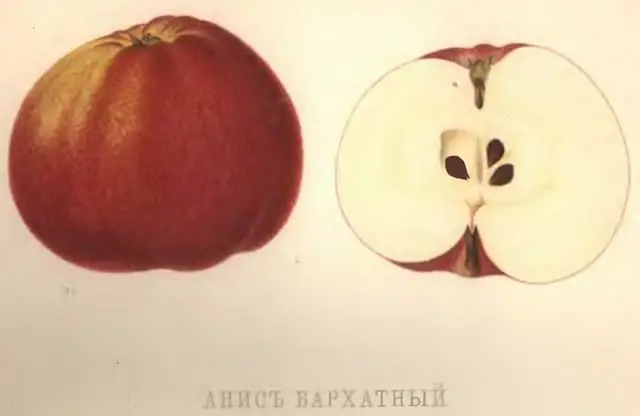
Anis
An old Volga folk apple whose clones bear small, bloom-dusted red fruit; Anis Polosaty has an anise-like scent
-
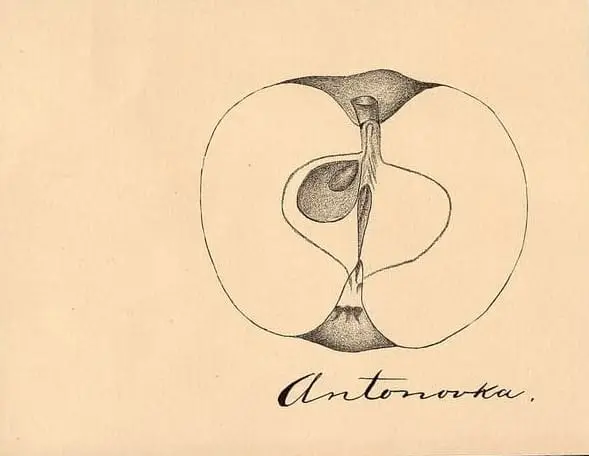
Antonovka
Central Russia's old folk apple, prized for its scent and hardiness; DNA shows Schmidt's Antonovka is the same variety
-
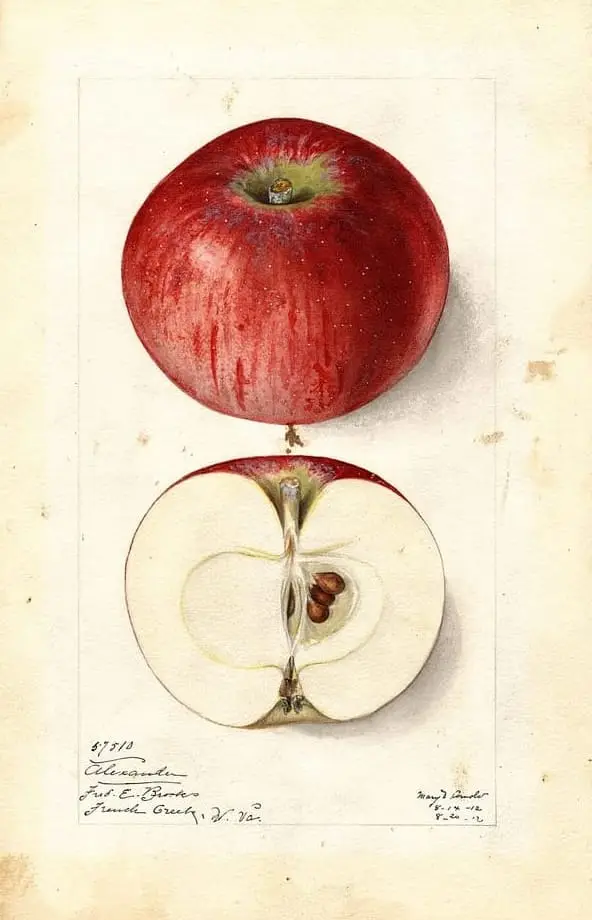
Aport
An old Russian apple, known in the West as Alexander, that became the celebrated Aport of Almaty after 1865
-
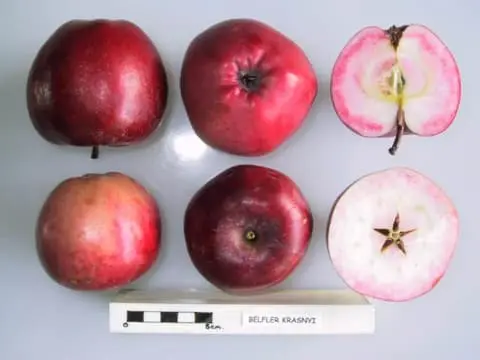
Bellefleur Krasny
-
Bessemyanka Michurina
-
Byeloborodovka
-
d'Eylau
-
Dolgo
A Siberian crab brought from Russia to South Dakota in 1897 and introduced in 1917 for its ruby-red jelly