Apple varieties, United Kingdom
Egremont Russet
Of unrecorded origin and first recorded in 1872, it is probably the UK's most important commercial russet
History
Egremont Russet’s origin is unrecorded2. The National Fruit Collection says it is thought to have come from England and was first recorded in 18721; Bunyard, writing in 1920, said it was “introduced to notice about 1880”2. A 2020 SNP study of more than 1,400 mostly old cultivars identified no parent for it among them3.
It is grown commercially. In England and Wales it covered 308 hectares of commercial orchard in 2004 and 224 hectares in 2012, more than Discovery or Worcester Pearmain that year4. In 2025, growers representing 92 per cent of the British apples and pears sold to supermarkets and other major retailers reported 33.48 hectares of it, 0.61 per cent of their apple orchards5. The National Fruit Collection calls it “probably the most important commercial russet in the UK at the present time”1.
The fruit
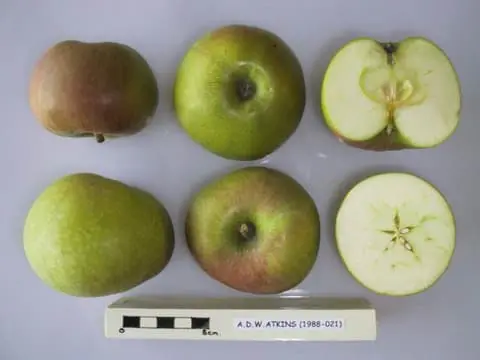
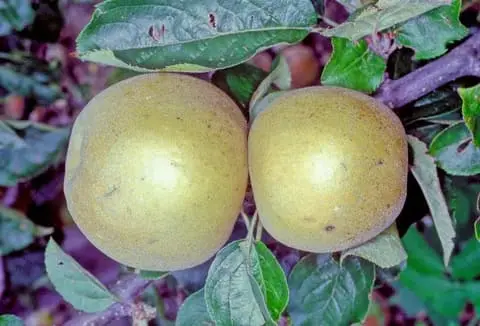
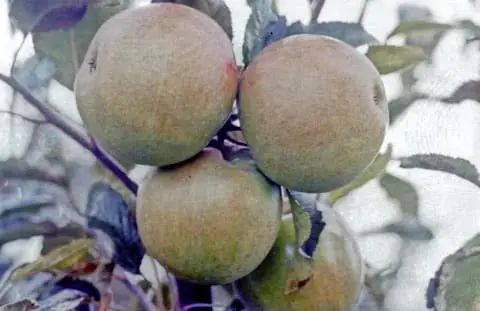
The fruit is medium-sized and round to broadly conical1,2; the UK’s National Apple Register of 1971, as given on the collection’s record, measured it at 63 mm wide and 51 mm high1. Its yellow skin carries a golden-brown flush and is almost covered with russet1,2. The flesh is cream to greenish yellow, firm, fine-textured and rather dry1,2. The collection describes the flavour as rich and nutty, and the 1971 register as sweet, aromatic and distinctive1; Bunyard found it “of very distinct and good flavour”2.
At Brogdale, Kent, the trees reach 10 per cent flowering around 30 April, and the fruit is picked in late September1. Bunyard gave its season as October to December2. UK storage guidance is to keep it until December in cold air at 3.5–4.0 °C, or until April in a controlled atmosphere with 5 per cent carbon dioxide and 1.2 per cent oxygen; it is prone to shrivel and may soften quickly once out of store6.
Growing
Bunyard described the tree as neat and upright, well spurred and fertile2. It is diploid3.
Uses
It is a dessert apple1,2, which Bunyard thought “especially suited for garden use”2.
Family tree
Offspring in the atlas
- Great Expectations × red sport of Cox; Ireland, by 1951
Sources
- Egremont Russet (accession 1979-159), National Fruit Collection, Brogdale, Kent (Defra). Supports: "Thought to have originated in England"; "first recorded in 1872"; synonym Egremont; "firm, fine-textured, rather dry flesh with a rich, nutty flavour"; "probably the most important commercial russet in the UK at the present time"; medium, broad globose-conical fruit with a yellow ground, golden-brown flush and high to very high russet, cream flesh tinged green; from the National Apple Register (Smith, 1971) as shown on the record, height 51 mm and width 63 mm and flavour "sweet, aromatic, distinctive"; 10% flowering on 30 April and picking in late September at Brogdale; a dessert apple.
- A Handbook of Hardy Fruits, vol. I, p. 52: Egremont Russet, E. A. Bunyard, John Murray, Internet Archive, 1920. Supports: a dessert apple, October to December; medium, round, regular; yellow with a golden-brown flush "almost covered with russet"; firm, greenish-yellow flesh "of very distinct and good flavour"; growth neat, upright, well spurred, fertile; "Origin, unrecorded. Introduced to notice about 1880"; "especially suited for garden use".
- Using whole-genome SNP data to reconstruct a large multi-generation pedigree in apple germplasm, H. Muranty and others, BMC Plant Biology 20: 2, with Additional files 1, 3 and 7, 2020. Supports: a study of more than 1,400 mostly old cultivars; Egremont Russet genotyped as a diploid (2n), dated 1872 (Table S1); no parent identified for it among the inferred trios (Table S3) or parent–offspring pairs (Table S6).
- Survey of Orchard Fruit at October 2012, England and Wales, Department for Environment, Food and Rural Affairs (Defra), 2013-05-30. Supports: Table 2, area of commercial apple orchard in England and Wales: Egremont Russet 308 ha in 2004 and 224 ha in 2012, against 157 ha of Discovery and 115 ha of Worcester Pearmain in 2012.
- Orchard and Storage Census Report 2025, British Apples & Pears Limited, 2025. Supports: respondents representing 92% of the annual picked crop of British apples and pears sold to UK supermarkets and other major retailers; Egremont Russet on 33.48 ha (63,981 trees), 0.61% of their apple hectares (Appendix I).
- Storage conditions recommended for major apple varieties in the UK, NIAB, Apple Best Practice Guide. Supports: Egremont Russet stored in air at 3.5–4.0 °C until December, and in scrubbed controlled atmosphere at 3.0–3.5 °C with 5% carbon dioxide and 1.2% oxygen until April; "Risk of shrivel"; fruit "may soften rapidly after storage".