Apple varieties, United Kingdom
Reine des Reinettes
France's Reine des Reinettes is England's King of the Pippins; Leroy thought them two apples, DNA finds one
History
The apple grown in France as Reine des Reinettes is the one known in England as King of the Pippins1. The National Fruit Collection calls its origin confused but the variety “identical to Reine des Reinettes grown in France”, and gives 1800 as its first record1. DNA agrees: the tree kept as Reine des Reinettes in INRAE’s collection in France is the genotype named King of the Pippins5,6.
Its earlier English name seems to have been Golden Winter Pearmain1,3. Kirke, a nurseryman at Brompton, near London, introduced it as King of the Pippins1,3, and Bunyard noted that it was generally attributed to England4. Loddiges of London sent it to the German pomologist Diel in 18003.
The French name, André Leroy explained, arose when King of the Pippins was not translated literally but turned, king into queen, into Reine des Reinettes, a name already borne by another apple3. The two were then constantly confused, and the quarrel ran through the Revue horticole from 1863 to 18653. Leroy described the other Reine des Reinettes separately: about a century old, apparently first called Kroon Renet, crown reinette, and described by Diel in 1802 from a tree sent from The Hague2. Its fruit resembled King of the Pippins, but its tree did not2. Bunyard, in 1920, called the history of the two “a tangle which I have not yet been able to unravel”4.
SNP data name Reinette de Hollande, a child of Reinette Franche and Reinette des Carmes, as one parent5,6. King of the Pippins has itself been a parent of George Carpenter, Belle de Mleiev, Sandringham and others5, and the National Fruit Collection lists two sports, King Russet and Rote Goldparmane1.
The fruit
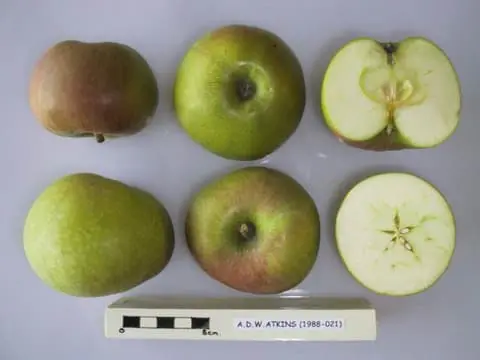
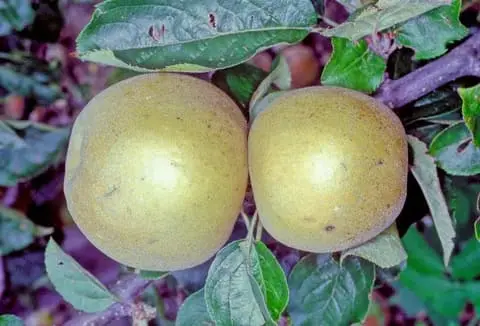
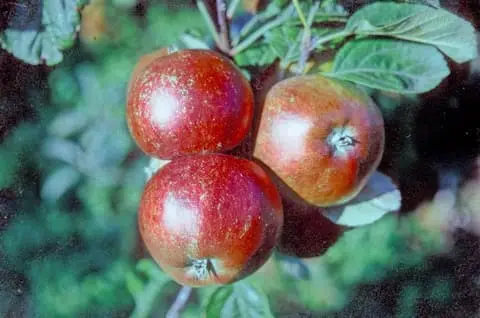
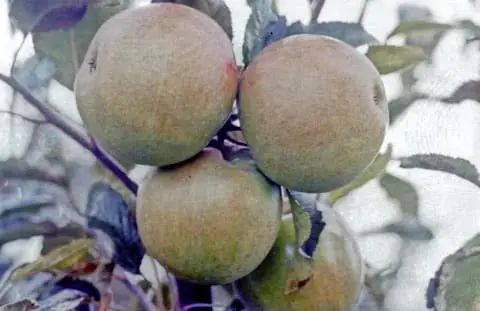
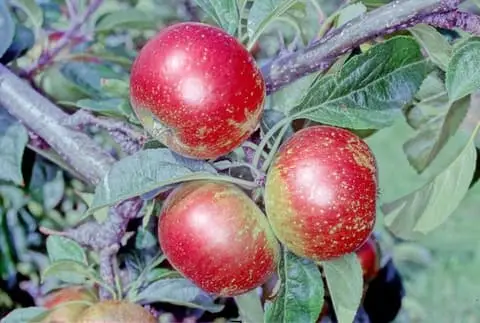
The fruit is medium-sized and conical, about 62 mm wide and 56 mm high, golden, flushed orange or reddish brown and streaked with red, with dots of russet1,4. The flesh is firm, juicy and yellowish white or creamy1,4: sweet, aromatic and subacid to the National Fruit Collection1, but with “a distinct slightly bitter flavour” to Bunyard4. At Brogdale it begins to flower about 6 May and is picked in early October1. Bunyard gave its season as October to December, Leroy as November to February3,4.
Growing
Leroy found the tree extremely vigorous; for dwarf trees it had to be budded on paradise stock, because doucin made it almost barren3. Bunyard found its growth moderate and upright4. It is diploid5,6.
Uses
A dessert apple1,4, it is one of the varieties of the protected geographical indication for Savoie apples and pears, Pommes et Poires de Savoie, in which its fruit is marked by some russet and must reach at least 12.5 °Brix and 6 grams of malic acid per litre of juice7.
Where the sources disagree
- One apple or two. Leroy held Reine des Reinettes and King of the Pippins to be different apples with very different trees, joined only by a mistranslation2,3. The National Fruit Collection treats them as one1, and the French collection’s tree has the DNA of King of the Pippins5,6. The sources read do not say what became of Leroy’s Dutch apple.
- Country. Diel took Leroy’s Reine des Reinettes to be Dutch2; Bunyard and English writers placed King of the Pippins in England3,4.
- The parent’s date. Reinette de Hollande is dated to the early or mid-1800s, later than King of the Pippins, so Muranty and colleagues flag the parentage as dubious on dates, although the SNP data fit it with a single Mendelian error5.
Family tree
Parents, grandparents and great-grandparents, as the entries in the atlas record them.
- Reine des Reinettes United Kingdom, by 1800
- Parent Reinette de Hollande
Offspring in the atlas
- Allington Pippin × Cox's Orange Pippin; United Kingdom, before 1884
- Cox's Early Export × Cox's Orange Pippin; New Zealand, by 1950
- Fillingham Pippin × Keswick Codlin; United Kingdom, by 1923
- Foster's Seedling × Cellini; United Kingdom, by about 1893
- George Carpenter × Peasgood's Nonsuch; United Kingdom, 1902
- Hope Cottage Seedling United Kingdom, 1900
- King Russet United Kingdom, late 1950s
- Laxton's Triumph × Cox's Orange Pippin; United Kingdom, 1902
- Neue Goldparmane × Dutch Mignonne; Germany, 1905
- Sandringham × Woodford; United Kingdom, by 1883
16 varieties in the atlas descend from Reine des Reinettes.
Sources
- King of the Pippins (accessions 1972-030 and 1957-218), National Fruit Collection, Brogdale, Kent (Defra). Supports: "Origin confused but is identical to Reine des Reinettes grown in France"; introduced by Kirke of Brompton as King of the Pippins, its prior name apparently Golden Winter Pearmain; "First recorded in 1800"; a dessert apple, its fruit "firm, juicy and subacid"; synonyms including Reine des Reinettes, Queen of the Pippins, Reinette de la Couronne, Pearmain Doree, Winter Gold Pearmain, Hampshire Yellow, Jones's Southampton Pippin and Shropshire Pippin; the sports King Russet and Rote Goldparmane; from the National Apple Register (Smith, 1971; set b): medium, conic, 56 mm high and 62 mm wide, golden ground flushed orange and streaked red, dotted russet, flesh yellowish white and firm, flavour sweet and aromatic; 10% flowering on 6 May and picking in early October at Brogdale.
- Dictionnaire de pomologie, vol. IV, pp. 611–612: Reine des Reinettes (in French), André Leroy, Paris and Angers, Internet Archive, 1873. Supports: entry no. 364, with the synonyms Kroon Renet (Diel, 1802), Queen of the Pippin and Reinette de la Couronne; his Reine des Reinettes and King of the Pippins confused and sold one for the other, their fruits alike in some outward features but their trees "assurément très-dissemblables"; its original name apparently Kroon Renet, Dutch for Reinette de la Couronne; about a hundred years old; held by Diel, who described it in 1802 from a tree received from The Hague, to be Dutch.
- Dictionnaire de pomologie, vol. IV, pp. 538–540: Pearmain Dorée (in French), André Leroy, Paris and Angers, Internet Archive, 1873. Supports: entry no. 322, with the synonyms Golden Winter Pearmain, King of the Pippins, Hampshire Yellow, Jones's Southampton Pippin and Winter Gold Pearmain; Golden Winter Pearmain its original name; made known by Kirke, then a nurseryman at Brompton near London; sent to Diel by Loddiges of London in 1800; English writers calling it English; the French, instead of translating King of the Pippins, changing King to Queen and calling it Reine des Reinettes, a name already borne by another apple, so that the two were continually mistaken; long, acrimonious polemics in the Revue horticole in 1863, 1864 and 1865; for dwarf forms to be budded on paradise, not doucin, which increases its "extrême vigueur" and makes it almost unproductive; ripe November to February.
- A Handbook of Hardy Fruits, vol. I, p. 77: King of the Pippins, E. A. Bunyard, John Murray, Internet Archive, 1920. Supports: dessert, October to December; Shropshire Pippin a synonym; medium, golden yellow shaded reddish-brown; flesh creamy yellow, firm and juicy "with a distinct slightly bitter flavour"; growth moderate and upright; "generally attributed to England", but its history and that of the Reine des Reinettes of France "a tangle which I have not yet been able to unravel".
- Using whole-genome SNP data to reconstruct a large multi-generation pedigree in apple germplasm, H. Muranty and others, BMC Plant Biology 20: 2, with Additional files 1, 3 and 5, 2020. Supports: preferred names given to genotypes after considering "all available genotypic and passport information"; King of the Pippins (MUNQ 37, from accession X2640 in the INRA collection) diploid and dated 1800 (Table S1); Reinette de Hollande inferred as its parent with one Mendelian error, the dates flagged "dubious" (Table S4), Reinette de Hollande being dated "early or mid 1800s" (Table S1) and itself the offspring of a cross of Reinette Franche and Reinette des Carmes; King of the Pippins inferred as a parent of George Carpenter, Belle de Mleiev and Sandringham, among others (Table S3).
- Cultivar fingerprinting and SNP-based pedigree reconstruction in Danish heritage apple cultivars utilizing genotypic data from multiple germplasm collections in the world (Supplementary Table S2), B. Larsen and others, Genetic Resources and Crop Evolution 72: 2397, 2025. Supports: the INRAE accession X02640, named Reine des Reinettes, with SNP data from Muranty and others (2020), assigned to genotype MUNQ 37 under the analysis name King of the Pippins (reference accessions); King of the Pippins diploid, with Reinette de Hollande as its SNP-confirmed parent and the other parent unknown (pedigree table).
- Specification of the protected geographical indication Pommes et Poires de Savoie (in French), Ministry of Agriculture, Agrifood and Forestry, Bulletin officiel no. 51-2016; approved by Commission Implementing Regulation (EU) 2016/2213, 2016. Supports: Reine des reinettes among the varieties, and their mutants, from which Savoie apples may come; russeting a mark of Reine des Reinettes, as of Reinette Blanche du Canada, Reinette Grise du Canada and Belle de Boskoop; for Reine des reinettes, at least 12.5 °Brix and acidity of at least 6 g of malic acid per litre of juice.