Apple varieties, United States
Idared
Raised in Idaho from Jonathan and Wagener and introduced in 1942; in the US today nearly all of it is processed
History
Idared was raised by Leif Verner at the Idaho Agricultural Experiment Station in Moscow, Idaho, from a cross of Jonathan and Wagener1,2. The USDA records it as selected in 1935 and introduced in 19422. SNP data confirm both parents3,4.
In 1960 W. J. Lord counted it “one of the newer fruit varieties worthy of trial in Massachusetts” and “one of the more promising late keeping dessert and general purpose apples”5. Idared is itself a parent: SNP data confirm it as a parent of Fiesta3, and the National Fruit Collection lists it as the pollen parent of Fiesta and Arlet1.
In the US industry’s forecast for 2025/26 it made up 2 per cent of the US crop, with New York the largest grower and Michigan next7. Almost all the US crop is processed: on average in 2020–2024, 94 per cent went to processing and 6 per cent was sold fresh7. In Europe it ranked among the largest varieties after Golden Delicious, with 4 per cent of the 2025/26 forecast crop, down from 6 per cent on the five-year average7.
The fruit
The National Fruit Collection describes a large, flat fruit, 79 mm wide and 64.5 mm high, red over a yellow ground, whose white, green-tinged flesh is firm, crisp and fine-textured, with a sweet, pleasant, vinous flavour1. The USDA finds it slightly sweet and moderately acid2, and Lord thought its quality good “but somewhat on the mild side”, with an attractive bright red finish5.
It is picked in early October both in Massachusetts and at Brogdale in Kent5,1. It keeps well2,5: a USDA storage handbook gives three to four months in cold air and seven to nine in controlled atmosphere, with only slight susceptibility to scald6.
Growing
The USDA describes a small to medium tree that bears heavy crops every year, is susceptible to fire blight and has some resistance to scab2. The storage handbook notes that it tolerates freezing damage in the orchard6. It is diploid3,4.
Uses
The USDA calls it an excellent dessert apple, good also for baking, sauce and pies2, and Lord a general-purpose apple5; in the United States it is now grown mainly for processing7.
Where the sources disagree
- Which parent bore the seed. The National Fruit Collection, the USDA and the literature cited by Muranty and colleagues write the cross as Jonathan × Wagener1,2,3. Larsen and colleagues’ SNP table puts Wagener first, in the column that gives the mother where pedigree records name one4. None of the sources read says outright which tree bore the seed.
Family tree
Parents, grandparents and great-grandparents, as the entries in the atlas record them.
- Idared United States, selected 1935
- Parent Jonathan United States, by 1826
- Parent Esopus Spitzenburg United States, before 1790
- Parent Reinette Franche France, by 1540
- Parent Esopus Spitzenburg United States, before 1790
- Parent Wagener United States, 1791
- Parent Jonathan United States, by 1826
Offspring in the atlas
Sources
- Idared (accession 1976-146), National Fruit Collection, Brogdale, Kent (Defra). Supports: raised by Leif Verner at the Idaho Agricultural Experiment Station, Moscow, Idaho; introduced in 1942; parentage "Jonathan x Wagener"; father of Fiesta and Arlet; a dessert apple, large and flat, 64.5 mm high and 79 mm wide, red over yellow; white, green-tinged, firm, crisp, fine-textured flesh with "a sweet and pleasant vinous flavour"; picking in early October at Brogdale.
- Plant Inventory No. 204, Part I (Plant Materials Introduced January 1 to June 30, 1995), p. 328: PI 588841, Idared, R. A. Norris (ed.), USDA Agricultural Research Service, 1996-08. Supports: developed by L. Verner, Agricultural Experiment Station, Moscow, Idaho; "Pedigree - Jonathan x Wagener Selected 1935; intro: 1942"; skin yellow with a bright red flush; flesh white, slightly tinged green; flavour "slightly sweet, moderately acid"; "Excellent dessert apple, good for baking sauce and pies"; keeps well; a small to medium tree bearing heavy crops annually; susceptible to fire blight, with some resistance to scab.
- Using whole-genome SNP data to reconstruct a large multi-generation pedigree in apple germplasm, Hélène Muranty and others, BMC Plant Biology 20: 2, with Additional files 1 and 3, 2020. Supports: Table S3: Idared inferred as the offspring of Jonathan and Wagener, in agreement with the literature (Jonathan and "Wagnerapfel"); Fiesta inferred as the offspring of Cox's Orange Pippin and Idared, as documented; Table S1: Idared diploid (2n).
- Cultivar fingerprinting and SNP-based pedigree reconstruction in Danish heritage apple cultivars utilizing genotypic data from multiple germplasm collections in the world, Bjarne Larsen and others, Genetic Resources and Crop Evolution 72: 2397, with supplementary Table S5, 2025. Supports: Table S5: Idared diploid, with Wagener as parent 1 and Jonathan as parent 2, both confirmed by SNP data; parent 1 defined as "the mother" where known from pedigree records, otherwise in arbitrary order.
- Idared Apple, Journal of the American Pomological Society 15(1): 16 (journal archive), quoting W. J. Lord in Fruit Notes, 15 March 1960, 1960. Supports: Lord's view that Idared was "one of the newer fruit varieties worthy of trial in Massachusetts", with an attractive bright red finish, quality "good but somewhat on the mild side", a long storage season and harvest in early October; "one of the more promising late keeping dessert and general purpose apples".
- Apple, in The Commercial Storage of Fruits, Vegetables, and Florist and Nursery Stocks (Agriculture Handbook 66), Chris B. Watkins, Eugene Kupferman and David A. Rosenberger, USDA Agricultural Research Service, 2016. Supports: Table 2 (p. 180): Idared "3-4" months at 0 °C in air and "7-9" in controlled atmosphere; slight susceptibility to superficial scald; "Temperature sensitive; tolerant to orchard freezing damage".
- Industry Outlook 2025, Christopher Gerlach, U.S. Apple Association, 2025. Supports: Table 6: Idared 2% of US production in the 2025/26 forecast and on the five-year average; Table 7: New York (3,130,918 bushels) and Michigan (1,953,362) the largest producers in the 2025/26 forecast; Table 9: 6% fresh and 94% processing, 2020–2024 average; Table 13 and text (from the World Apple and Pear Association): Idared 4% of European production in the 2025/26 forecast against 6% on the five-year average, and among the largest varieties after Golden Delicious.
More from United States
-
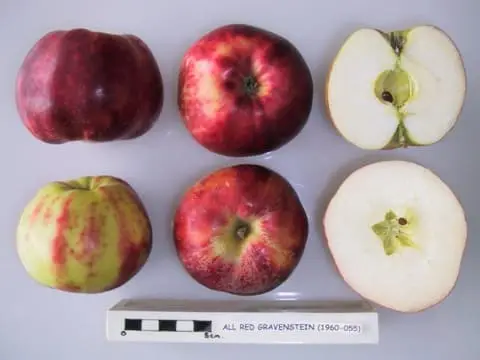
All-Red Gravenstein
-
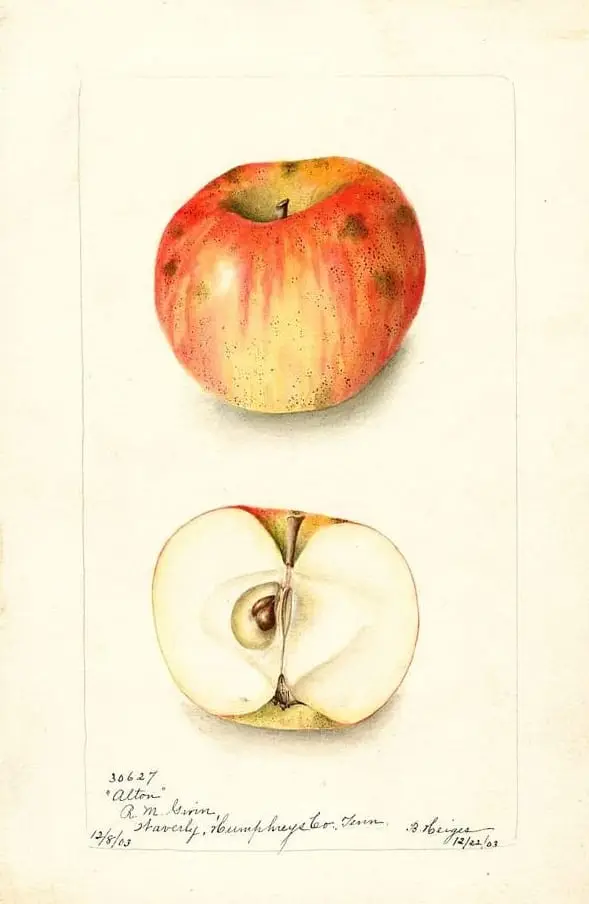
Alton
-
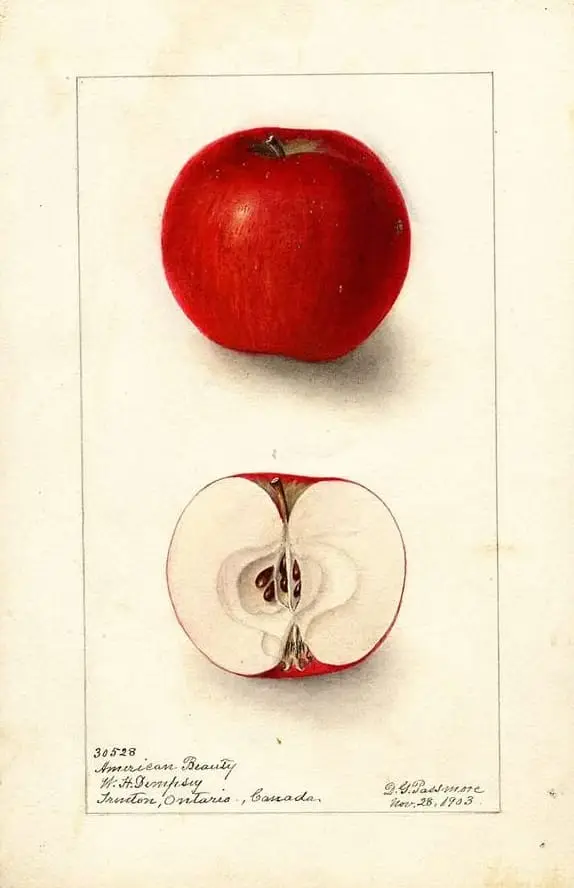
American Beauty
-
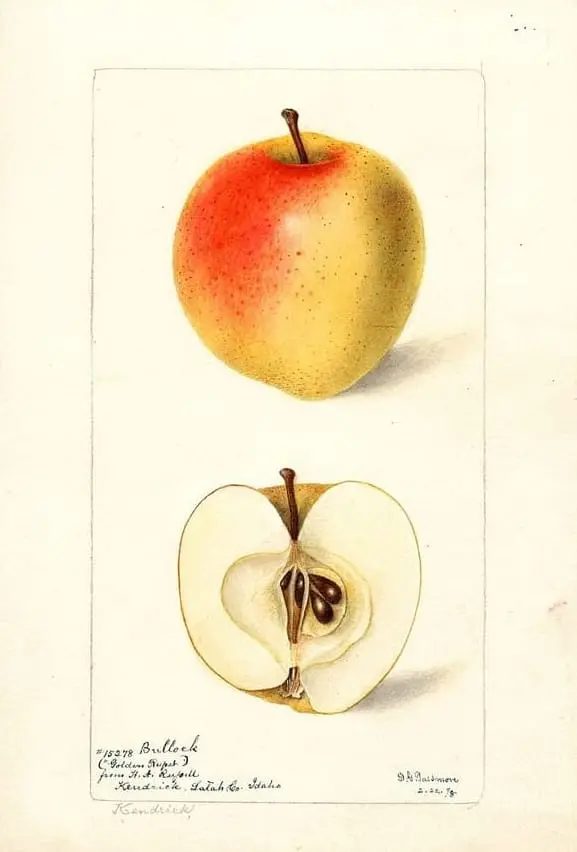
American Golden Russet
A small New Jersey russet whose flesh Downing likened to a buttery pear; Coxe knew it in 1817 as Sheep-nose
-
American Grindling
-
American Summer Pearmain
-
Ames
-
Arkansas