Luresweet
A scab-resistant red-fleshed apple from Markus Kobelt's nursery at Buchs; sold under the trade mark Redlove Odysso
History
Markus Kobelt founded the Lubera nursery at Buchs, near Lake Constance, in 1993 and bred apples and small fruits there, seeking red-fleshed apples from the start, with material from breeding programmes in eastern Germany and the Czech Republic5. In 2010 he sowed about 10,000 to 20,000 seeds a year, infected the young seedlings with scab to find resistant ones, and looked for red leaves, since red-leaved seedlings generally bear red fruit5. Luresweet was selected at Buchs in October 2006 from a planned cross of two unpatented selections, LubA688 as the seed parent and LubA275 as the pollen parent1. Its Australian record says it was chosen for scab resistance and red leaves, and that its resistance has been confirmed over four generations at an unsprayed site under heavy scab pressure3.
Kobelt formed a company, Fruture, with a tree nursery and a Swiss grower to supply his red apples to commercial orchards, and planned to sell them all under the Redlove brand rather than their variety names5. A Community plant variety right, held by Fruture GmbH, was applied for in September 2013 and granted in February 20182, and Lubera’s US plant patent, filed in 2014, was granted in December 20161. Its Australian record adds rights granted in Switzerland and France, and a first sale in South Korea in March 20133. Its fruit is sold under the trade marks Redlove and Odysso, as Redlove Odysso; other varieties are listed under the Redlove mark too4. In 2020 a microsatellite study confirmed Weirouge as a parent, and gave the other, unconfirmed, as a cultivar of the “Re” series6.
The fruit
At Buchs the fruit averages 190 g, 70–80 mm high and 66–76 mm across, conical to ovoid, with a smooth skin; the flesh is red, very firm, aromatic and slightly juicy, high in both sugar and acid, with 15 per cent Brix1. In an Australian trial at Lenswood it was medium to large, almost wholly covered in a dark purple-red flush with faint stripes, and its flesh was reddish where that of Luregust, another of Kobelt’s apples, was pinkish3. It is picked at the beginning of October at Buchs, with Golden Delicious or just after, and keeps for about three months in a cool store, but is harmed below 4–5 °C1.
Growing
The tree flowers from mid to late April at Buchs and needs a pollinator; its flower buds are dark red1,3. It is resistant to scab, hardy to −18 °C1 and diploid6.
Uses
The patent classes it as a dessert apple that stores well1.
Where the sources disagree
- Parents. The US patent names two unpatented selections, LubA688 and LubA2751; the 2020 DNA study gives Weirouge, which its data confirm, and a cultivar of the Re series6. Neither says whether Weirouge is one of the two selections.
- Tree and fruit. At Buchs the four-year-old tree was of medium vigour and spreading, and the fruit conical to ovoid with very firm flesh1; at Lenswood the tree was medium to strong, upright and bore only on long shoots, and the fruit was cylindrical and waisted, with flesh medium to firm3.
Family tree
Parents, grandparents and great-grandparents, as the entries in the atlas record them.
- Luresweet Switzerland, 2006
- Seed parent LubA688
- Pollen parent LubA275
Sources
- US Plant Patent 27,502: Apple tree named Luresweet, Markus Kobelt, for Lubera AG; United States Patent and Trademark Office, via Google Patents, 2016-12-27. Supports: filed by Lubera AG on 25 November 2014 and granted on 27 December 2016, inventor Markus Kobelt; "discovered in October of 2006 in Buchs, Switzerland", the result of a planned breeding programme in which LubA688 (female parent, unpatented) was crossed with LubA275 (male parent, unpatented), the purpose being red-fleshed apples with improved eating quality; similar to the female parent in sugar, size and scab resistance but more acid and red-fleshed, similar to the male parent in red flesh and acidity but different in eating quality; first grafted at Buchs in the spring of 2007; four-year-old trees of medium vigour, ramified and spreading, about 7 kg of fruit a tree; flowering from the middle to the end of April at Buchs over about 15 days, cross-pollination necessary; fruit picked at the beginning of October, similar to or just after Golden Delicious; 190 g, 70–80 mm high and 66–76 mm wide, conical to ovoid, skin smooth; flesh red and very firm, eating quality very good, high sugar and acidity, aromatic, slightly juicy, 15 Brix; a table or dessert fruit with good storage capability, keeping about 3 months in a cool store but very sensitive to storage temperatures below 4–5 °C; tree and buds hardy to −18 °C; resistant to scab.
- Community plant variety rights register, public search: Luresweet, Community Plant Variety Office (CPVO). Supports: denomination Luresweet (Malus domestica); applicant Fruture GmbH; application 20132376 of 12 September 2013; examination office the Bundessortenamt (Germany); grant 48401 of 19 February 2018; expiry date 31/12/2048.
- Plant Varieties Journal 37 (4): apple Luresweet, application 2018/021, IP Australia, Plant Breeder's Rights Office, 2025-04-01. Supports: application accepted on 20 February 2018, applicant Fruture GmbH, Felben-Wellhausen, breeder Markus Kobelt; selected from a conventional cross-breeding population for resistance to apple scab and for red leaves as an indicator of red flesh, scab resistance "confirmed over four generations, by nil infection in a high scab pressure area with nil sprays being applied"; comparative trial at Lenswood, South Australia, planted in 2015 and observed in 2020, beside Luregust, "a red fleshed variety from the breeding program of the candidate"; tree medium to strong in vigour, upright, bearing on long shoots only; flowers dark red at the balloon stage; fruit medium to large, cylindrical waisted, ground colour not visible, a very large area of dark purple-red over colour, a solid flush with weakly defined stripes; flesh medium to firm and reddish (Luregust's pinkish); prior applications granted in Switzerland and the EU (2013), France and the United States (2014); first sold in South Korea in March 2013.
- Commission Delegated Regulation (EU) 2023/2429, Annex I, Part B, Part 1 (marketing standard for apples), Appendix: non-exhaustive list of apple varieties, European Commission; Official Journal of the European Union, L series, 3 November 2023, 2023-08-17. Supports: Luresweet listed with the trade marks "Redlove® Odysso®" in the column of "references to known trademarks", given "for information only"; Lurefresh, Lureprec and Luregust listed with Redlove Era, Redlove Circe and Redlove Calypso.
- Totally red, Geraldine Warner, Good Fruit Grower, October 2010, pp. 20–21 (copy on the Lubera website), 2010-10. Supports: Markus Kobelt, owner of the Lubera nursery at Buchs, near Lake Constance, breeding apples and small fruits since founding the business in 1993, interested in red-fleshed apples from the beginning and using material from breeding programmes in eastern Germany and the Czech Republic; 10,000 to 20,000 seeds a year, seedlings inoculated with scab at the two- or three-leaf stage, and red-leaved seedlings generally bearing red fruit; the company Fruture formed with Beat Lehner's nursery, which produces trees for commercial growers, and the Swiss grower Thomas Hungerbühler, to supply the red varieties to the commercial fruit industry; all to be marketed under the Redlove brand name rather than by their variety names.
- Molecular genetic identification of apple cultivars based on microsatellite DNA analysis. I. The database of 600 validated profiles, S. Baric, A. Storti, M. Hofer, W. Guerra and J. Dalla Via, Erwerbs-Obstbau 62: 117–154, 2020. Supports: Table 2: Luresweet, with the trade mark names Odysso and Redlove, diploid (2n), Switzerland, 2014; assumed parentage "Weirouge × Series Re", Weirouge confirmed (C) as a parent by the study's own SSR data.
More from Switzerland
-
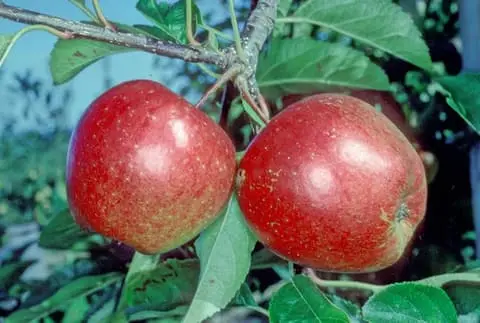
Arlet
-
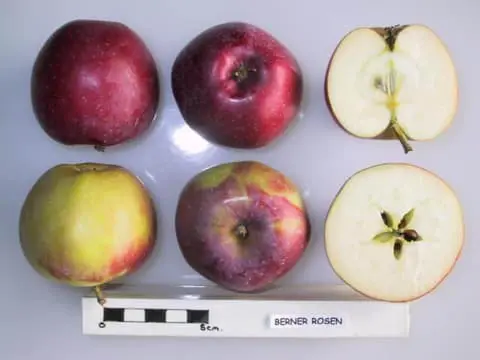
Berner Rose
A chance seedling from the canton of Bern that first fruited in 1888; its parents were found by DNA
-
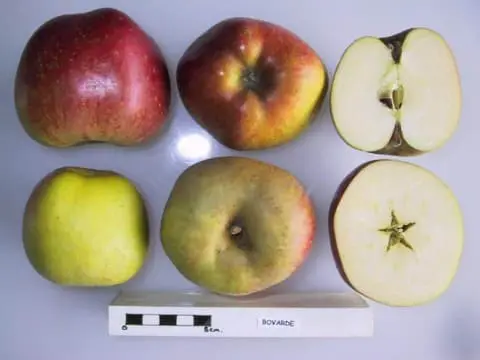
Bovarde
-
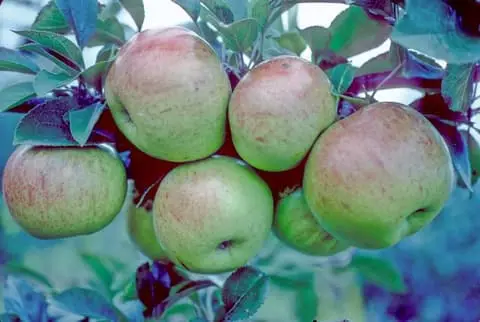
Chusenrainer
-
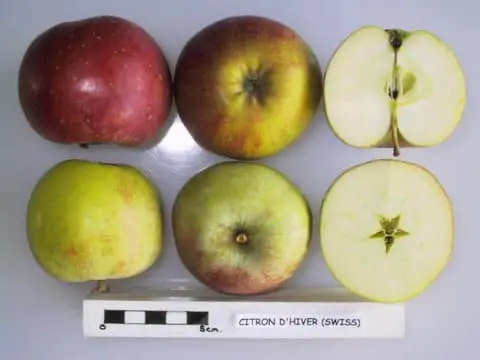
Citron d'Hiver (Swiss)
-
Elbee
-
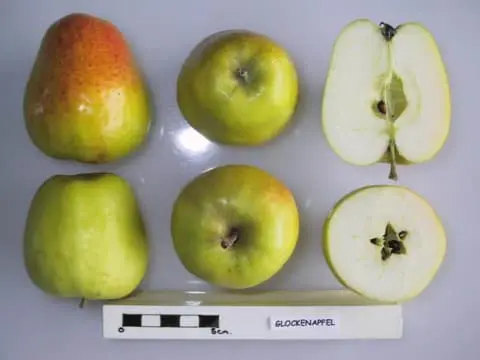
Glockenapfel
-
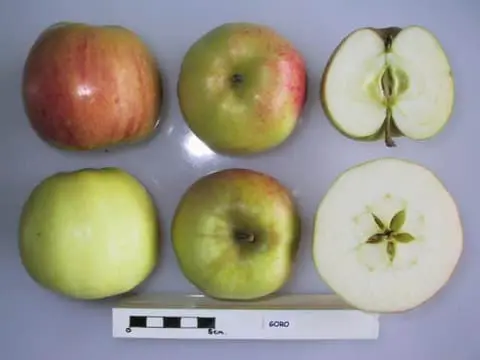
Goro