Apple varieties, United Kingdom
Blenheim Orange
Grown from a pip at Woodstock, beside Blenheim Park; a large triploid that DNA ties to Reinette de Hollande
History
Blenheim Orange was found at Woodstock in Oxfordshire and named after Blenheim, the Duke of Marlborough’s seat nearby2,3. An account in the Gardeners’ Chronicle, reprinted by Hogg and the Herefordshire Pomona, described the dead stump of the original tree, “a mere shell about ten feet high”, propped against a garden wall within ten yards of the wall of Blenheim Park2,3. It credited the pip to Kempster, a labouring man of Old Woodstock, after whom the apple was still known locally as Kempster’s Pippin2,3. The National Fruit Collection dates the find to about 17401. Hogg and the Pomona noted that no eighteenth-century nursery catalogue mentions it, and that London nurseries grew it only from about 18182,3. In 1822 it received the Royal Horticultural Society’s Banksian medal1.
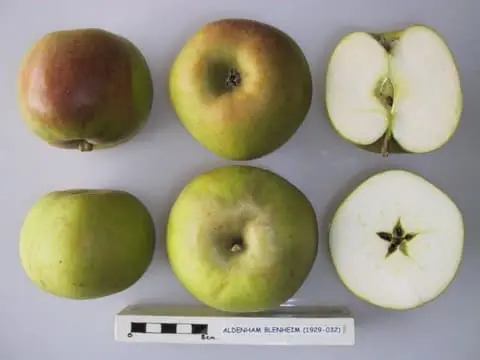
It is triploid1,6. SNP studies identify Reinette de Hollande, itself a child of Reinette Franche and Reinette des Carmes, as the parent that passed it an unreduced gamete; the other parent is unknown6,7. The same genotype has turned up in Danish collections under several local names, among them Bornholms Reinet and Holstenhus7. The UK’s National Apple Register of 1971 named Blenheim Orange as a possible parent of Cox’s Orange Pippin, but DNA has since shown Cox’s Orange Pippin to be the child of two diploids6. The National Fruit Collection records two sports, Aldenham Blenheim and Red Blenheim1.
The fruit
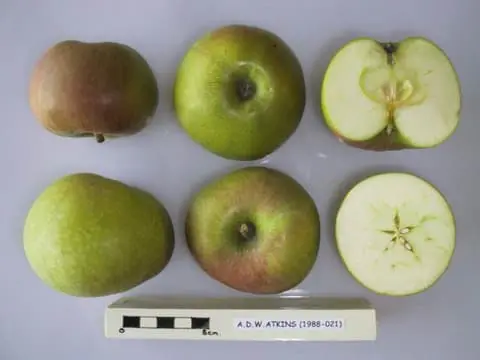
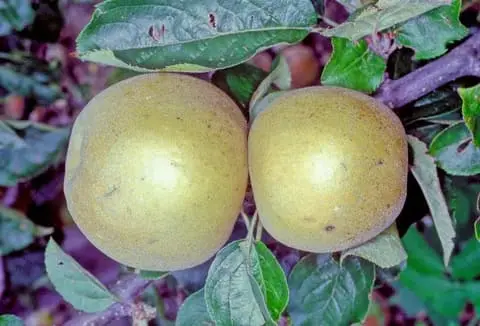
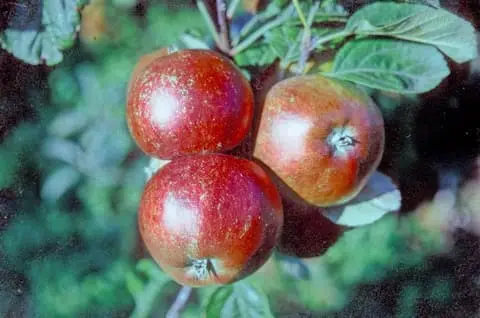
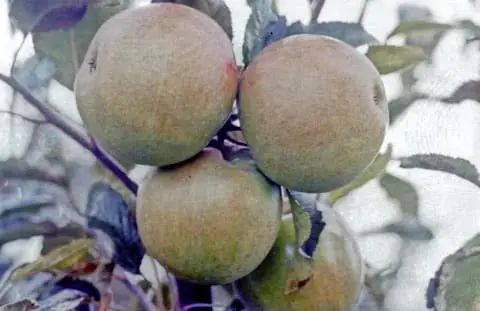
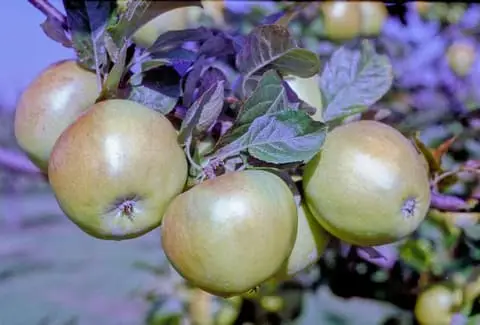
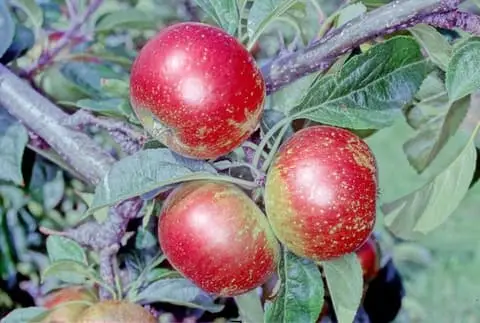
The fruit is large, flattened and regular1,2,4; the 1971 register gives it as 90 mm wide and 65 mm high1. Its yellow skin is flushed and streaked with dull or deeper red, with fine russet2,4. Hogg found the flesh yellow, crisp, juicy, sweet and pleasantly acid2; the collection describes it as creamy white, somewhat coarse and rather dry, with a rich, characteristic aromatic flavour1.
At Brogdale, Kent, it reaches 10 per cent flowering around 6 May and is picked in late September1. Hogg gave its season as November to February2, Bunyard as November to January4.
Growing
The tree is strong and vigorous and makes a large, spreading standard2,3,4. Hogg reported the common complaint that it bears badly while young, though it crops regularly and abundantly once older2; the Pomona added that even then it tends to bear well only in alternate years3.
Uses
Hogg judged it fit for dessert or kitchen but, “strictly speaking, more suitable for the latter”2. Bunyard thought it “one of the best all round apples grown”, cooking excellently and fine for dessert4, and the collection notes that it cooks well1.
Where the sources disagree
- Date. The National Fruit Collection gives about 17401; the Pomona said the exact date of its origin was not known3.
- Name. Hogg, the Pomona and the collection give Woodstock Pippin as another name for it1,2,3; Bunyard described a distinct apple of that name, and called the name an error when applied to Blenheim Orange5.
- Parentage. A 2018 marker study grouped it with several old triploids that seemed to share Golden Reinette as a parent8; SNP studies of 2022 and 2025 name Reinette de Hollande instead6,7.
- Offspring. The collection lists Blenheim Orange as a parent of fourteen varieties, among them Newton Wonder and Annie Elizabeth1, but SNP data give both of these other parents7. Howard and colleagues found every recorded pedigree they tested that named a triploid as the parent of a diploid to be false, and suggest that triploidy is “a dead end in pedigrees”6.
- Training. Hogg advised grafting it on paradise stock as a dwarf or espalier to bring it into bearing sooner2; the Pomona found it bore less regularly and less well in those forms3.
Family tree
Parents, grandparents and great-grandparents, as the entries in the atlas record them.
- Blenheim Orange United Kingdom, about 1740
- Parent Reinette de Hollande
Offspring in the atlas
- Aldenham Blenheim United Kingdom, before 1929
- Annie Elizabeth United Kingdom, about 1857
- Beauty of Hants United Kingdom, before 1850
- Celt × Cox's Orange Pippin; United Kingdom, 1943
- Edward VII × Golden Noble; United Kingdom, by 1902
- Eynsham Challenger × Lord Derby; United Kingdom, 1935
- Eynsham Dumpling × Sandringham; United Kingdom, by 1960
- Oxford Conquest × Court Pendu Plat; United Kingdom, 1927
- Oxford Yeoman × Lane's Prince Albert; United Kingdom, 1922
- Sergeant Peggy × Gloria Mundi; United Kingdom, 1922
- Victory (Carpenter) × Bismarck; United Kingdom, by 1923
13 varieties in the atlas descend from Blenheim Orange.
Sources
- Blenheim Orange (accession 1973-133), National Fruit Collection, Brogdale, Kent (Defra). Supports: "Triploid"; "Discovered by Mr Kempster at Woodstock near Blenheim, Oxfordshire, England in about 1740. Distributed in about 1818"; the Banksian medal from the Royal Horticultural Society in 1822; "creamy white, somewhat coarse-textured and rather dry flesh with a rich, characteristic aromatic flavour. Cooks well"; synonyms including Blenheim, Blenheim Pippin, Woodstock Pippin, Northwick Pippin and Reinette de Blenheim; listed as mother of eleven varieties, among them Annie Elizabeth, and father of three, among them Newton Wonder; sports Aldenham Blenheim and Red Blenheim (Wastie); from the National Apple Register (Smith, 1971) as shown on the record, a large, flat fruit 90 mm wide and 65 mm high, yellow, flushed and streaked red; 10% flowering on 6 May and picking in late September at Brogdale; a culinary and dessert apple.
- The Fruit Manual, 5th ed., pp. 24–25: Blenheim Pippin, Robert Hogg, Journal of Horticulture Office, Internet Archive, 1884. Supports: synonyms Blenheim Orange, Woodstock Pippin, Northwick Pippin and Kempster's Pippin; first discovered at Woodstock, Oxfordshire, and named from Blenheim, "the seat of the Duke of Marlborough"; "not noticed in any of the nursery catalogues of the last century", nor grown in the London nurseries "till about the year 1818"; the Gardeners' Chronicle account of the dead original stump, "a mere shell about ten feet high", within ten yards of the wall of Blenheim Park and propped against a basket-maker's garden wall, of Kempster, "a plain, practical, labouring man" of Old Woodstock who "first planted the kernel", and of the local name Kempster's Pippin; large, flattened, regular fruit; yellow skin tinged dull red and streaked with deeper red; yellow, crisp, juicy, sweet and pleasantly acid flesh; for dessert or kitchen, "but, strictly speaking, more suitable for the latter"; in use from November to February; strong and vigorous, forming a large standard; "a bad bearer" when young but bearing regular and abundant crops when older, and brought into bearing earlier on the paradise stock as an open dwarf or espalier.
- The Herefordshire Pomona, vol. I, plate VII: Blenheim Orange, Robert Hogg and H. G. Bull (eds), Woolhope Naturalists' Field Club, Internet Archive, 1876–1885. Supports: synonyms Blenheim Pippin, Kempster's Pippin, Woodstock Pippin and Northwick Pippin; discovered at Woodstock and named from Blenheim; "The exact date of its origin is not known"; absent from eighteenth-century nursery catalogues and not grown in the London nurseries until about 1818; the Gardeners' Chronicle account of the original stump and of Kempster; strong and vigorous, forming a large standard, bearing regular and abundant crops when full-grown but even then apt to bear well only in alternate years, and bearing less regularly and less well as a dwarf or espalier.
- A Handbook of Hardy Fruits, vol. I, p. 29: Blenheim Orange, E. A. Bunyard, John Murray, Internet Archive, 1920. Supports: synonyms Reinette de Blenheim, Goldreinette von Blenheim, Kempster's Pippin and Northwick Pippin; culinary or dessert, November to January; medium to fairly large, flattened, round, regular; yellow, "flushed and striped dull red and fine russet"; crisp, yellow, sub-acid flesh "with a characteristic flavour"; growth vigorous and spreading, "fertile when aged", making a large flat-headed tree; "raised at Woodstock, near Blenheim, by Mr. Kempster", coming into notice about 1818 near London; "One of the best all round apples grown, cooking excellently, and of fine quality and texture for dessert".
- A Handbook of Hardy Fruits, vol. I, pp. 136–137: Woodstock Pippin, E. A. Bunyard, John Murray, Internet Archive, 1920. Supports: a Woodstock Pippin described as a distinct apple, "Generally considered by pomologists as identical with Blenheim Orange, but is distinct from that in many respects"; "Woodstock Pippin (error): see Blenheim Orange".
- Pedigree reconstruction for triploid apple cultivars using single nucleotide polymorphism array data, N. P. Howard and others, Plants, People, Planet 5(1): 98–111 (online 2022); University of Reading repository, 2022. Supports: Figure 3, "The true pedigrees of apple cultivars Cox's Orange Pippin, Ribston Pippin, and Blenheim Orange": Blenheim Orange a triploid, with Reinette de Hollande (a child of Reinette Franche and Reinette des Carmes) passing it an unreduced gamete and no second parent shown; the UK National Apple Register (Smith, 1971) listing Ribston Pippin "and possibly another triploid, 'Blenheim Orange'" as parents of Cox's Orange Pippin, which the study showed to be "the product of two diploid cultivars"; of 19 recorded pedigrees naming triploids as parents of diploids, 18 "deemed false" and the remaining one, Cox's Orange Pippin, also shown to come from diploids; the results "suggest that triploidy is a dead end in pedigrees".
- Cultivar fingerprinting and SNP-based pedigree reconstruction in Danish heritage apple cultivars utilizing genotypic data from multiple germplasm collections in the world, B. Larsen and others, Genetic Resources and Crop Evolution 72: 2397, supplementary Tables S1 and S5, 2025. Supports: Blenheim Orange triploid, with Reinette de Hollande as SNP-confirmed parent and the second parent unknown, and Reinette de Hollande itself from Reinette des Carmes and Reinette Franche (Table S5); eight accessions in Danish collections, held as Femø Æble, Holstenhus, Bornholms Reinet, Hvidt Vinteræble, Tidlig Richard, Grand Richard and Mat æble, matching the genotype of Blenheim Orange (Table S1); Annie Elizabeth and Newton Wonder each with SNP-confirmed parents Maharaji and Northern Greening (Table S5).
- Genetic analysis of a major international collection of cultivated apple varieties reveals previously unknown historic heteroploid and inbred relationships, M. Ordidge and others, PLoS ONE 13(9): e0202405, PubMed Central, 2018-09-12. Supports: a study of the National Fruit Collection with SSR and DArT markers; Blenheim Orange (accession 1973133, "pre 1740") scored triploid and grouped with other old triploids, among them Orleans Reinette, Harberts Reinette and Beauty of Hants, under Golden Reinette as a potential gamete-donating parent (Table 4).