Apple varieties, United States
Roxbury Russet
Often called the oldest American apple; SNP data show the old French Reinette Franche to be one of its parents
History
The Roxbury Russet is generally supposed to have arisen at Roxbury, Massachusetts, early in the seventeenth century1,6; soon after 1649 it was taken to Connecticut1. It is often called the oldest American apple variety7. English writers knew it as the Boston Russet, though Bunyard noted that its correct name is Roxbury Russet4,5.
Grafts of it from Israel Putnam’s orchard at Pomfret, Connecticut, were among the first set in Ohio, at the Marietta nursery, in the spring of 17963. There it was renamed the Putnam or Marietta Russet, and its fruit grew so much more russeted that it was long taken for a different variety, until an exchange of grafts proved the two the same3. Downing counted it one of the most popular market apples in the country, excellent and a prodigious bearer2, and Warder reported the claim that more money had been made from it than from any other variety, though by 1867 its popularity was waning3. In 1905 it was still the most popular russet grown in New York, but cold storage had reduced the demand for long-keeping russets, and fewer were being planted1. Around Boston it was grown both for home use and for export to England4.
SNP data published in 2022 show it to be a triploid, and identify Reinette Franche, a French apple of the early sixteenth century, as the parent that supplied its unreduced gamete; the authors suggest that Reinette Franche, or its seeds, may have come to North America with European colonists7.
The fruit
The fruit is usually above medium in size but variable, flattened, often obscurely angular and sometimes strikingly elliptical1. Greenish to yellowish-brown russet covers most of the skin, sometimes with a bronze blush that rarely deepens to red1. The flesh is tinged with yellow or green, firm, somewhat coarse, moderately tender and juicy, with a sprightly subacid flavour; beside Golden Russet it is coarser, yellower and milder1. At Brogdale it flowers around 7 May and is picked in mid-October6. In New York it lasted from December to May, or until July in cold storage1.
Growing
The tree is medium-sized to large, moderately vigorous to vigorous and spreading, larger and more productive than that of Golden Russet1. It tends to bear in alternate years, and in many places crops only moderately1. In the South and West it drops its fruit too early2; Warder found it very subject to codling moth, which makes the fruit fall, and apt to ripen too early in southern places and on limestone soils3. The Herefordshire Pomona found the tree very hardy and an immense bearer, and the apple one of the few American varieties to reach perfection in England4.
Uses
The Herefordshire Pomona ranked it a dessert apple of the first quality, in season from January to April or later4; Warder put it to market and kitchen use3.
Where the sources disagree
- Origin. Beach, Bunyard and the National Fruit Collection place it at Roxbury early in the seventeenth century1,5,6; the Herefordshire Pomona says nothing is known of its origin beyond what its name suggests4.
- Quality. The Herefordshire Pomona rated it first-class for dessert4, Beach good to very good1, and Warder second-rate and decidedly acid3.
- Arrival in Ohio. Warder has the first grafts set at Marietta in 17963; Beach gives about 17971.
Family tree
Parents, grandparents and great-grandparents, as the entries in the atlas record them.
- Roxbury Russet United States, early 17th century
- Parent Reinette Franche France, by 1540
- Parent Reinette de Saintonge
- Parent Reinette Franche France, by 1540
Sources
- The Apples of New York, vol. I, pp. 293–295: Roxbury, S. A. Beach, New York Agricultural Experiment Station, Internet Archive, 1905. Supports: the synonyms (pp. 293–294); the most popular russet apple cultivated in New York; cold storage lessening the demand for long-keeping russets, so that it was no longer planted as extensively; a reputed biennial bearer, reliable on rich soils in favourable places but in many places only a moderate cropper; generally supposed to have originated in Roxbury, Massachusetts, early in the seventeenth century, and taken to Connecticut soon after 1649; introduced into Ohio about 1797 and spread there as Putnam Russet and Marietta Russet; tree medium to large, moderately vigorous to vigorous, spreading (p. 294); the fruit usually above medium, variable, oblate, often obscurely angular and sometimes remarkably elliptical, largely covered with greenish to yellowish-brown russet, sometimes with a bronze blush that rarely deepens to red; flesh tinged with yellow or green, firm, somewhat coarse, moderately tender, juicy, sprightly subacid, good to very good; season December to May or in cold storage to July; compared with Golden Russet, a larger, more spreading and more productive tree, and coarser, yellower, more mildly subacid flesh (p. 295).
- The Fruits and Fruit Trees of America, p. 342: Roxbury Russet, A. J. Downing, revised by Charles Downing, John Wiley & Sons, Internet Archive, 1900. Supports: a native of Massachusetts and one of the most popular market fruits in the country, excellent and a prodigious bearer; dropping its fruit too early in the South and West.
- American Pomology: Apples, pp. 24–25, 491–493: Roxbury Russet, J. A. Warder, Orange Judd, Internet Archive, 1867. Supports: grafts from Israel Putnam's orchard at Pomfret, Connecticut, the first set in Ohio, at the Marietta nursery in the spring of 1796, including "Putnam Russet, (Roxbury)" (pp. 24–25); renamed Marietta and Putnam Russet in Ohio and long thought a different variety because its fruit was more russeted, until exchanged grafts proved the identity; the claim that more money had been made from it than from any other variety; popularity on the wane because codling moth makes it fall and it ripens too early in southern places and on limestone soils; flavour "decidedly acid", quality "second rate", use market and cooking (pp. 491–493).
- The Herefordshire Pomona, vol. II, plate LIV: Boston Russet, R. Hogg and H. G. Bull (eds), Woolhope Naturalists' Field Club, Internet Archive, 1876–1885. Supports: the synonyms Roxbury Russet, Shippen's Russet and Putman's Russet; an old American variety of whose origin nothing is known beyond inference from its name; extensively grown around Boston for home use and for export to England; a dessert apple of the first quality, from January to April, May or even June; a very hardy tree and an immense bearer; one of the few introduced American varieties to attain perfection in England.
- A Handbook of Hardy Fruits, vol. I, p. 29: Boston Russet, E. A. Bunyard, John Murray, Internet Archive, 1920. Supports: the French name Reinette Rousse de Boston; supposed to have originated at Roxbury, Massachusetts, early in the seventeenth century; "The correct name is Roxbury Russet"; Reinette de Canada Grise often wrongly called Boston Russet.
- Roxbury Russet (accession 1952-111), National Fruit Collection, Brogdale, Kent (Defra). Supports: originated in the early 1600s in Roxbury, Massachusetts; green ground colour with russet "high-very high"; 10% flowering on 7 May and picking in mid-October at the collection.
- Pedigree reconstruction for triploid apple cultivars using single nucleotide polymorphism array data, N. P. Howard and others, Plants, People, Planet 5: 98–111; University of Reading repository, 2022. Supports: Roxbury Russet among the classic triploids whose pedigrees were uncovered, "the oldest known American cultivar", "commonly cited as being the oldest US cultivar"; Reinette Franche, "a French cultivar from the early 16th century", identified as its unreduced-gamete-donating parent, so that Reinette Franche or its seeds may have been brought to North America by European colonists in the 17th or 18th century.
More from United States
-
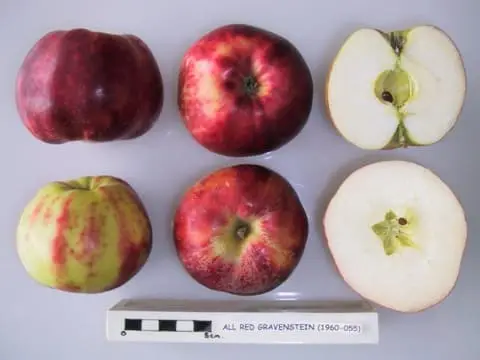
All-Red Gravenstein
-
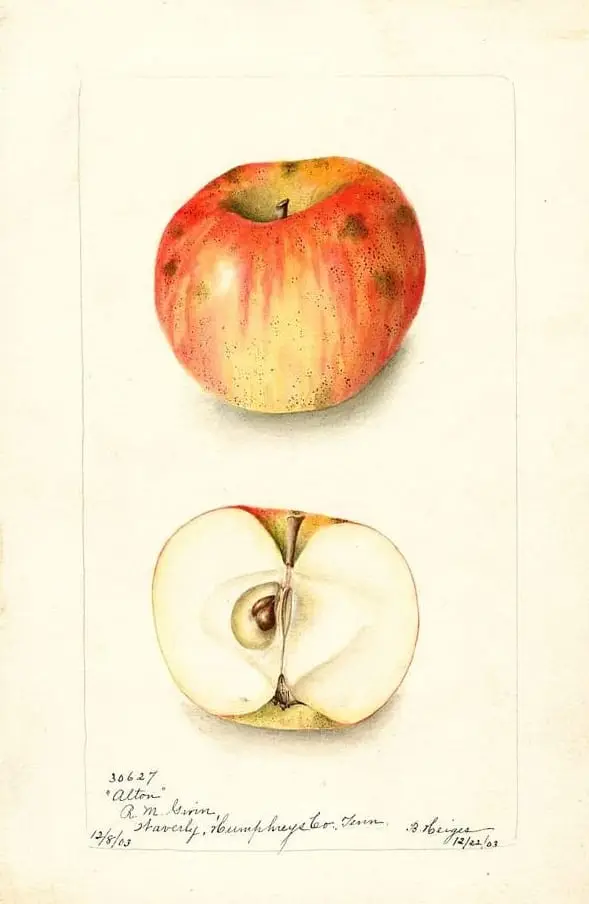
Alton
-
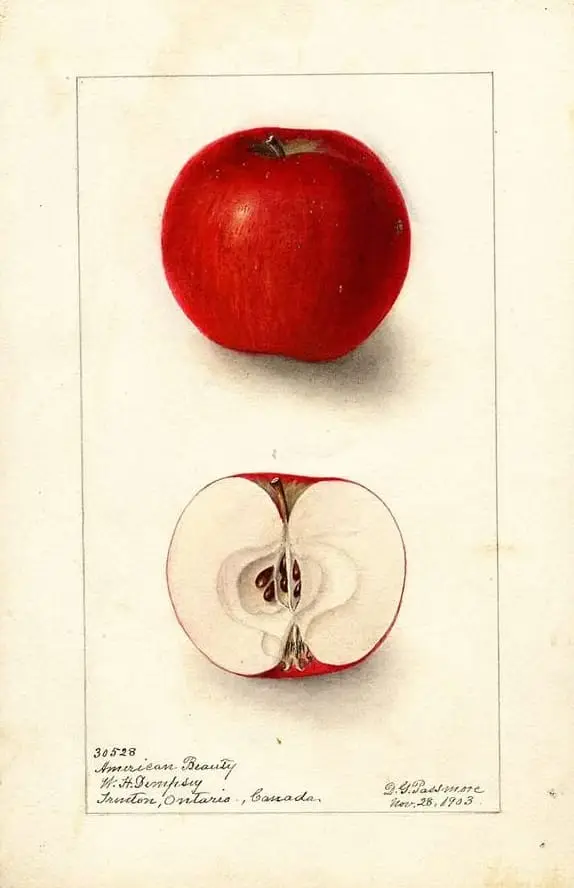
American Beauty
-
American Golden Russet
A small New Jersey russet whose flesh Downing likened to a buttery pear; Coxe knew it in 1817 as Sheep-nose
-
American Grindling
-
American Summer Pearmain
-
Ames
-
Arkansas