Reinette du Canada
Probably French despite its name: first announced in Paris in 1771 as the monstrous reinette of Canada
History
The earliest record André Leroy could find is from 1771, when the Parisian botanist and florist Andrieux announced that he hoped soon to offer grafts of the Monstrueuse Reinette de Canada, excellent to eat and weighing between a pound and a pound and a quarter2. Beach and Bunyard also place it in France by 17713,5.
Where the name came from was already a puzzle in Leroy’s day2. In 1809 Louis Bosc wrote that it had come back to France from North America, where the first European settlers had taken the apple tree, and around 1830 Poiteau and Sageret agreed that it did not come from Canada, the name having been given through ignorance or speculation2. Downing doubted a Canadian origin because Merlet had described the same fruit in the seventeenth century, and reported the view that it had gone to America from Normandy and come back under its new name4. Leroy found these accounts plausible but “une tradition, pas autre chose”, a tradition and nothing more, and could trace the name Reinette de Caen only to 18262. The National Fruit Collection thinks it probably originated in Normandy1.
Beach found it “much esteemed in Europe” under numerous names, Bunyard counting some forty-eight, but little wanted in America, where other varieties easily excelled it3,5. The Royal Horticultural Society gave it an Award of Merit in 19011. It is a triploid, and SNP data give Reinette Franche as one parent1,6.
The fruit
The fruit is large and often very large1,2,3: the National Fruit Collection’s record gives 68–83 mm across and 53–64 mm high1, and in 1852 fruit 40 cm round, from dwarf trees at Meudon, sold for a franc apiece2. It is flattened to conical, irregular and broadly angular1,3. The thick, dry, slightly rough skin is greenish to golden yellow, much covered with patchy russet and rough grey dots, and sometimes flushed brownish, orange or wine-red in the sun1,2,3. The yellowish flesh is firm and rather coarse1,3; Leroy found its juice abundant, sweet and strongly acid, with the delicate flavour peculiar to reinettes2.
Leroy gave its season as January to March, Beach as early winter to March or April, when the fruit begins to lose its flavour2,3. At Brogdale it begins to flower about 7 May and is picked in mid-October1. It must be picked with great care, as the slightest knock blackens the flesh; for long keeping Leroy advised picking it a little green from the end of September2.
Growing
The tree is vigorous and spreading4,5, though only moderately vigorous and drooping in Beach’s experience3. On paradise stock it makes cordons or bushes whose fruit is as plentiful as it is large; as a standard it should be top-grafted2. Bunyard found it best in warm seasons and very subject to canker5.
Uses
It is used for dessert and for cooking1. In France it is one of the varieties of the protected geographical indication for Savoie apples and pears, Pommes et Poires de Savoie, in which its fruit is marked by some russet and must reach at least 12 °Brix and 6 grams of malic acid per litre of juice7.
Where the sources disagree
- Origin. Probably Normandy1,4; at least not Canada, for Bosc, Poiteau and Sageret2; unknown to Beach, and to Leroy beyond tradition2,3.
- Cropping. A good, productive bearer to Downing4, satisfactory to Leroy and moderate to Bunyard2,5, but to Beach irregular, more often only moderately productive or unproductive3.
- Texture. Juicy to Leroy and Beach2,3, “somewhat dry” to the National Fruit Collection, whose staff call the flesh soft where its 1971 register says firm1.
Family tree
Parents, grandparents and great-grandparents, as the entries in the atlas record them.
- Reinette du Canada France, by 1771
- Parent Reinette Franche France, by 1540
- Parent Reinette de Saintonge
- Parent Reinette Franche France, by 1540
Offspring in the atlas
- Reinette Grise du Canada France, by 1805
Sources
- Reinette du Canada (accessions 1948-661 and 2001-125), National Fruit Collection, Brogdale, Kent (Defra). Supports: "Triploid. Thought to have probably originated in Normandy, France. First mentioned in 1771"; Award of Merit from the Royal Horticultural Society in 1901; "firm, rather coarse-textured, somewhat dry flesh"; culinary and dessert; synonyms including Canada Reinette, Canadian Reinette, Reinette Blanche du Canada, Reinette de Canada, Grosse Reinette du Canada, Reinette Monstrueuse du Canada, Reinette de Caen and Pariser Rambour Reinette; from the National Apple Register (Smith, 1971; set b): 68–83 mm wide and 53–64 mm high, flat to conic, irregular, pale yellowish-green ground, sometimes with a slight orange or brownish flush, almost covered with fine patchy russet, skin dry, tough and slightly rough, flesh firm and creamy white, flavour acid; from the collection's own characterisation (set a): flesh soft and crisp; 10% flowering on 7 May and picking in mid-October at Brogdale.
- Dictionnaire de pomologie, vol. IV, pp. 637–641: Reinette du Canada (in French), André Leroy, Paris and Angers, Internet Archive, 1873. Supports: entry no. 381, with synonyms including Reinette monstrueuse du Canada (Andrieux, 1771), Reinette de Canada blanche, Grosse Reinette du Canada and Reinette de Caen; fertility satisfactory; as a standard to be top-grafted, and on paradise making cordons or bushes whose fruit is as numerous as it is large; fruit "considérable et parfois énorme"; skin thick, a little rough, golden yellow marbled with fawn and light brown, with many large rough grey dots, washed wine-red in the sun; flesh yellowish, fine, half-tender and slightly crisp; juice abundant, sweet and strongly acid, with the delicate flavour peculiar to reinettes; ripe January to March; first quality; Bosc (1809) saying that it came back from North America, where the first European settlers had taken the apple tree; Poiteau (about 1828) and Sageret (1830) of the same opinion, that it does not come from Canada and was so named through ignorance or speculation; the Norman origin "une tradition, pas autre chose"; the synonym Reinette de Caen traced only to 1826; its first appearance, as far as Leroy knew, in 1771, when the Parisian botanist and florist Andrieux announced grafts of the "Monstrueuse Reinette de Canada", excellent to eat and weighing "entre une livre et cinq quarterons"; Duval (1852) on dwarf trees at Meudon whose fruit, 40 cm round, sold at one franc apiece; the flesh blackening at the slightest knock; to be picked a little green from the end of September for long keeping.
- The Apples of New York, vol. I, pp. 93–94: Canada Reinette, S. A. Beach, New York Agricultural Experiment Station, Internet Archive, 1905. Supports: an irregular bearer, "in some years very productive, but more often only moderately productive or unproductive"; "much esteemed in Europe" under numerous synonyms, but little in demand in America, being easily excelled by other varieties; "Origin unknown"; listed in France as Canada Reinette "at least as early as 1771"; tree moderately vigorous, spreading and drooping; fruit above medium and often very large, oblate or roundish-conic, irregular and broadly angular; skin yellow, sometimes with a decided blush, with dots, flecks or patches of russet; flesh yellowish, firm, coarse, juicy, subacid, "very good"; season early winter till March or April, the fruit losing flavour late in the season.
- The Fruits and Fruit Trees of America, pp. 115–116: Canada Reinette, A. J. Downing, revised by Charles Downing, John Wiley & Sons, Internet Archive, 1900. Supports: doubtful "whether it is truly of Canadian origin, as Merlet, a French writer, describes the same fruit in the 17th century", and thought by some authors to have been brought to America from Normandy and carried back under its new name; a good bearer; tree vigorous, spreading, open and productive; ripe in December, keeping till April if picked early in autumn; the Canada Reinette Grise "very much like the above", and possibly identical.
- A Handbook of Hardy Fruits, vol. I, pp. 108–109: Reinette du Canada, E. A. Bunyard, John Murray, Internet Archive, 1920. Supports: "Some forty-eight synonyms exist", among them Pariser Rambour Reinette; dessert, till April; growth vigorous and rather spreading, fertility moderate; "Origin, uncertain; known in France before 1771"; "Excellent in warm seasons. Very subject to canker".
- Cultivar fingerprinting and SNP-based pedigree reconstruction in Danish heritage apple cultivars utilizing genotypic data from multiple germplasm collections in the world (Supplementary Table S2), B. Larsen and others, Genetic Resources and Crop Evolution 72: 2397, 2025. Supports: Reinette Blanche du Canada (genotype MUNQ 294; the Copenhagen accession Canada Reinet) triploid, with Reinette Franche as its SNP-confirmed parent and the other parent unknown (accession and pedigree tables).
- Specification of the protected geographical indication Pommes et Poires de Savoie (in French), Ministry of Agriculture, Agrifood and Forestry, Bulletin officiel no. 51-2016; approved by Commission Implementing Regulation (EU) 2016/2213, 2016. Supports: Reinette blanche du Canada among the varieties, and their mutants, from which Savoie apples may come; russeting a mark of the variety; at least 12 °Brix and acidity of at least 6 g of malic acid per litre of juice.
More from France
-
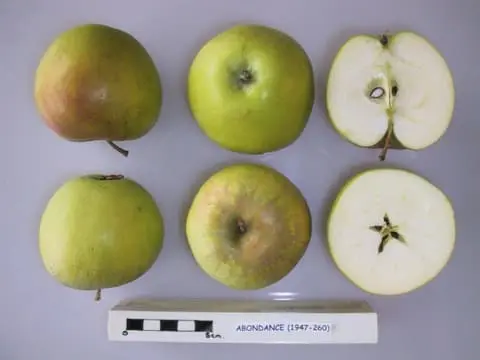
Abondance
-
Alfred Jolibois
-
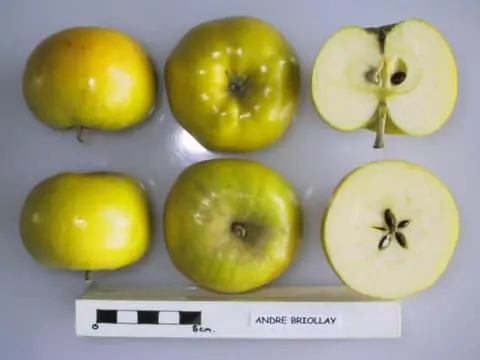
Andre Briollay
-
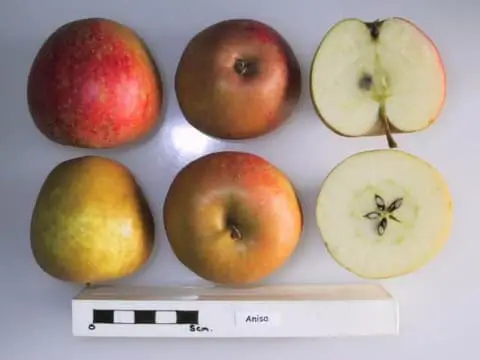
Anisa
-
Api
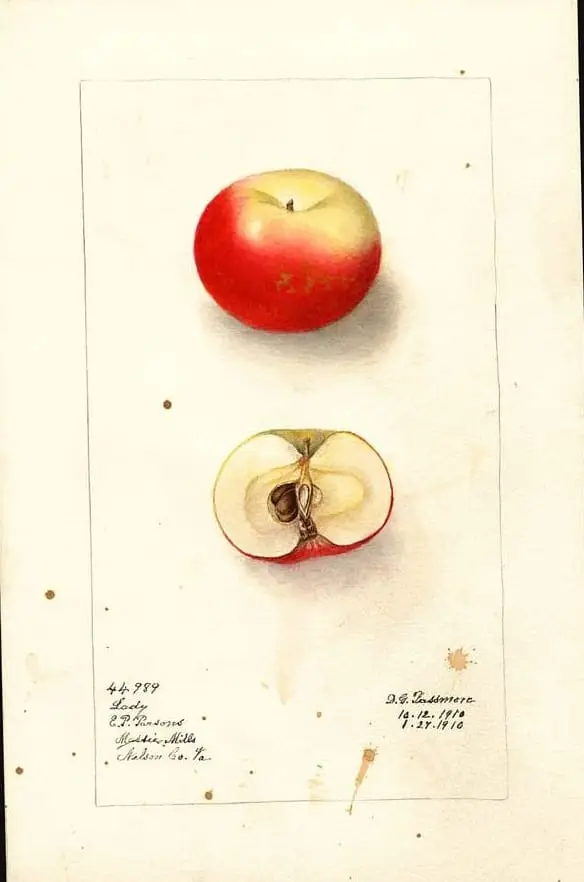
A tiny, glossy, red-cheeked apple recorded in 1628 and said to have been found wild in a forest in Brittany
-
Api Noir
-
Barre
-
Bassard