Apple fritters
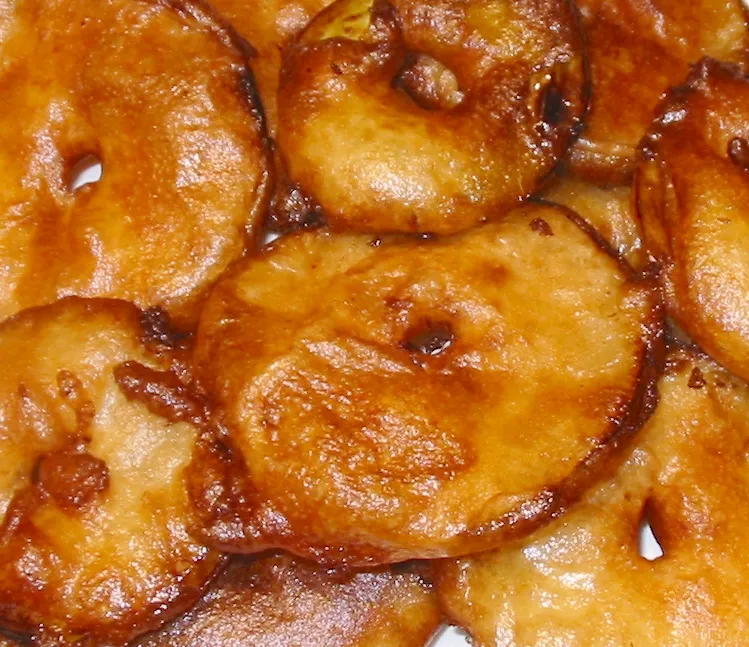
Apple rings dipped in batter, fried golden in oil and showered with vanilla sugar, from Rome's Jewish kitchen.

- Makes
- 1 batch, each for 6 to 8 people
- Cooking time
- 2 to 3 minutes per side
- From
- Italy, Rome
- Source
- Mele fritte: A Roman Jewish fritter, Joe Baur, with the recipe "Apple fritters with vanilla sugar" by Leah Koenig; BBC Travel, 7 December 2023
- Called
- Italian: mele fritte (fried apples)
Allergens
- Contains
-
- wheat (gluten): plain flour (all-purpose flour)
- milk: milk
Suits vegetarians.
Worked out from the ingredients as written. Products differ, so read their labels. How allergens are worked out
Adjust the recipe
Scale to what I have
Ingredients
Vanilla sugar
Fritters
-
the source uses coarse kosher salt
-
or a non-dairy milk
-
sunflower or grapeseed, for example
Tick what you have: copying then takes only what is left.
You will need
- a food processor
- a glass jar with a lid
- an apple corer, a melon baller or a sturdy metal teaspoon
- a large frying pan
- a large plate lined with kitchen paper
Method
Vanilla sugar
-
For this step: 2 vanilla pods (vanilla beans)
-
For this step: 300 g (1½ cups) sugar
Fritters
-
For this step: 4 baking apples
-
For this step: 210 g (1⅔ cups) plain flour (all-purpose flour); 3 tablespoons sugar; ½ teaspoon salt; ½ teaspoon bicarbonate of soda (baking soda); 355 ml (1½ cups) milk
-
For this step: vegetable oil
Timers come with you from page to page on this site, and ring while it is open in your browser and this device is not silenced. They cannot ring once the tab is closed or the phone is asleep, so the screen stays on while one runs.
Notes
- The vanilla sugar can be used at once, though its flavour grows with time; in a tightly closed jar it keeps for up to a year.1
- Hot oil can burn and can start a fire. Writing of deep frying, the Food Safety and Inspection Service of the United States Department of Agriculture says never to leave the fryer unattended, to keep water out of the hot fat, and never to put out a grease fire with water.5
Older ways
-
The International Jewish Cook Book of 1919 cut four sour apples into small slices and stirred them into a fritter batter of flour, baking powder, salt, an egg and milk or water; the bell fritters printed just before them are fried by spoonfuls in hot oil.4
Today: Cut the cored apples into small slices instead of rings, stir them all into the batter and fry the mixture by the spoonful, a few at a time, turning once, until golden on both sides.
-
The same book tested hot fat by lowering a piece of stale bread into it: if the bread browned in thirty seconds, the fat was hot enough.4
Today: Before the first batch, drop a small cube of stale bread into the oil, and start frying when it browns within thirty seconds.
The apples
The source asks for four large baking apples, peeled.1 Saveur's printing of the recipe, adapted from the same book, names Honeycrisp or Granny Smith, and gives the four apples as 1½ lb (about 680 g).2
Varieties the sources name:
- Honeycrisp (North America)
- Granny Smith (North America)
Where it is from
This recipe
It follows Mele fritte: A Roman Jewish fritter. The source uses metric measures; the US amounts are this site's conversions. This site has no kitchen and has not cooked the recipe.
What was changed: The source gives every quantity in both systems; we follow its metric ones, and the American amounts are our conversions. For the flour that gives 1 2/3 cups where the source prints 1 1/2 cups, because the site counts 125 g of plain flour to the cup. The source allows milk or a non-dairy milk; we list milk and name the other in a note. Its kosher salt is listed as salt, with a note, and its baking soda as bicarbonate of soda. Its yield, "Makes 6 to 8", is read as people, as Saveur's printing has it, and given as the note to one batch; the frying time of 2 to 3 minutes is for each side.
How the recipes are chosen and converted
Print or download
- PDF, metric measures, A4 paper
- PDF, US measures, Letter paper
- Recipe data (schema.org JSON-LD), metric measures
- Recipe data (schema.org JSON-LD), US measures
- Cooklang file, metric measures
- Cooklang file, US measures
- Plain text (Markdown), metric measures
- Plain text (Markdown), US measures
The files give the source's quantities. A recipe app can import this page from its address.
You have changed the quantities. Printing keeps them; the files above give the source's quantities.
With your quantities and measures:
About this dish
The BBC called mele fritte, fried apples, a Roman Jewish fritter when it published this recipe by the cookbook author Leah Koenig in December 2023, in time for Hanukkah.1 It comes from Portico: Cooking and Feasting in Rome’s Jewish Kitchen, which W. W. Norton published in 2023.2
While writing Portico, Koenig came upon apple fritters in Dal 1880 ad oggi: La cucina ebraica della mia famiglia, a cookbook that Donatella Limentani Pavoncello, a teacher, wrote by hand in the early 1980s for her own family, arranging its recipes by holiday.1 Pavoncello served the fritters at Hanukkah, and Koenig told the BBC that she now does the same; her recipe starts from Pavoncello’s.1
At Hanukkah it is the custom to eat foods fried in oil, which recall the miracle of the oil: one cruse that lasted eight days.1,3 Besides potato pancakes and jelly doughnuts, My Jewish Learning counts “other kinds of fritters” among them.3
The International Jewish Cook Book, in its second edition of 1919, made apple fritters from small slices of sour apple stirred into a batter raised with baking powder, fried them “in boiling hot fat or oil”, drained them on paper and sprinkled them with powdered sugar.4 Its chapter on frying tells the cook to use oil for food meant for a milk meal, and allows fat, rendered by its own directions, for a meat meal.4
Sources
- Mele fritte: A Roman Jewish fritter, Joe Baur, with the recipe "Apple fritters with vanilla sugar" by Leah Koenig; BBC Travel, 7 December 2023. Supports: the recipe followed: its ingredients and quantities, method, frying time and yield; the dish called a Roman Jewish fritter and presented in time for Hanukkah; frying at Hanukkah in memory of the miracle of the oil; Koenig's source, the cookbook Donatella Limentani Pavoncello wrote by hand in the early 1980s for her family, with its recipes grouped by holiday; the fritters on Pavoncello's Hanukkah menu and now on Koenig's; how the vanilla sugar keeps.
- Apple Fritters With Vanilla Sugar, Leah Koenig; Saveur, 12 September 2023. Supports: another printing of the recipe, adapted from Portico: Honeycrisp or Granny Smith apples, the four weighing 1 1/2 lb, and a yield of 6 to 8 servings; the book's copyright, 2023, and its publisher, W. W. Norton.
- Recipes for Hanukkah, My Jewish Learning, last modified 27 November 2023. Supports: the custom of eating foods fried in oil at Hanukkah and the miracle of the oil it recalls, one cruse lasting eight days; potato pancakes, jelly doughnuts and other fritters among the fried foods.
- The International Jewish Cook Book (second edition), Florence Kreisler Greenbaum; Project Gutenberg, 1919. Supports: the recipes "Fritter Batter", "Bell Fritters" and "Apple Fritters" in the chapter "Pancakes, Fritters, etc."; the chapter "Frying": the test with stale bread; oil for food meant for a milk meal, and fat, rendered by its directions, allowed for a meat meal.
- Deep Fat Frying and Food Safety, Food Safety and Inspection Service, United States Department of Agriculture. Supports: the dangers of hot oil, burns and fires; never leaving the fryer unattended, keeping water out of the hot fat, and never using water on a grease fire.
From The World of Apples, apple.io/recipes/apple-fritters/
In these collections
More of this kind
-
Dutch apple fritters
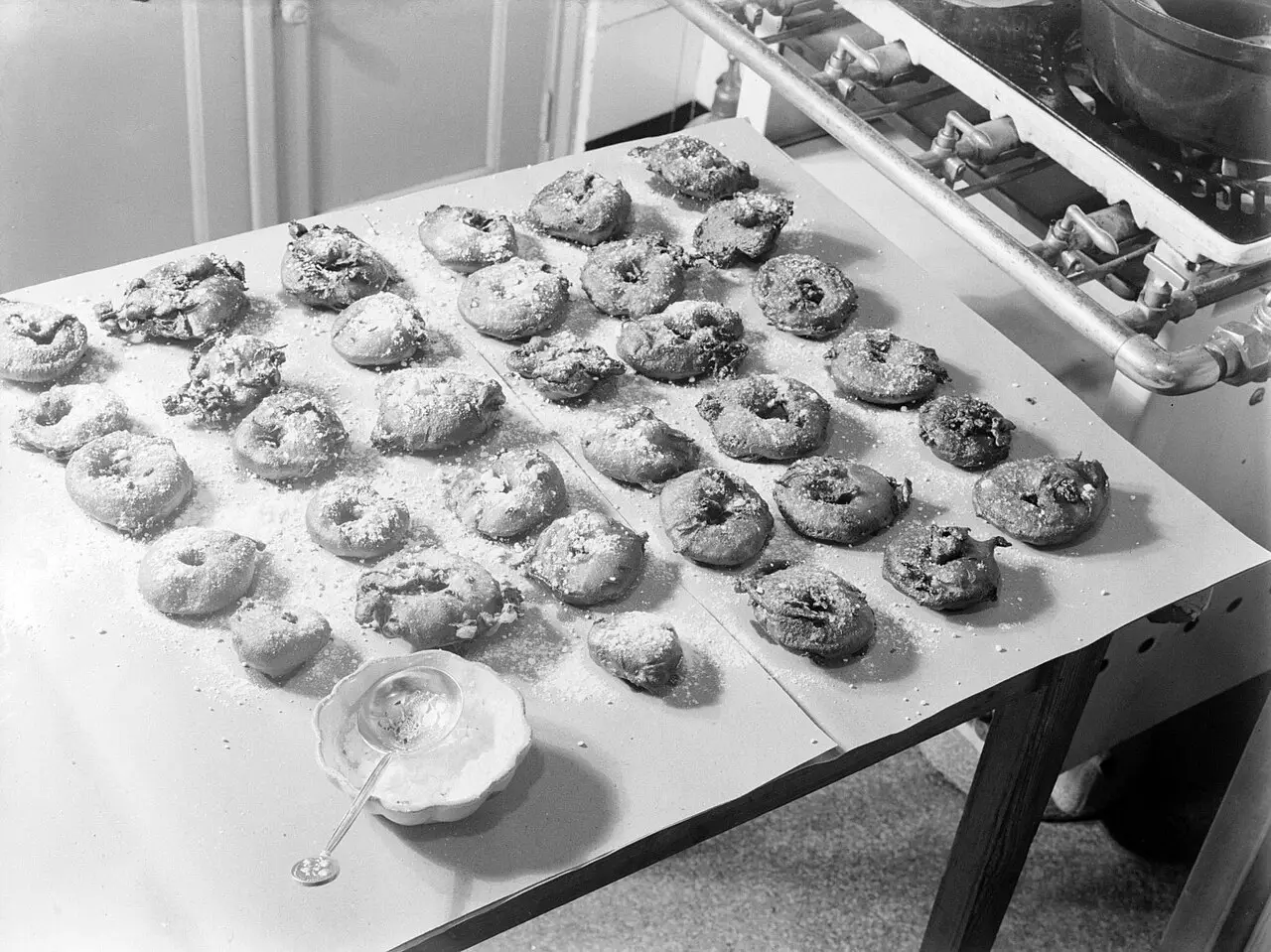
Slices of sour apple dipped in a batter of flour and beer, fried and dusted with icing sugar.
-
Æbleskiver
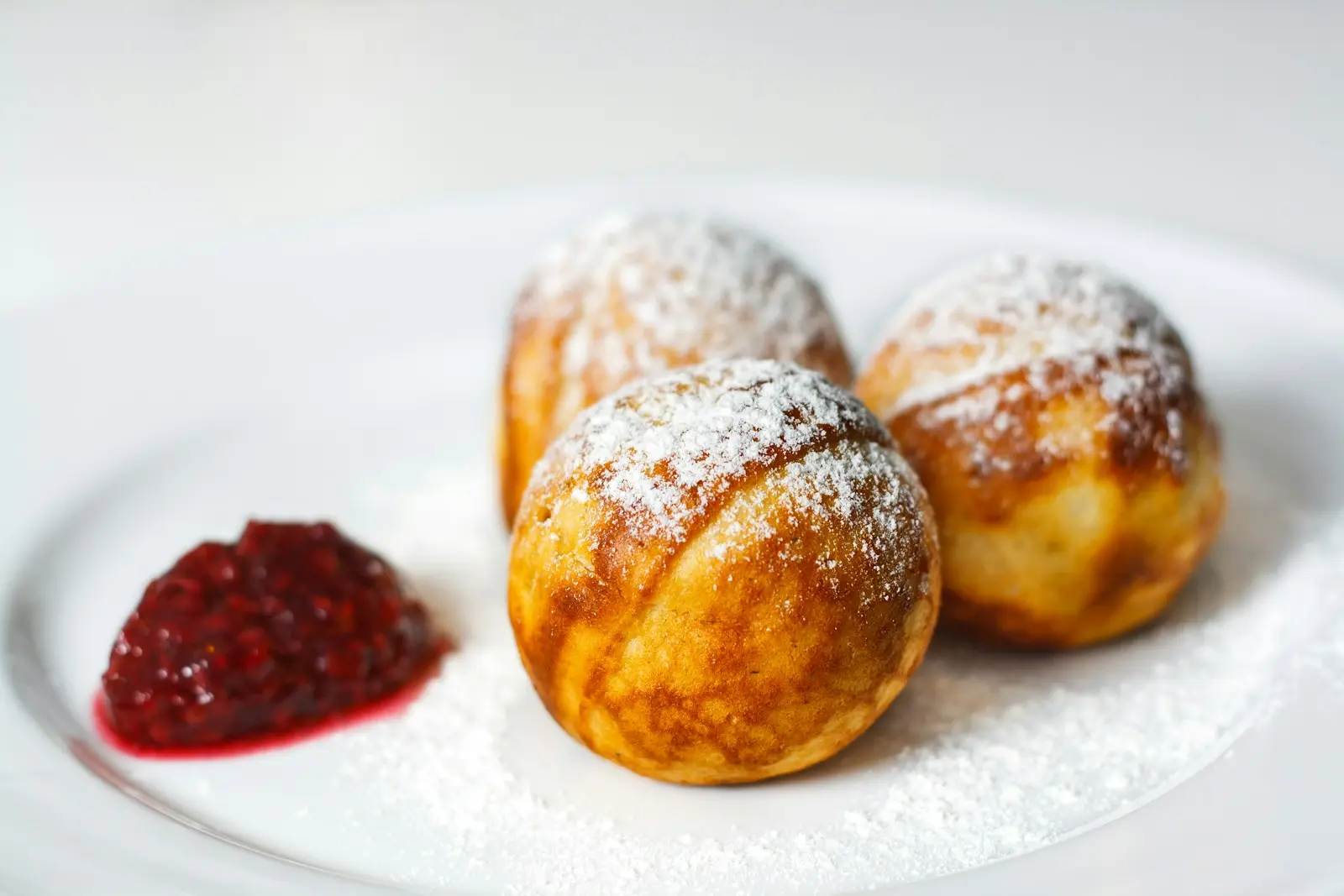
Balls of buttermilk batter baked in a pan with round hollows, with apple at the centre, eaten with jam and icing sugar.