Æbleskiver
Balls of buttermilk batter baked in a pan with round hollows, with apple at the centre, eaten with jam and icing sugar.
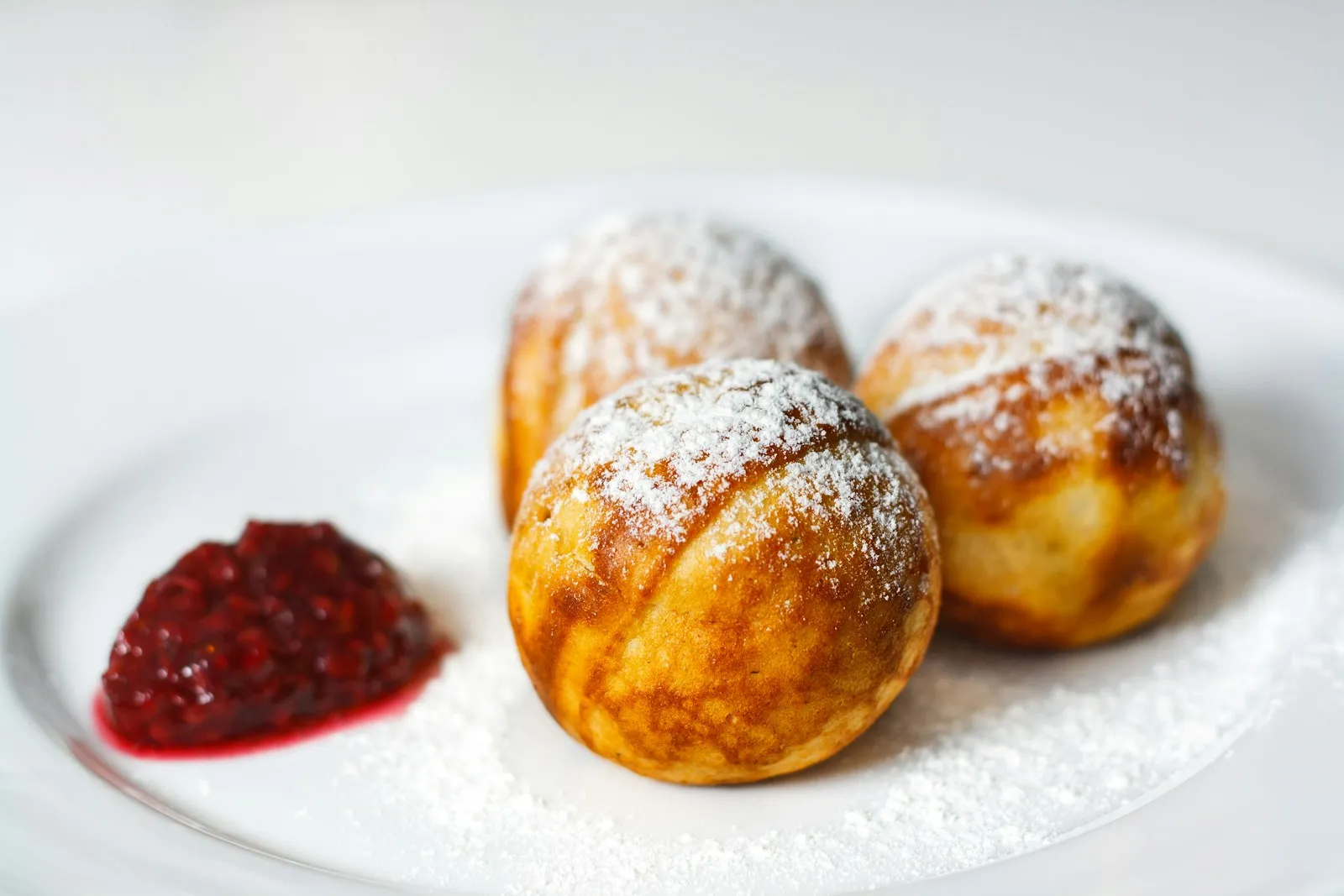
- Makes
- 6 servings
- Time in all
- 1 hourThe batter rests for 20 to 30 minutes.
- From
- Denmark
- Source
- Æbleskiver med æble, DR (Danmarks Radio), DR Mad, Den store bagedyst, 8 August 2016
- Called
- Danish: æbleskiver (apple slices)
Allergens
- Contains
-
- wheat (gluten): plain flour (all-purpose flour)
- milk: buttermilk, butter
- egg: eggs
- Check the label for
-
- sulphites: raspberry jam
Suits vegetarians.
Worked out from the ingredients as written. Products differ, so read their labels. How allergens are worked out
Adjust the recipe
Scale to what I have
Ingredients
-
Polynesian, as the source asks
-
from an unsprayed lemon
-
for the pan
To serve
-
home-made, as you like it
Tick what you have: copying then takes only what is left.
You will need
- an æbleskive pan
Method
-
For this step: 4 eggs; 1 litre (4¼ cups) buttermilk
-
For this step: ½ vanilla pod (vanilla bean); 75 g (6 tablespoons) sugar
-
For this step: 600 g (4¾ cups) plain flour (all-purpose flour); 2 teaspoons bicarbonate of soda (baking soda); 1 teaspoon salt; ½ teaspoon ground cardamom
-
For this step: 1 teaspoon grated lemon zest (grated lemon rind)
-
For this step: 4 apples
-
For this step: 4 tablespoons butter
-
For this step: raspberry jam; icing sugar (confectioners' sugar)
Timers come with you from page to page on this site, and ring while it is open in your browser and this device is not silenced. They cannot ring once the tab is closed or the phone is asleep, so the screen stays on while one runs.
Notes
- For its 6 servings the source counts about 28 æbleskiver.1
Older ways
-
The oldest æbleskiver, found in Danish cookery of the 1700s, were thin slices cut from a cored apple, dipped in a batter like a pancake batter and boiled or fried in fat; afterwards they often lay for about a day in wine, lemon juice and spices.2
Today: To try that kind, core one of the apples and cut it across into thin slices. Dip them in the batter and fry them in butter in a frying pan.
-
Frøken Jensen's cookbook, in its printing of 1921, let a little stewed apple, a piece of cooked apple or some rhubarb compote go into each æbleskive before it was turned, but it preferred the fruit served beside them, because the æbleskiver then rose better.3
Today: To do it her preferred way, bake the æbleskiver without the apple and serve the apples beside them, cooked, or stewed to a purée.
The apples
The source asks for four apples, cut so that every æbleskive gets a bit at its centre, and names no variety.1
Where it is from
This recipe
It follows Æbleskiver med æble. The source uses metric measures; the US amounts are this site's conversions. This site has no kitchen and has not cooked the recipe.
What was changed: Translated from the Danish. The source lists cardamom, which it says can be left out, but does not say when it goes in; we add it with the flour. It does not say when or how to cut the apples, only that a small piece goes into each; we cut them while the batter rests. It gives the pan no heat beyond hot, and the baking no time. It gives one hour as the time the recipe takes, shown here as the time in all. It suggests home-made raspberry jam, as the cook likes it, and gives no amount for the jam or the icing sugar. The American amounts are our conversions. The steps are in our own words.
How the recipes are chosen and converted
Print or download
- PDF, metric measures, A4 paper
- PDF, US measures, Letter paper
- Recipe data (schema.org JSON-LD), metric measures
- Recipe data (schema.org JSON-LD), US measures
- Cooklang file, metric measures
- Cooklang file, US measures
- Plain text (Markdown), metric measures
- Plain text (Markdown), US measures
The files give the source's quantities. A recipe app can import this page from its address.
You have changed the quantities. Printing keeps them; the files above give the source's quantities.
With your quantities and measures:
About this dish
Æbleskiver are a Danish sweet, cakes of batter fried in a pan made for them and traditionally served with jam and icing sugar; most today have no apple in them.2 The earliest, recorded in Danish cookery of the 1700s, were slices of apple dipped in a thin batter before being boiled or fried.2
The Danish encyclopaedia lex.dk counts them among the country’s oldest baked goods, long made for celebrations through the year and through life, and says that they have belonged to Christmas baking only for about a century.2 Recipes for baking them in an æbleskive pan appear from the early 1800s, and by the middle of that century cooks had stopped putting slices of apple in them.2
The recipe here was published in 2016 by DR, the Danish public broadcaster, under its programme Den store bagedyst.1 DR calls it the genuine old-fashioned kind, with a bit of apple at the centre of every one, and offers it for Christmas.1 A batter of buttermilk and bicarbonate of soda with grated lemon zest and cardamom, like this one but without its eggs, sugar and vanilla, is already in the 1921 printing of Frøken Jensen’s cookbook, as the second of its recipes for æbleskiver.3 Kristine Marie Jensen, who lived from 1858 to 1923, first published the book in 1901.4
They go by other names around Denmark: Fedtnummer on Møn, Bublipan on Samsø, Kukker, Efelkach or Pomler in Southern Jutland, and Nonner or Nuner on Lolland and Falster.2
Sources
- Æbleskiver med æble, DR (Danmarks Radio), DR Mad, Den store bagedyst, 8 August 2016. Supports: the recipe followed, for 6 people: its ingredients, quantities, method, resting time, the time of one hour, and the count of about 28 æbleskiver; a bit of apple at the centre of each; the recipe called the genuine old-fashioned kind and offered for Christmas.
- æbleskive, Bettina Buhl, Det Grønne Museum; Lex (lex.dk), 22 July 2025. Supports: æbleskiver as a sweet baked in an æbleskive pan, usually without apple, eaten with icing sugar and jam; among the oldest Danish baked goods, served at the feasts of the year and of life, and linked with Christmas baking only in the last hundred years; the oldest kind, in cookery of the 1700s, slices of a cored apple dipped in batter, boiled or fried in fat, and often left for a day in wine, lemon juice and spices; recipes for the pan from the early 1800s, and slices of apple given up in the middle of that century; the regional names.
- Frøken Jensens Kogebog (23rd printing), Kristine Marie Jensen; Gyldendalske Boghandel, Nordisk Forlag, Copenhagen; the Boston Public Library copy at the Internet Archive, 1921. Supports: No. 1025, "Æbleskiver. 1.", page 245: stewed apple, cooked apple in pieces or rhubarb compote may go into each before it is turned, but the fruit is better served beside them, since the æbleskiver then rise better; No. 1026, "Æbleskiver. 2.", on the same page: a batter of flour, buttermilk and bicarbonate of soda with salt, grated lemon zest and cardamom.
- Kristine Marie Jensen, Claus Bech, Dansk Biografisk Leksikon; Lex (lex.dk), 8 December 2020. Supports: her dates, 17 July 1858 to 7 February 1923, and her cookbook, first published in 1901.
From The World of Apples, apple.io/recipes/aebleskiver/
In these collections
More of this kind
-
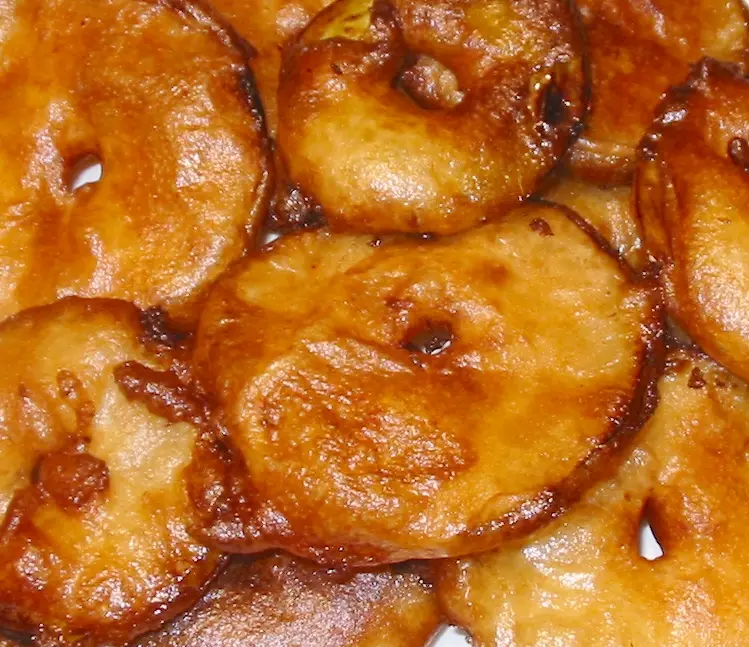
Apple fritters
Apple rings dipped in batter, fried golden in oil and showered with vanilla sugar, from Rome's Jewish kitchen.
-
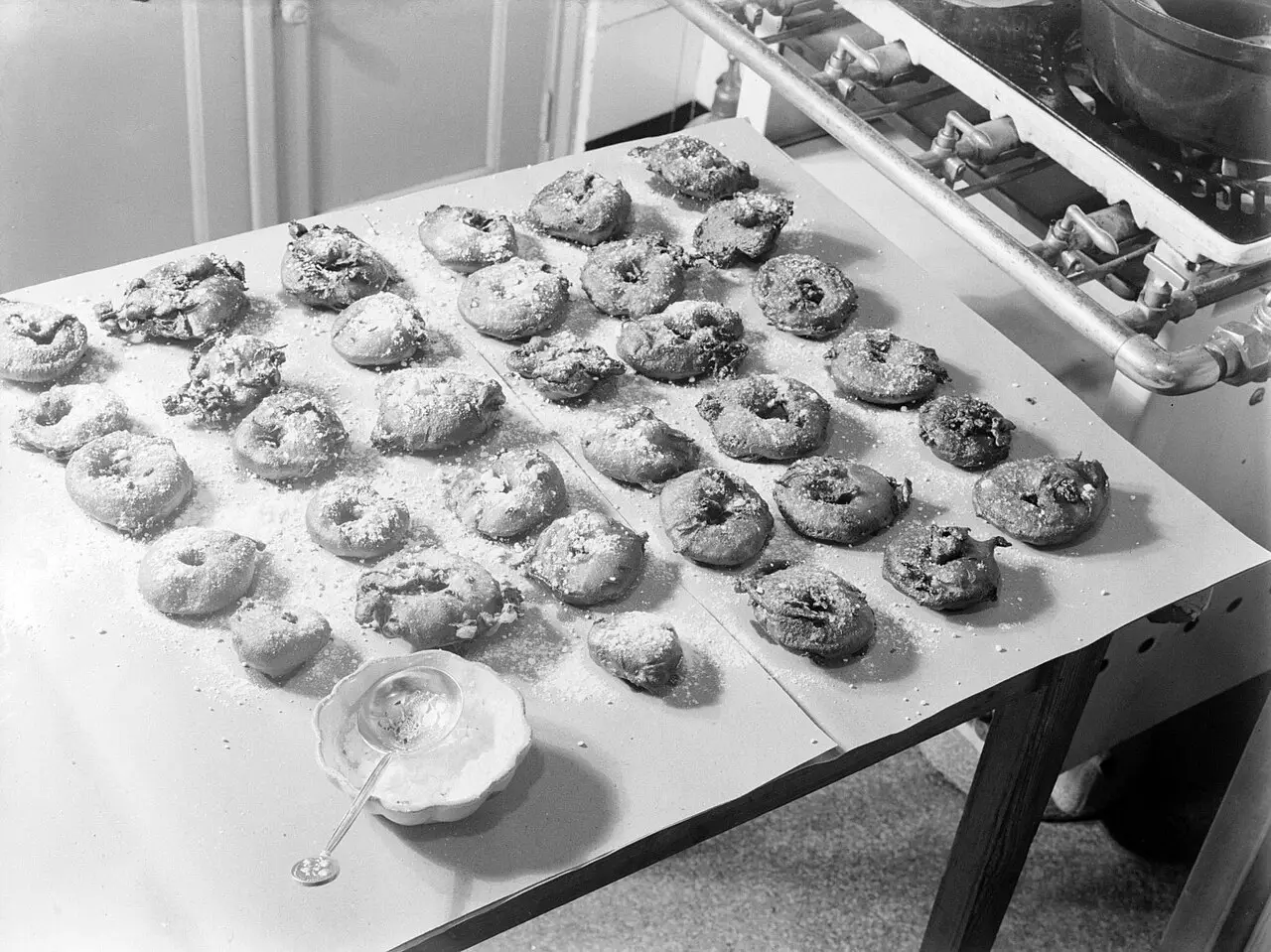
Dutch apple fritters
Slices of sour apple dipped in a batter of flour and beer, fried and dusted with icing sugar.