Apple strudel
Sourish apples, rum-soaked raisins and walnuts on buttered crumbs, rolled in a dough pulled by hand until wafer-thin.
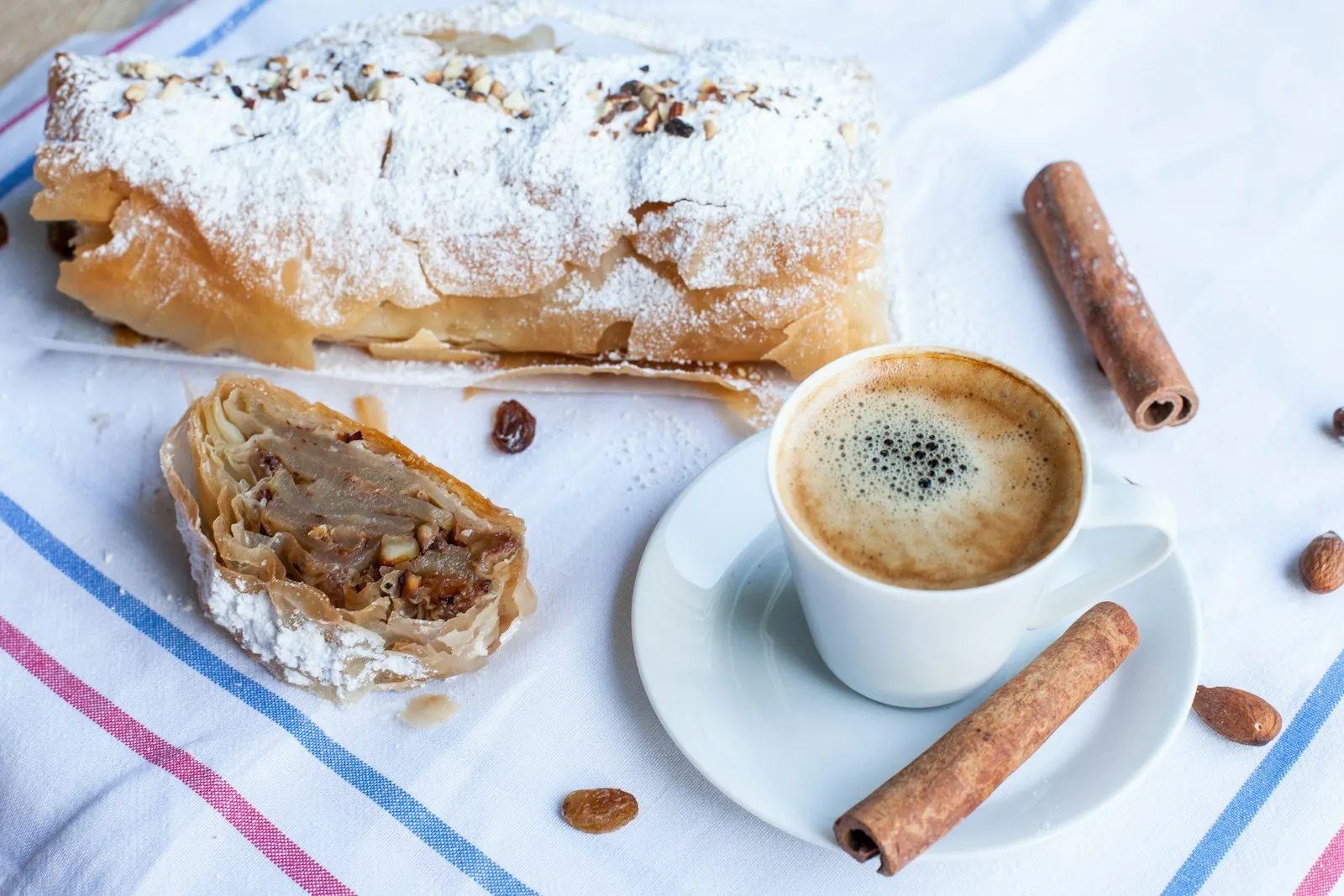
- Makes
- 1 strudel, each for 4 people
- Cooking time
- 35 to 45 minutesThe dough rests for at least an hour before it is pulled.
- Kind
- Pies and tarts
- From
- Austria, Vienna
- Source
- Alt-Wiener Apfelstrudel (11.11.), Alexander Hübler; Silvia kocht, ORF 2; extra.ORF.at, 11 November 2025
- Called
- German: Apfelstrudel (apple strudel)
Allergens
- Contains
-
- wheat (gluten): plain flour (all-purpose flour), dry breadcrumbs (dry bread crumbs)
- milk: butter
- tree nuts (walnuts): walnuts
- Check the label for
-
- barley (gluten): dry breadcrumbs (dry bread crumbs)
- egg: dry breadcrumbs (dry bread crumbs)
- soya: dry breadcrumbs (dry bread crumbs)
- sesame: dry breadcrumbs (dry bread crumbs)
- sulphites: raisins
Suits vegetarians. Contains alcohol.
Worked out from the ingredients as written. Products differ, so read their labels. How allergens are worked out
Adjust the recipe
Scale to what I have
Ingredients
Dough
Filling
Crumbs and nuts
To finish
Tick what you have: copying then takes only what is left.
You will need
- a clean strudel cloth, spread on a large table
- a rolling pin
- a frying pan
- a baking tray lined with baking paper
Method
Dough
-
For this step: 250 g (2 cups) plain flour (all-purpose flour); 6 g (1 teaspoon) salt; 18 g (4 teaspoons) sunflower oil; 125 ml (½ cup) water
-
For this step: sunflower oil
Filling
-
For this step: 80 g (2¾ ounces) raisins; rum
-
For this step: 800 g (1¾ pounds) tart apples; ½ lemon
-
For this step: 100 g (½ cup) sugar; 2 teaspoons ground cinnamon
-
For this step: 40 g (2¾ tablespoons) butter; 80 g (¾ cup) dry breadcrumbs (dry bread crumbs); 1 tablespoon sugar; ½ teaspoon ground cinnamon
Pulling and rolling
-
For this step: plain flour (all-purpose flour)
-
For this step: 50 g (1¾ ounces) walnuts
-
For this step: butter
Baking
-
For this step: icing sugar (confectioners' sugar)
Timers come with you from page to page on this site, and ring while it is open in your browser and this device is not silenced. They cannot ring once the tab is closed or the phone is asleep, so the screen stays on while one runs.
Notes
- The source gives the oven setting for a fan oven: 190°C (375°F).1
- Austria's register of traditional foods says that the strudel is traditionally eaten warm, under a dusting of icing sugar, and that whipped cream often goes with it.2
Older ways
-
In spring, when apples are "not at their best", The Settlement Cook Book of 1930 added one cup of fresh rhubarb to every three cups of apples.4
Today: In spring, use fresh rhubarb, cut small, for a quarter of the fruit and apples for the rest.
-
The International Jewish Cook Book of 1919 made its first apple strudel with no butter: the apples went over the dough "with plenty of chicken-fat or oil", and the strudel was basted often with fat or oil while it baked.5
Today: To make the strudel without butter, use sunflower oil wherever this recipe uses butter: for toasting the crumbs, for drizzling over the dough and for brushing the roll.
-
The Settlement Cook Book of 1930 kept its dough warm under a hot bowl for half an hour before pulling it out over a whole table until it was "thin as paper".4
Today: Rest the dough under an upturned bowl, warmed first, in a warm place, instead of in cling film.
The apples
The source asks for sourish apples.1 Austria's register of traditional foods says that sourish varieties are especially suitable for an apple strudel.2 ORF's studio in Lower Austria names Boskop and Elstar for its own apple strudel.3
Varieties the sources name:
- Belle de Boskoop (Austria and Germany)
- Elstar (Austria and Germany)
Where it is from
This recipe
It follows Alt-Wiener Apfelstrudel (11.11.). The source uses metric measures; the US amounts are this site's conversions. This site has no kitchen and has not cooked the recipe.
What was changed: The source gives the oven setting for a fan oven, 190 °C; we give the conventional 210 °C, 20 °C higher, as the site's oven table does, and the fan setting in a note. It lists the raisins already soaked in rum, with no amount of rum and no time for the soaking; we put them to soak as the first step of the filling. It gives no amounts for the oil and butter for brushing, the flour for the cloth or the icing sugar. Its smooth wheat flour is given as plain flour and its sourish apples as tart apples. The yield, for 4 people, is given as one strudel. The American amounts are our conversions.
How the recipes are chosen and converted
Print or download
- PDF, metric measures, A4 paper
- PDF, US measures, Letter paper
- Recipe data (schema.org JSON-LD), metric measures
- Recipe data (schema.org JSON-LD), US measures
- Cooklang file, metric measures
- Cooklang file, US measures
- Plain text (Markdown), metric measures
- Plain text (Markdown), US measures
The files give the source's quantities. A recipe app can import this page from its address.
You have changed the quantities. Printing keeps them; the files above give the source's quantities.
With your quantities and measures:
About this dish
The apple strudel, Apfelstrudel, is in Austria’s register of traditional foods, which gives Austria as its region and calls strudels the epitome of Viennese and Austrian sweet cookery today.2 The register says that the paper-thin pulled dough probably came from the Orient, and that the strudel came to Austria from Hungary, to be taken up and developed by the cooks of Vienna.2 Its oldest handwritten recipe is held to be one for a milk-cream strudel in an anonymous cookery book of 1696, and Anna Dorn’s Großes Wiener Kochbuch of 1827 has a pulled apple strudel.2 The Viennese apple strudel grew so popular, the register adds, that it gave its name to an apple, the Strudler, a word now used for any variety whose sourish, firm flesh suits a strudel.2
ORF’s studio in Lower Austria names Vienna, Lower Austria and Burgenland as Austria’s classic strudel country, and says that pulled strudels, the apple strudel above all, are among the best-loved sweet dishes.3
The fourth volume of The Jewish Encyclopedia, of 1903, says of the Jews of eastern Europe that “the strudel, or single-layered jelly or fruit cake, takes the place of the pie for dessert”.6 In Milwaukee, The Settlement Cook Book printed an apple strudel under the heading “Grandmother’s Puddings”; its edition of 1930 pulls the dough “as large as the table and thin as paper” and bakes the strudel for an hour, first at 400 °F and then at 350 °F.4
Sources
- Alt-Wiener Apfelstrudel (11.11.), Alexander Hübler; Silvia kocht, ORF 2; extra.ORF.at, 11 November 2025. Supports: the recipe followed: its ingredients and quantities, method, oven setting, baking time, resting time and yield; sourish apples.
- Apfelstrudel, Milchrahmstrudel, Topfenstrudel (Traditionelle Lebensmittel in Österreich, Registernummer 177), Bundesministerium für Land- und Forstwirtschaft, Klima- und Umweltschutz, Regionen und Wasserwirtschaft, Austria, revised 2023. Supports: apple strudel in Austria's register of traditional foods, with Austria as its region; strudels as the epitome of Viennese and Austrian sweet cookery; the pulled dough, probably from the Orient, and the strudel's coming to Austria from Hungary, to be taken up by Viennese cookery; the handwritten milk-cream strudel of 1696 and Anna Dorn's pulled apple strudel of 1827; sourish apples as especially suitable; the apple named after the strudel, Strudler, and the word used for sourish, firm varieties; apple strudel served warm with icing sugar and often whipped cream.
- Wie handgezogener Apfelstrudel funktioniert, Andrea Karrer, Radio Niederösterreich; noe.ORF.at, 22 October 2022. Supports: Vienna, Lower Austria and Burgenland as Austria's classic strudel lands, where pulled strudels, the apple strudel above all, are among the best-loved sweet dishes; Boskop and Elstar named as sourish apples for strudel.
- The Settlement Cook Book (eighteenth edition, enlarged and revised), Mrs. Simon Kander, compiler; The Settlement Cook Book Co., Milwaukee; Internet Archive, March 1930. Supports: the recipe "Apple Strudel" on page 346, under "Grandmother's Puddings": the dough kept warm under a hot bowl for half an hour, pulled as large as the table and thin as paper, an hour's baking at 400 °F and then 350 °F, and the note on rhubarb in spring.
- The International Jewish Cook Book (second edition), Florence Kreisler Greenbaum; Project Gutenberg, 1919. Supports: "Apple Strudel, No. 1": the apples spread with plenty of chicken fat or oil, and the strudel basted with fat or oil as it bakes.
- Cookery (The Jewish Encyclopedia, volume IV, pages 254 to 257), Funk and Wagnalls Company, New York and London; Internet Archive, 1903. Supports: the strudel in the cookery of the Jews of eastern Europe, taking "the place of the pie for dessert" (page 257).
From The World of Apples, apple.io/recipes/apple-strudel/
In these collections
More of this kind
-
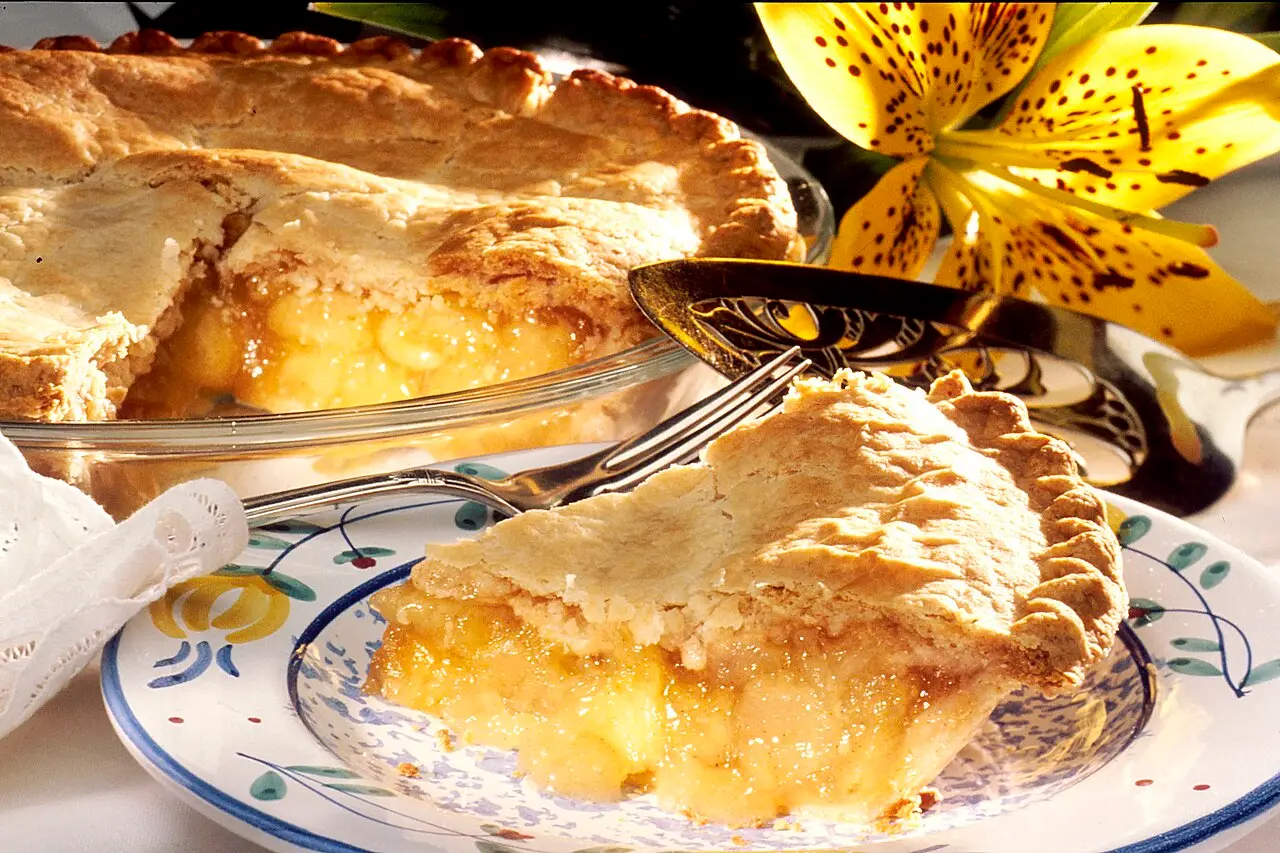
Apple pie
Sliced tart apples under sugar, cornflour and cinnamon, baked between two crusts of shortening pastry.
-
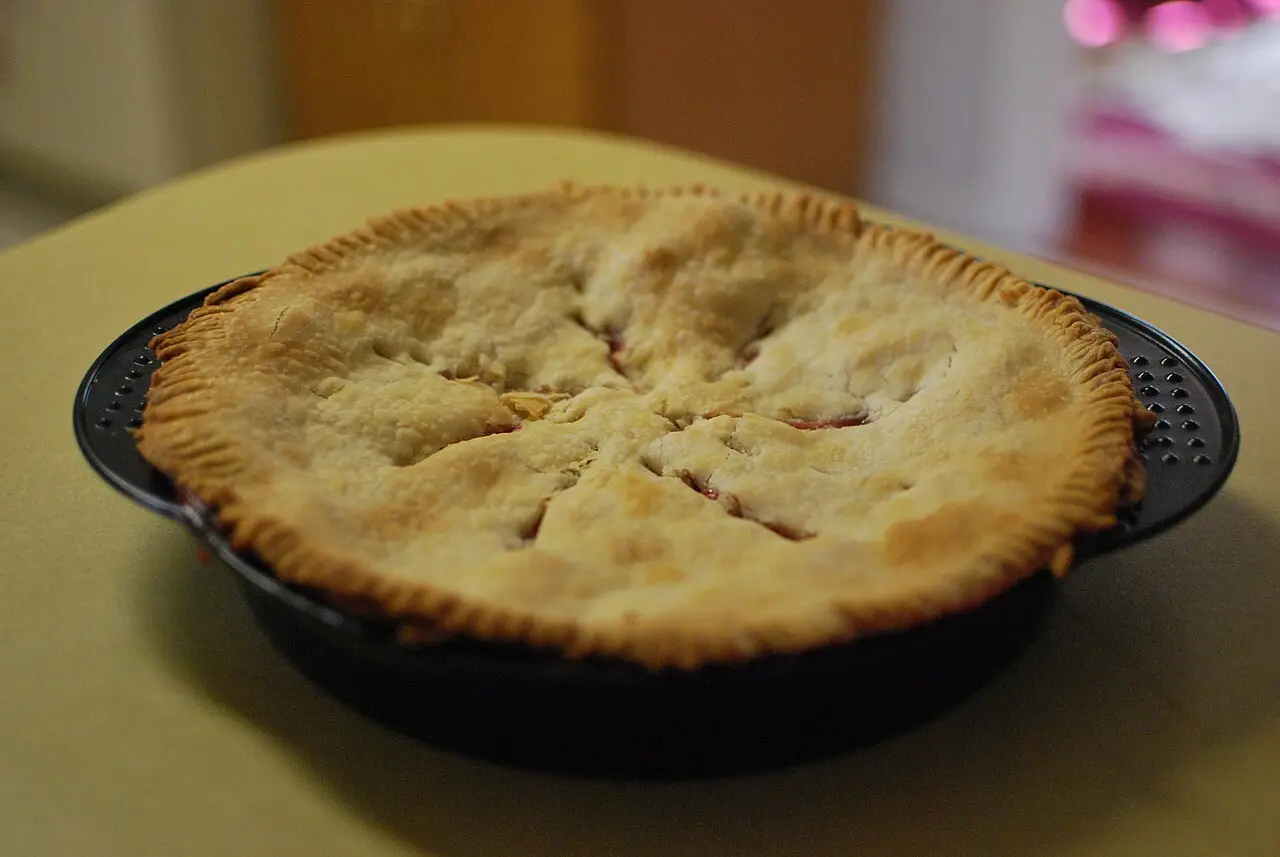
Cranberry-apple pie
A two-crust apple pie in which fresh cranberries take the place of some of the apples.
-
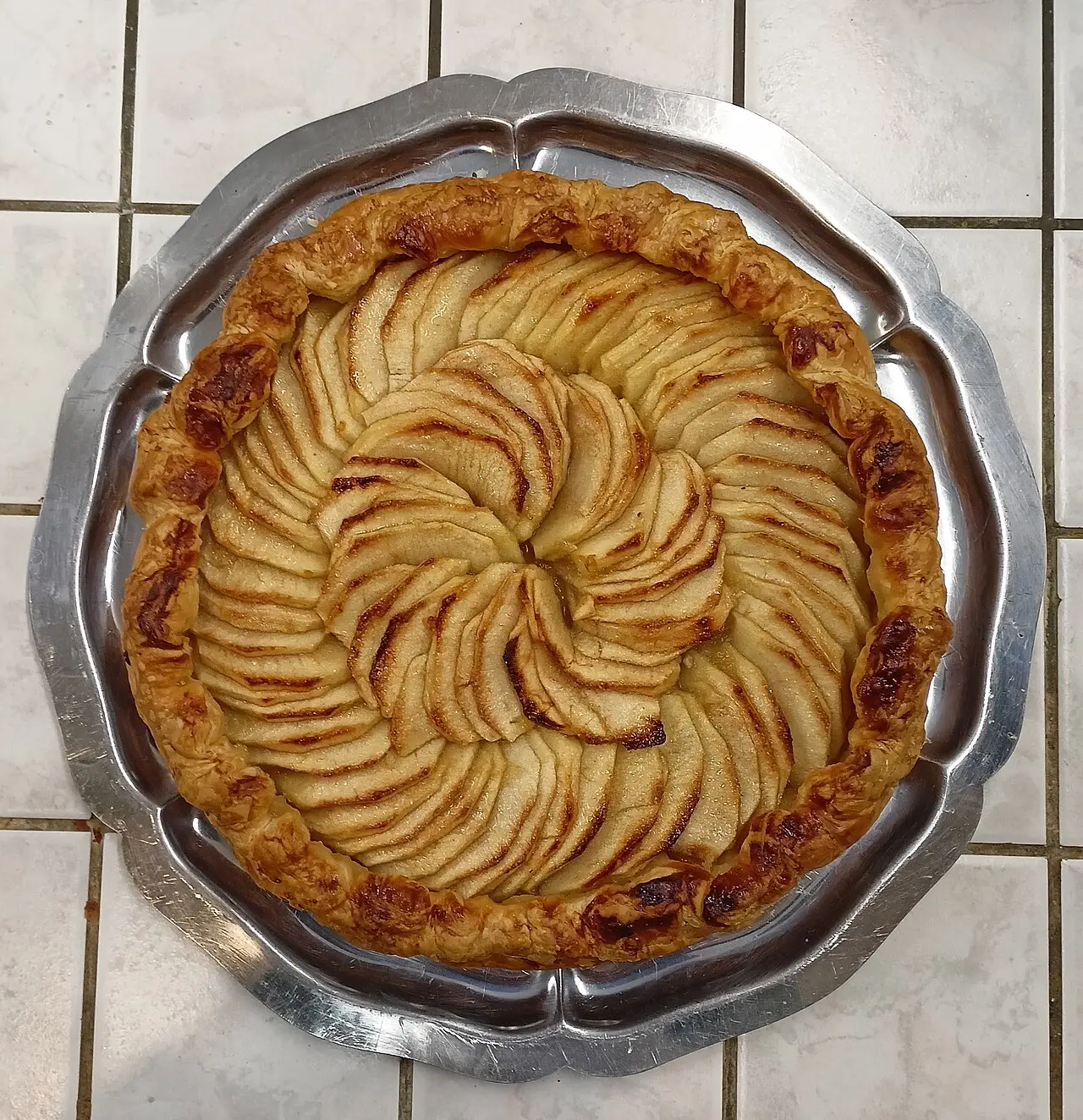
Flan de pommes
A puff pastry case filled with apples cooked in butter and sugar, baked and glazed with apricot jam.
-
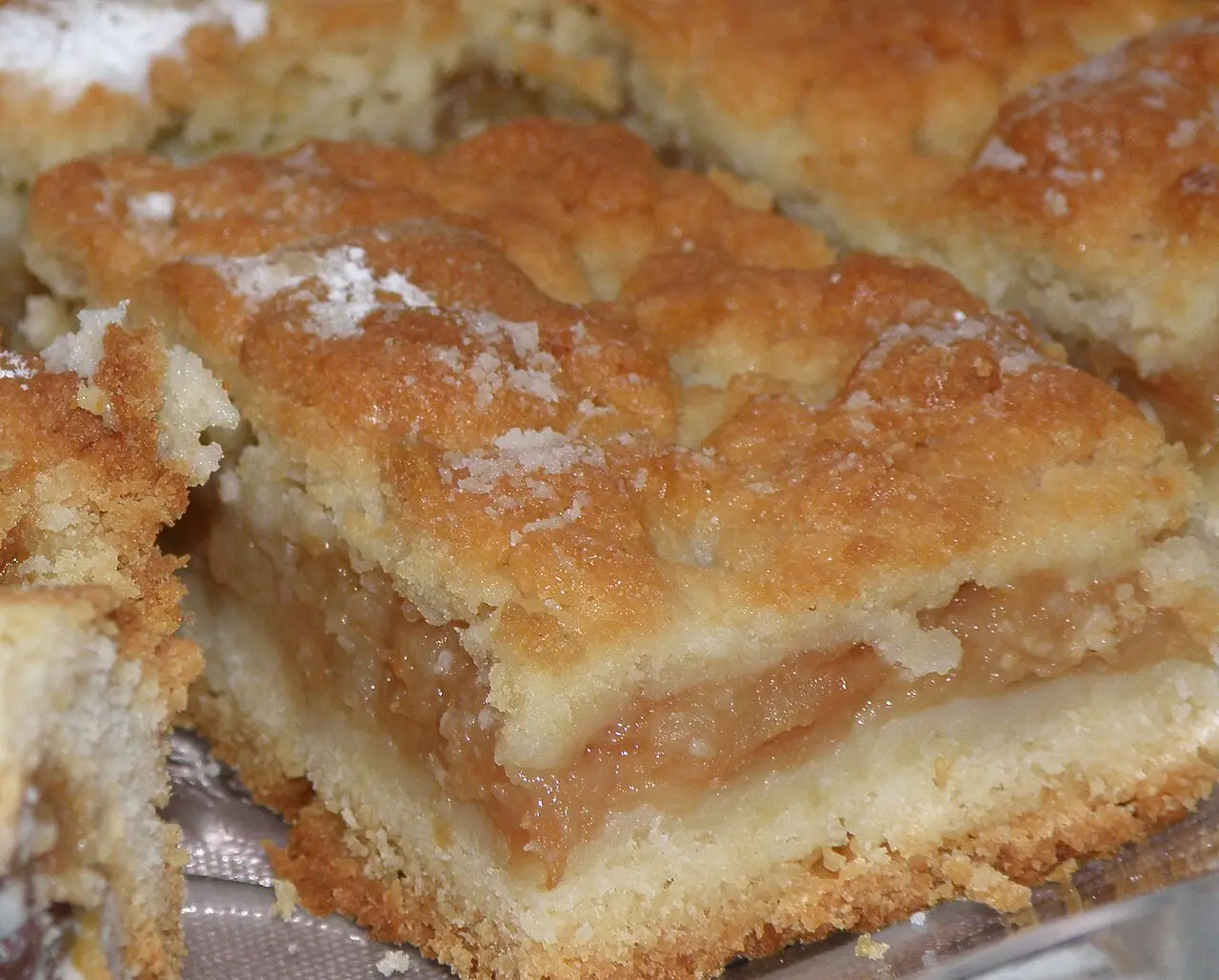
Szarlotka
A shortcrust case baked empty under dry peas, then filled with apples stewed in butter with cinnamon and sultanas.