Applesauce
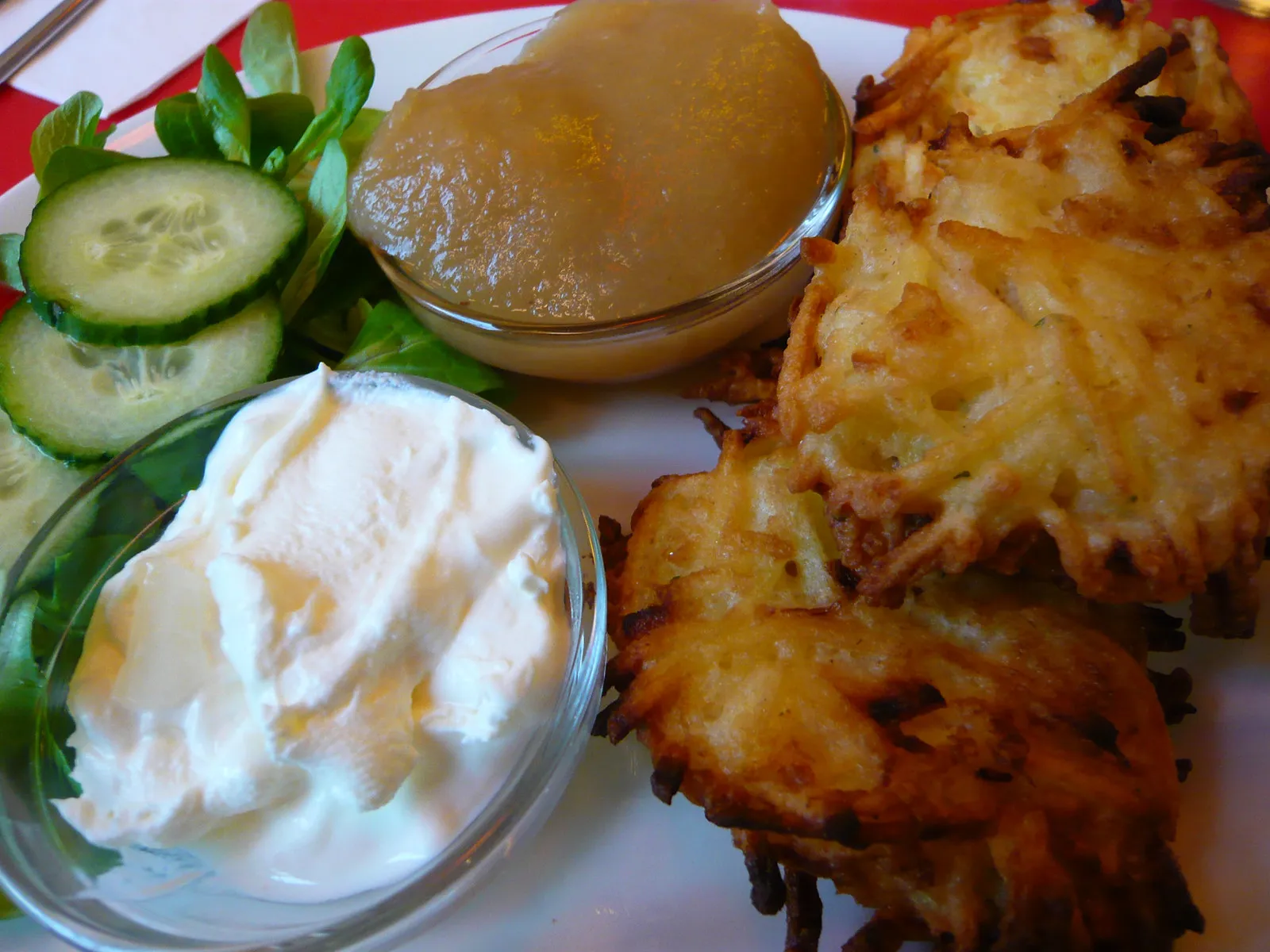
Sweet red apples simmered in their skins with cinnamon, then passed through a food mill: a pink sauce for latkes.
- Makes
- 1 batch, each 480 to 720 ml (2 to 3 cups)
- Cooking time
- 15 minutes, or until the apples are very tender
- Kind
- Sauces and preserves
- From
- United States
- Source
- Homemade Applesauce, Tina Wasserman; ReformJudaism.org, Union for Reform Judaism, 28 July 2014
Allergens
None of the allergens that the law in the UK, the EU or the United States requires to be declared is in the ingredients as written.
Suits vegetarians and vegans.
Worked out from the ingredients as written. Products differ, so read their labels. How allergens are worked out
Adjust the recipe
Scale to what I have
Ingredients
-
sweet and red, such as Fuji or Gala
-
or enough to cover the bottom of the pan
-
or 1/2 tsp ground cinnamon
-
or to taste
Tick what you have: copying then takes only what is left.
You will need
- an apple corer and slicer
- a saucepan of 2.8 litres (3 quarts), with a lid
- a food mill with a medium disc
- a bowl of 1.9 litres (2 quarts), and a second bowl for the cooking liquid
Method
-
For this step: 4 to 6 eating apples
-
For this step: 240 ml (1 cup) water; 1 cinnamon stick
-
For this step: 50 g (¼ cup) sugar
Timers come with you from page to page on this site, and ring while it is open in your browser and this device is not silenced. They cannot ring once the tab is closed or the phone is asleep, so the screen stays on while one runs.
Notes
- No food mill? The source mashes the apples instead: drained in a colander (keep the liquid) and cooled, their flesh is scraped from the skins and mashed with a fork, loosened if need be with a little of the liquid.1
- The source says that a cinnamon stick gives an impression of sweetness even when little or no sugar is added.1
Older ways
-
A bulletin of the United States Department of Agriculture, issued in April 1969, said that apples which "go to pieces" when cooked are usually the best for applesauce, and early summer apples especially, as they are likely to be juicy, tart and quick to cook.5
Today: In early summer, use tart summer apples in place of the sweet red ones, and taste the sauce before deciding how much sugar to stir in.
-
The same bulletin gave a honey applesauce, sweetened with honey instead of granulated sugar.5
Today: Sweeten the sauce with honey, to taste, in place of the sugar.
-
Eliza Leslie's apple sauce of 1840 was of pared, sliced apples stewed with a little water and grated lemon peel, mashed to a paste, made "very sweet with brown sugar" and finished with "a small piece of butter and some nutmeg". Apple sauce, she wrote, "is eaten with roast pork, roast goose and roast ducks".6
Today: Add a little grated lemon zest to the pan with the apples, and stir soft brown sugar, a small knob of butter and a grating of nutmeg into the finished sauce.
The apples
The source asks for four to six sweet red apples, such as Fuji or Gala, cooked in their skins, which it says give the sauce a pink colour and a natural sweetness, so that little or no sugar is needed.1
Varieties the sources name:
Where it is from
This recipe
It follows Homemade Applesauce. The source uses American measures (cups, spoons, pints and pounds); the metric amounts are this site's conversions. This site has no kitchen and has not cooked the recipe.
What was changed: The source allows a cinnamon stick, 2 inches long, or half a teaspoon of the ground spice; we list the stick and give the ground cinnamon in a note (with it, there is no stick to take out). Its sugar is optional, 1/4 cup or to taste. It gives the yield as "Serving Size: 2-3 cups", which we read as the whole batch. Its way of making the sauce without a food mill, from its additional notes, is given as a note. The metric amounts and sizes are our conversions.
How the recipes are chosen and converted
Print or download
- PDF, metric measures, A4 paper
- PDF, US measures, Letter paper
- Recipe data (schema.org JSON-LD), metric measures
- Recipe data (schema.org JSON-LD), US measures
- Cooklang file, metric measures
- Cooklang file, US measures
- Plain text (Markdown), metric measures
- Plain text (Markdown), US measures
The files give the source's quantities. A recipe app can import this page from its address.
You have changed the quantities. Printing keeps them; the files above give the source's quantities.
With your quantities and measures:
About this dish
In Tina Wasserman’s account, applesauce was the first thing spooned over potato latkes: early in the nineteenth century, as potatoes caught on, latkes were eaten at Hanukkah with meat meals in Germany, and afterwards in eastern Europe and Russia.1 The Henry Ford, a museum, tells it the same way: the Jews of eastern Europe took potato recipes from the Jews of Germany, and the potato latke, with applesauce as “its newest consort”, became “the most widespread Hanukkah pancake”.7 Latkes today are topped with applesauce or with sour cream, says My Jewish Learning.2
Two cookbooks printed in the United States tell the cook to serve potato pancakes “with apple sauce”: The International Jewish Cook Book, in its second edition of 1919, and the Milwaukee Settlement Cook Book, in its edition of 1930.3,4 Neither names Hanukkah.3,4
A bulletin of the United States Department of Agriculture, issued in April 1969, cooked six cups of apple pieces in a cup of water for 10 to 15 minutes, mashed them if they had been pared or put them through a food mill or sieve if not, and stirred in a quarter to a third of a cup of sugar.5
Sources
- Homemade Applesauce, Tina Wasserman; ReformJudaism.org, Union for Reform Judaism, 28 July 2014. Supports: the recipe followed: its ingredients and quantities, method, time and yield, and its way without a food mill; Fuji, Gala or other sweet red apples, cooked in their peel for colour and sweetness; the cinnamon stick and sweetness; applesauce as the first topping for potato latkes, served at Hanukkah with meat meals in the early 1800s, first in Germany and later in eastern Europe and Russia; Tina Wasserman as food editor of ReformJudaism.org.
- Recipes for Hanukkah, My Jewish Learning, last modified 27 November 2023. Supports: potato pancakes (latkes) topped with applesauce or sour cream.
- The International Jewish Cook Book (second edition), Florence Kreisler Greenbaum; Project Gutenberg, 1919. Supports: potato pancakes, with the words "Serve with apple sauce"; no mention of Hanukkah anywhere in the text.
- The Settlement Cook Book (eighteenth edition, enlarged and revised), Mrs. Simon Kander, compiler; The Settlement Cook Book Co., Milwaukee; Internet Archive, March 1930. Supports: the potato pancake on page 85, which ends "Serve with apple sauce"; no mention of Hanukkah in the text.
- Apples in Appealing Ways (Home and Garden Bulletin No. 161), Human Nutrition Research Division, Agricultural Research Service, United States Department of Agriculture; Project Gutenberg, April 1969. Supports: apples for applesauce (page 3); the recipe "Applesauce" and its honey variation (pages 12 and 13): six cups of apple pieces cooked in a cup of water for 10 to 15 minutes, mashed or put through a food mill or sieve, and a quarter to a third of a cup of sugar. A work of the United States government.
- Directions for Cookery, in its Various Branches (tenth edition), Eliza Leslie; Project Gutenberg, 1840. Supports: the recipe "Apple Sauce" of 1840 and the meats it is eaten with.
- A Rare Intersection of Holidays, Saige Jedele; The Henry Ford, 25 November 2013. Supports: eastern European Jews taking potato recipes from the Jews of Germany, and the potato latke, with applesauce as "its newest consort", becoming "the most widespread Hanukkah pancake".
From The World of Apples, apple.io/recipes/applesauce/
In these collections
More of this kind
-
Cranberry-apple relish
Raw cranberries, unpeeled tart apples and an unpeeled orange, chopped fine and sweetened.
-
Fresh apple chutney
Thin strips of raw apple with onion, green chilli, parsley and green ginger, dressed with vinegar and oil.
-
Apple sauce for goose and pork
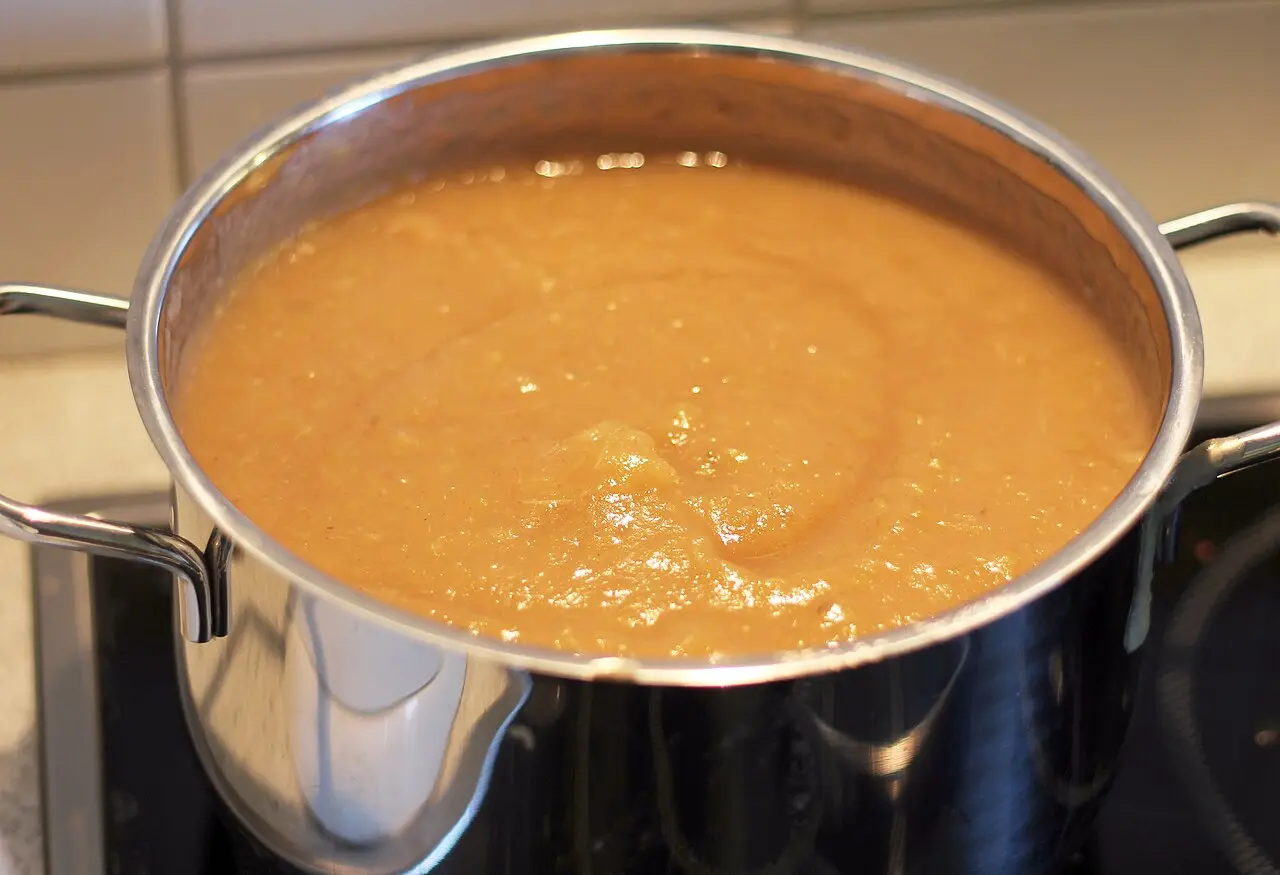
Apples boiled soft in a little water and beaten to a pulp with sugar and a small piece of butter.
-
Mincemeat
Suet, raisins, currants, sugar and candied peel mixed with boiled lemons, baked apples and brandy.