M.9
The world's most widely planted dwarfing rootstock, from a stock found near Metz by 1828 and numbered at East Malling
History
Apples do not come true from seed, so varieties are grafted onto rootstocks, which largely set a tree’s size, how soon and how well it crops, and how it copes with soils, pests, diseases and cold1. M.9 is the most widely planted dwarfing apple rootstock in the world2.
It descends from a “Paradise”, a dwarfing stock propagated from layers rather than seed1,3. In 1879 the Revue Horticole announced a new one, the Paradis jaune (“yellow Paradise”), which a nursery near Metz had long preferred to the ordinary Paradise because it was more robust and could be grafted almost all year3. A Metz nurseryman, Dieudonné, explained that in 1828 his family had bought a vineyard at Montigny with two seedling apple trees that suckered freely and did not “burn” like the old Paradise, and multiplied them as stocks3.
In November 1912 the fruit station at East Malling, Kent, began collecting the Paradise stocks of British and continental nurseries, whose names were often wrong4. Begun by the director, R. Wellington, and continued by R. G. Hatton from 1914, the work sorted 71 collections into nine recurring types4. Type IX was the Paradis Jaune de Metz, much used in France and Germany but only recently brought into England; Hatton found it healthier than the French Paradise and perhaps “a useful dwarfing type”4. In East Malling’s first rootstock trial, planted in 1919, trees on it were very small1. Type IX became EM IX and M IX, and from the 1970s M.9; virus-free stock, heat-treated between the 1950s and the 1970s, is called M.9 EMLA1.
An American study of 1939 saw no commercial future for M.9 except for special purposes, yet by the early 1980s it had been important in Europe for over forty years1. Dwarfing stocks took hold in North America only in the mid-1990s, after a multi-site NC-140 trial showed intensive orchards on them to be more profitable1; in 2019 the Extension Foundation reckoned that at least 30 per cent of apple trees in the United States were on M.92. European nurseries have selected many clones of it, which differ in vigour; NAKB T337 is the most widely planted1,2. The clones Lancep and Cepiland are sold under the trade marks Pajam 1 and Pajam 29,10.
Growing
Trees on M.9 reach about 45–50 per cent of the size of a standard tree, start to bear very early and crop heavily for their size2. Its roots are brittle and its anchorage poor, so the trees need full support1,2. It is very susceptible to fire blight and woolly aphid2,6 and forms many burr knots, but is fairly resistant to crown and root rots1,2. Results vary with the site: in an NC-140 planting of 1980–81 at 27 sites in the United States and Canada, ten-year losses of trees on M.9 were 20 per cent or less at 14 sites but half or more at 45. M.9 is diploid8.
The fruit
Grown as a tree, M.9 bears fruit of its own: at the National Fruit Collection it is small and strongly ribbed, about 60 mm wide and 50 mm high, whitish yellow with a solid pink flush7.
Where the sources disagree
- Origin. The Extension Foundation says M.9 was selected in England in the late 1800s from French stocks called Jaune de Metz2; Hatton, in 1917, calls the Jaune de Metz a recent arrival in England4, and NIAB’s table gives East Malling as M.9’s origin6.
- Winter hardiness. The Extension Foundation rates it hardy2; NIAB lists it as susceptible to winter cold6, and Marini and Fazio count poor winter hardiness among its weaknesses1.
Family tree
Offspring in the atlas
- M.26 × M.16; United Kingdom, 1929
Sources
- Apple Rootstocks: History, Physiology, Management, and Breeding, Richard P. Marini and Gennaro Fazio, Horticultural Reviews 45: 197–312 (Wiley, doi:10.1002/9781119521082.ch6); full text at AppleView Global, 2018. Supports: apples not coming true from seed and their cuttings hard to root, so genotypes are kept by grafting or budding onto rootstocks; rootstock effects on precocity, flowering and cropping of young trees, tree size, performance in different soils and tolerance of biotic and abiotic stresses; clonal stocks propagated by layers called Paradise; the first East Malling rootstock trial, planted in 1919 with Lane's Prince Albert on 16 clonal rootstocks, trees on EM IX very small; Type IX renamed EM IX, M IX and M.9, Arabic numerals replacing Roman in the 1970s; Malling stocks heat-treated from the 1950s to the 1970s to remove known viruses, the virus-free M.9 designated M.9 EMLA; Sudds (1939) finding that M.9 "had no commercial potential except for certain special purposes"; M.9 an important rootstock in Europe for more than 40 years by the early 1980s and the most popular there, but lacking winter hardiness, difficult to propagate and needing support; clones of M.9 selected by European nurserymen and researchers; dwarfing rootstocks important in North America only from the mid-1990s, after the multi-location NC-140 trial showed the vertical axis system on dwarf rootstocks more profitable than the central leader on semi-dwarf rootstocks; poor anchorage of dwarfing rootstocks from asymmetric or brittle roots; Phytophthora species causing apple root and crown rots, and M.9 among the rootstocks resistant to P. cactorum (Browne and Mircetich 1993).
- Apple Rootstock Info: M.9, Extension Foundation (Cooperative Extension), apples.extension.org, 2019-08-22. Supports: pedigree unknown, "selected in England from a group of French genotypes known collectively as 'Juane de Metz' in the late 1800s"; "the most widely planted dwarf apple rootstock in the world" and "at least 30% of the trees in the U.S. are on M.9"; M.9 EMLA free of known viruses and slightly more vigorous than the original; clones selected by European nurseries varying in vigour; NAKBT337 the most widely planted clone; very precocious with high yield efficiency; poor anchorage from brittle roots and a high fruit-to-wood ratio, needing full tree support; very susceptible to fire blight and woolly apple aphid, fairly resistant to crown and root rots; many burr knots; trees 45–50% of standard; winter hardiness "Hardy"; the synonyms Malling 9, Malling IX and EM IX.
- Un nouveau sujet pour greffer les pommiers: le Paradis jaune (in French), pp. 436–437, E.-A. Carrière, Revue Horticole 1879; Internet Archive, 1879. Supports: the Paradise used almost only for dwarf trees and cordons, and raised, like the doucin, vegetatively rather than from seed; the "Paradis jaune", which in the Simon-Louis nurseries at Plantières-les-Metz had long completely replaced the ordinary Paradise, being more robust and growing almost continuously, so that it can be grafted almost all year; the account of M. Dieudonné, nurseryman at Metz and son of the man who first propagated it: in 1828 the family bought a vineyard at Montigny containing two seedling apple trees, which suckered freely and did not "burn" like the old Paradise, and multiplied them to replace it.
- Paradise Apple Stocks: being the first report of the work in progress at the Wye College Fruit Experiment Station, East Malling, pp. 361–399 (Type IX, pp. 372 and 396–397), R. G. Hatton, Journal of the Royal Horticultural Society, vol. 42; Internet Archive, 1917. Supports: the investigations begun in November 1912, initiated by the director, R. Wellington, and continued by Hatton after Wellington joined the forces in August 1914; samples from nurseries in Britain, Holland, France and Germany, 71 collections from 35 sources; the same trade name often given to very different stocks; nine recurring types described; the Paradis Jaune de Metz "only recently been introduced into England" and "coming into popularity" (p. 372); Type IX, the Jaune de Metz, not in common use in English nurseries but frequently used in France and Germany, at first more dwarfing than the French Paradise, "much healthier than the French", and possibly "a useful dwarfing type" (p. 396); the Broad-leaved English, the Nonsuch and the Jaune de Metz Paradise "merely chance seedlings selected as stocks", the origin of the Jaune de Metz given in the Revue Horticole, 1879, p. 437 (p. 397).
- Performance of 'Starkspur Supreme Delicious' on 9 Rootstocks at 27 Sites Over 10 Years, NC-140 Technical Committee, Fruit Varieties Journal 45(4): 200–208; Journal of the American Pomological Society archive, 1991. Supports: a spur-type Delicious on 9 rootstocks planted in 1980–81 at 27 sites in the United States and Canada; over ten years, 14 sites lost 20% or fewer of their trees on M.9 and 4 sites lost 50% or more; at all sites, trees on M.9 could be handled from the ground.
- Susceptibility of some apple rootstocks to pest and diseases, Niab (East Malling), Apple Best Practice Guide. Supports: M9: origin HRI-East Malling; dwarf; susceptible to fireblight and to woolly aphid; susceptible to winter cold, poor drainage and drought.
- M 9 (accession 1999-049), National Fruit Collection, Brogdale, Kent (Defra). Supports: a rootstock apple, Malus domestica, accession name M9; its fruit small, broad globose conical, 49.83 mm high and 59.80 mm wide, very strongly ribbed, whitish yellow with a solid pink flush and very little russet.
- Using whole-genome SNP data to reconstruct a large multi-generation pedigree in apple germplasm, H. Muranty and others, BMC Plant Biology 20: 2, 2020. Supports: M 9 (MUNQ 638) diploid (2n) (Additional file 1, Table S1).
- PAJAM 1 Lancep c.o.v. (in French), CEP Innovation (Novadi), catalogue of varieties and rootstocks. Supports: PAJAM 1, marked as a registered trade mark, for the protected rootstock Lancep; breeder CTIFL, editor CEP; origin "type M9, sélection de Paradis jaune de Metz".
- PAJAM 2 Cepiland (in French), CEP Innovation (Novadi), catalogue of varieties and rootstocks. Supports: PAJAM 2, marked as a registered trade mark, for the rootstock Cepiland; breeder CTIFL, editor CEP; origin "type M9, sélection de Paradis jaune de Metz".
More from France
-
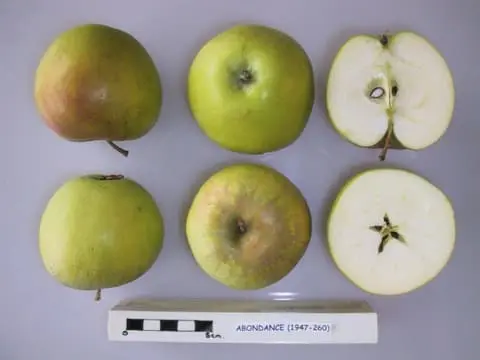
Abondance
-
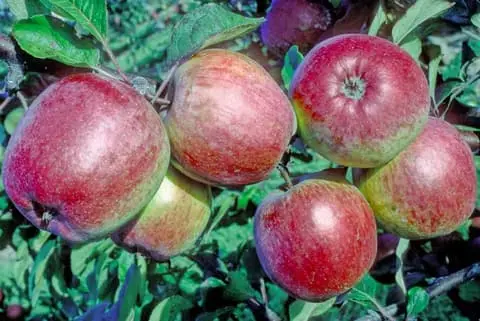
Alfred Jolibois
-
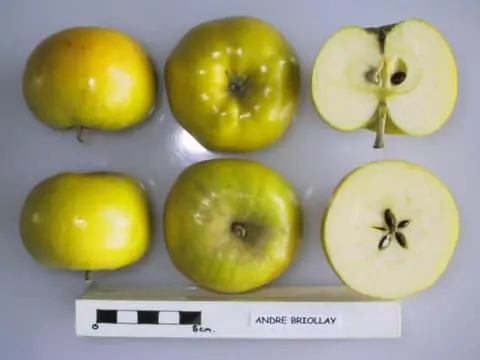
Andre Briollay
-
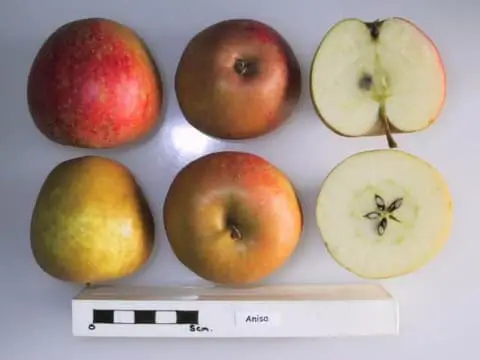
Anisa
-
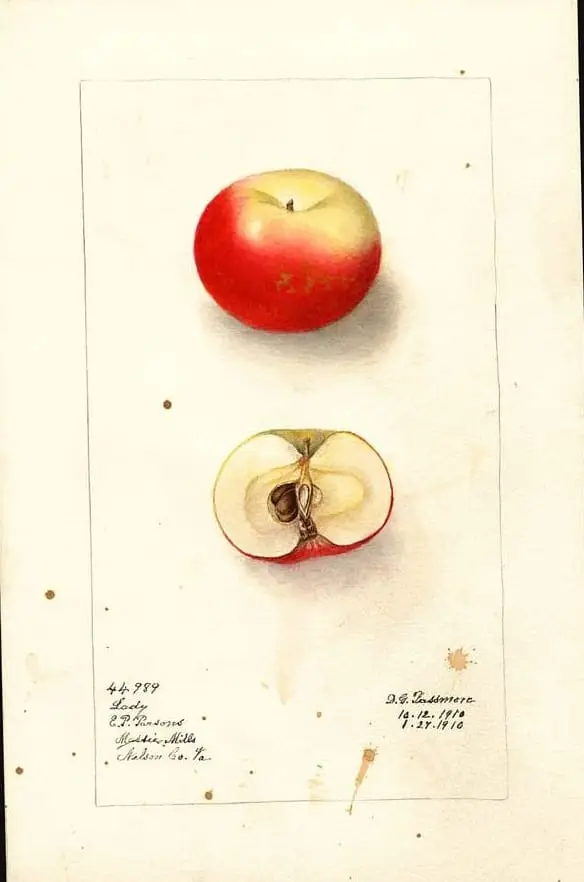
Api
A tiny, glossy, red-cheeked apple recorded in 1628 and said to have been found wild in a forest in Brittany
-
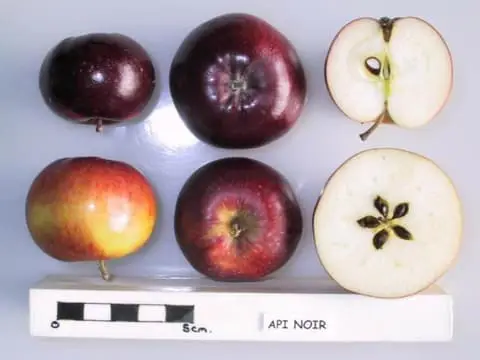
Api Noir
-
Barre
-
Bassard