Apple varieties, United Kingdom
M.26
A rootstock raised at East Malling in 1929 from M.16 and M.9; more vigorous than M.9 and a standard in rootstock trials
History
M.26 was raised at the East Malling Research Station in Kent from a cross of M.16 and M.9 made in 19291. Like M.9 and MM.106, it is an East Malling rootstock, on which other varieties are grafted1,2. In a joint effort to produce virus-free rootstocks, the East Malling and Long Ashton stations later used heat treatment against known viruses and released M.26 EMLA, and a similar programme in the Netherlands released M.26 NAKB1. Virus-free stocks are generally slightly more vigorous than the originals; in the NC-140 trial of 2002, at nine sites with Gala as the variety, trees on M.26 NAKB were slightly more vigorous than those on M.26 EMLA at most sites, and cropped about as well1.
M.26 is grown widely around the world and serves as a standard in many rootstock trials1. In Michigan’s fruit inventory for 2022, 1.2 million of the state’s 17.6 million apple trees stood on M.26, against 4.6 million on M.9 and 1.27 million on MM.106; the rootstock of 2.5 million was unknown4.
Growing
M.26 has traditionally been counted as a dwarfing rootstock, but eXtension calls it one of the more vigorous ones, giving trees 55–60 per cent of standard size1. NIAB classes it as semi-dwarfing, between the dwarfing M.9 and the semi-vigorous MM.1062. Trees on it bear very early and crop heavily, but they need support1. It sends up few suckers but forms many burr knots1. It is winter hardy, whereas NIAB rates M.9 as susceptible to winter cold, and its drought tolerance is average1,2. It is susceptible to crown and collar rot caused by Phytophthora and to fire blight1,2,3, and also to woolly aphid2.
The fruit
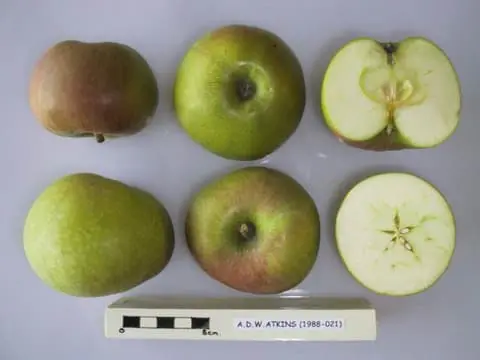
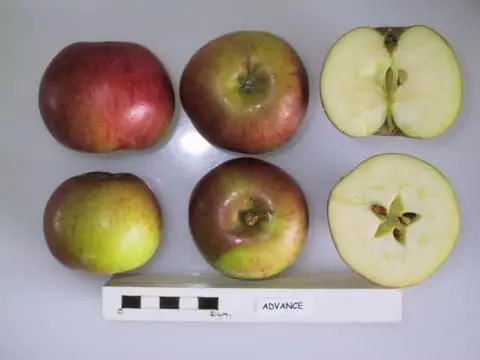
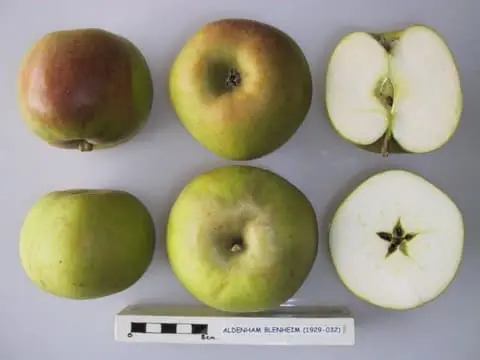
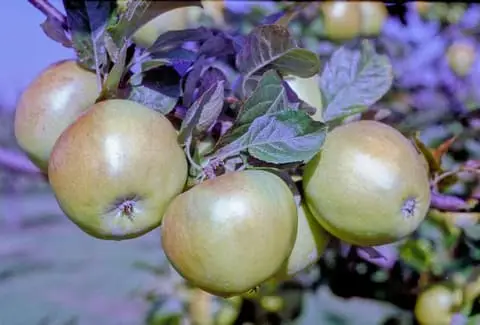
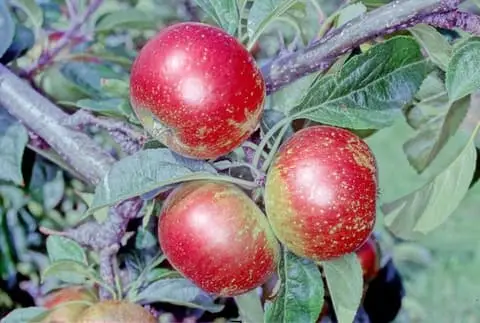
Left to fruit, M.26 bears small, flat, strongly ribbed apples, about 57 mm wide and 44 mm high, whitish yellow with a mottled orange flush, little russet and dry flesh5.
Where the sources disagree
Family tree
Parents, grandparents and great-grandparents, as the entries in the atlas record them.
- M.26 United Kingdom, 1929
- Parent M.16
- Parent M.9 France, by 1828
Sources
- Apple Rootstock Info: M.26, eXtension Apples, a national Cooperative Extension resource, 2019-08-22. Supports: from a cross of M.16 and M.9 made in 1929 at the East Malling Research Station, Maidstone, Kent (given also as "M-9 X M-16"); the synonym Malling 26; traditionally considered dwarfing but one of the more vigorous dwarfing rootstocks; grown widely throughout the world and a "standard" in many rootstock trials; precocious and very productive; many burr knots; susceptible to crown rot and fire blight; M.26 EMLA released after heat treatment against known viruses by the East Malling and Long Ashton stations, and M.26 NAKB by a similar programme in the Netherlands, virus-free stocks being in general slightly more vigorous; in the 2002 NC-140 trial at nine locations with Gala, trees on M.26 NAKB slightly more vigorous than on M.26 EMLA at most locations, with similar productivity; tree size 55–60% of standard; precocity very early; winter hardy; little suckering; tree support needed.
- Susceptibility of some apple rootstocks to pest and diseases, NIAB, Apple Best Practice Guide. Supports: M.26 from HRI-East Malling, semi-dwarf, susceptible to Phytophthora, fire blight and woolly aphid, winter hardy, with average drought tolerance; M9 from East Malling, dwarf and susceptible to winter cold; MM.106 from East Malling, semi-vigorous.
- Apple Cultivar Performance (HortFact-3006), Table 4: rootstocks, Joe Masabni and Dwight Wolfe, University of Kentucky Cooperative Extension, Horticulture Department, 2007-04. Supports: M.26 "A dwarfing rootstock that produces a tree about 45% of Standard tree size. Very susceptible to fireblight and collar rot"; M.9 about 35% of standard.
- Michigan Fruit Inventory 2022: Apples, USDA National Agricultural Statistics Service, 2024. Supports: acres and trees by rootstock in Michigan, 2022: 26, 1,200,000 trees; 9 (IX), 4,600,000 trees; 106, 1,270,000 trees; unknown, 2,500,000 trees; all apples, 17,600,000 trees.
- M 26 (accession 1999 - 047), National Fruit Collection, Brogdale, Kent (Defra). Supports: a rootstock apple, accession name M26; fruit small and flat, 44.04 mm high and 56.71 mm wide, strongly ribbed; ground colour whitish yellow, over-colour orange, mottled; russet low; flesh dry.