Apple varieties, United Kingdom
MM.106
A Malling-Merton rootstock bred from Northern Spy against woolly aphid, sent out by East Malling and John Innes in 1951
History
A rootstock is the root system on which an apple variety is grafted or budded. Grafting keeps the variety true to name, while the rootstock decides the size of the tree, and so how closely trees can be planted, and influences how soon and how heavily it crops and how it copes with soils, pests and diseases1,2. MM.106 belongs to the Malling-Merton series, bred jointly by the East Malling Research Station in Kent and the John Innes Horticultural Institution at Merton, in south London3,1. The work, begun by M. B. Crane at Merton and H. M. Tydeman at East Malling, sought resistance to woolly apple aphid, a common pest in North America and especially New Zealand1. Malling stocks were crossed with Northern Spy, an apple that resists the aphid; of some 3,500 seedlings, 15 were kept and numbered Malling-Merton 101 to 1151. In the autumn of 1951 the series was sent to research stations throughout the Commonwealth and the United States3.
MM.106 comes from a cross of Northern Spy and M.11, dated to 19324,5, and SNP data confirm Northern Spy as one parent4. It has been planted widely in North America since the 1960s5; with M.7 and MM.111 it carried the free-standing trees that growers there preferred until dwarfing stocks took hold in the mid-1990s1, and by 2019 commercial growers were turning away from it to smaller trees with fewer disease problems5. It is widely grown in the UK6.
Growing
Trees on MM.106 are about 60 per cent of the size of trees on seedling roots, and early and heavy in cropping5. In a trial of 18 vigorous rootstocks planted in Washington in 1986, it was among the most precocious and, over nine seasons, among those giving the most fruit for the size of the trunk2. It resists woolly aphid, apparently through a single gene from Northern Spy1,6. The resistance does not pass to the variety grafted on it, and it matters most where the aphid attacks roots, as in Australia, South Africa and North America, and little in the UK, where it does not6.
It is highly susceptible to the crown and root rots caused by Phytophthora: although it tolerates waterlogging fairly well, trees on it often die on wet soils, and it should not be planted on wet sites1,5,7. It is also susceptible to fire blight, and when Delicious and some other varieties are grafted on it, tomato ringspot virus causes “brown line necrosis”, after which the trees decline and die1,5,7. It is diploid4.
The fruit
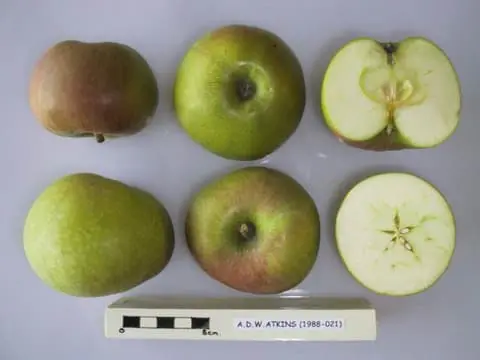
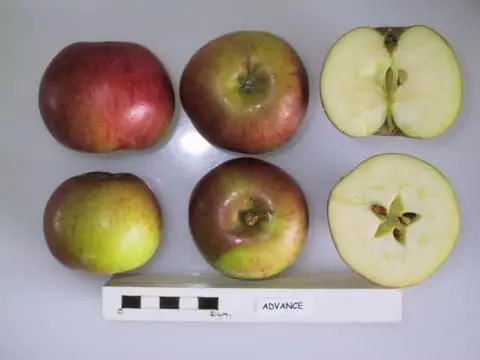
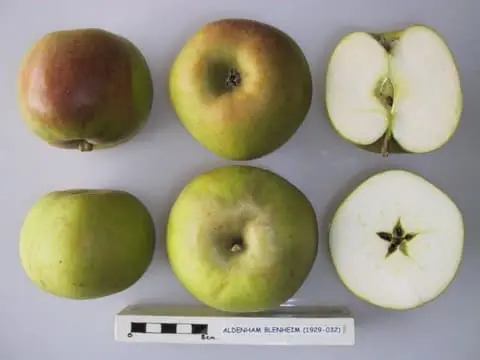
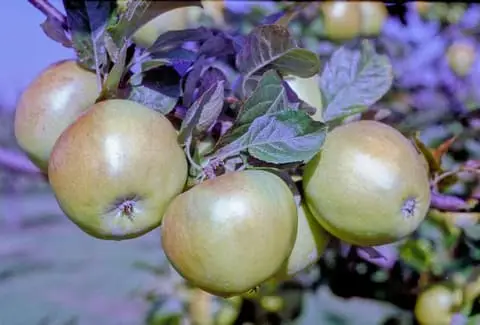
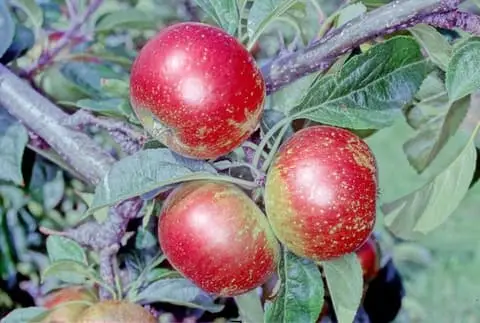
Grown as a tree at the National Fruit Collection, MM.106 bears medium-sized, rounded fruit about 64 mm wide and 55 mm high, whitish yellow with a washed-out brownish flush, its flesh coarse and dry8.
Where the sources disagree
- Parents. Marini and Fazio, and the pedigree records used in the 2020 DNA study, give Northern Spy × M.11,4; the Extension Foundation’s note gives M.2 × Northern Spy in its description and Northern Spy × M.1 in its table5.
- Vigour. NIAB calls MM.106 semi-dwarfing on one page and semi-vigorous in its table of rootstocks6,7. The Extension Foundation puts trees on it at about 60 per cent of seedling size in one place and 70–75 per cent of standard in another, and says both that it usually needs no support and that it does5.
- The series. The John Innes Centre numbers it MM101 to MM1143; Marini and Fazio, MM.101 to MM.1151.
Family tree
Parents, grandparents and great-grandparents, as the entries in the atlas record them.
- MM.106 United Kingdom, 1932
- Parent Northern Spy United States, about 1800
- Parent M.1
Sources
- Apple Rootstocks: History, Physiology, Management, and Breeding, Richard P. Marini and Gennaro Fazio, Horticultural Reviews 45: 197–312 (Wiley, doi:10.1002/9781119521082.ch6); full text at AppleView Global, 2018. Supports: apples kept true to type by grafting or budding onto rootstocks, which affect precocity, cropping, tree size, performance in different soils and tolerance of stresses; the joint breeding programme begun by M. B. Crane of the John Innes Horticultural Institute at Merton and H. M. Tydeman at East Malling, for resistance to woolly apple aphid, a common problem in North America and especially New Zealand; East Malling clones crossed with the resistant Northern Spy; 15 of the resulting 3,500 seedlings selected and numbered Malling-Merton 101–115, later MM.101–115; MM.106 (Northern Spy × M.1), its Northern Spy resistance apparently monogenic (the Er1 locus); North American growers' preference, until dwarfing stocks took hold in the mid-1990s, for free-standing trees on seedling stocks or the semi-dwarf M.7, MM.106 and MM.111; Phytophthora species causing apple root and crown rots, more severe in waterlogged soils, and MM.106 highly susceptible to P. cactorum (Browne and Mircetich 1993); MM.106 tolerating wet soils fairly well but with high tree mortality on them because it is quite susceptible to Phytophthora; tomato ringspot virus causing "brown line necrosis" when Delicious and some other cultivars are budded on MM.106, the trees declining in vigour and dying.
- Performance of Three Apple Cultivars with 18 Vigorous Rootstocks During Nine Seasons in Washington, Bruce H. Barritt, Bonnie S. Konishi and Marc A. Dilley, Fruit Varieties Journal 50(2): 88–98; Journal of the American Pomological Society archive, 1996. Supports: rootstocks "determine the size of the tree and, therefore, tree density" and influence precocity and yield for the life of the orchard; a trial planted in May 1986 at the Tree Fruit Research and Extension Center, Wenatchee, Washington, of Golden Delicious, Granny Smith and Delicious on 18 vigorous rootstocks; "The most precocious rootstocks were B.118, MM.106 EMLA and MM.106"; cumulative yield efficiency after nine seasons greatest for M.7A, MM.106, E13, MM.106 EMLA and M.7 EMLA.
- The history of plant science and microbial science at the John Innes Centre, John Innes Centre. Supports: the John Innes Horticultural Institution founded in 1910 at Merton in south London; "In the autumn of 1951" a series of woolly aphid-resistant apple rootstocks "raised jointly by John Innes and East Malling Research Station, Kent" sent to research stations all over the Commonwealth and the United States; the Malling-Merton series (MM101-114), produced by crossing Malling and Merton rootstocks with Northern Spy.
- Using whole-genome SNP data to reconstruct a large multi-generation pedigree in apple germplasm, H. Muranty and others, BMC Plant Biology 20: 2, 2020. Supports: MM 106 (MUNQ 16) diploid (2n) and dated 1932 (Additional file 1, Table S1); Northern Spy found from SNP data to be a parent of MM 106, whose parents in the literature are Northern Spy and M1 (English broadleaf) (Additional file 6, Table S6).
- Apple Rootstock Info: MM.106 EMLA, Extension Foundation (Cooperative Extension), apples.extension.org, 2019-08-22. Supports: "Selected in 1932 from a cross of M.2 x 'Northern Spy' by the John Innes Horticultural Institute and the East Malling Research Station", the origin given in its table as "Northern Spy X Malling 1"; a semi-dwarf rootstock producing a tree "about 60% the size of seedling", and "70-75% of standard" in its table; quite precocious and productive; "usually does not need tree support", but "Tree Support Needed: Yes" in its table; resistant to woolly apple aphid; highly susceptible to crown and root rots and not to be planted on wet sites; susceptible to fire blight; hypersensitive to tomato ringspot virus, which causes "brown line necrosis" with Delicious and some other cultivars; grown widely throughout North America since the 1960s, its use declining among commercial growers who want smaller trees with fewer disease problems.
- Varietal susceptibility (Woolly aphid), Niab (East Malling), Apple Best Practice Guide. Supports: the Malling-Merton rootstocks bred from crosses between Northern Spy, highly resistant to woolly aphid, and Malling rootstocks, and themselves highly resistant; "the rootstock does not confer resistance to the scion"; "MM106 is a semi-dwarfing woolly aphid resistant rootstock which is widely grown in the UK"; the resistance very valuable where root infestation occurs (Australia, South Africa and North America) but of limited benefit in the UK, where it does not.
- Susceptibility of some apple rootstocks to pest and diseases, Niab (East Malling), Apple Best Practice Guide. Supports: MM.106: origin HRI-East Malling; semi-vigorous; susceptible to Phytophthora and fireblight; resistant to woolly aphid; average cold tolerance; susceptible to tomato ring spot virus.
- MM 106 (accession 1999-050), National Fruit Collection, Brogdale, Kent (Defra). Supports: a rootstock apple, Malus domestica, accession name MM106; its fruit medium, globose, 55.08 mm high and 63.55 mm wide, weakly ribbed, whitish yellow with a washed-out brown flush, little russet, the flesh coarse and dry.