Geneva
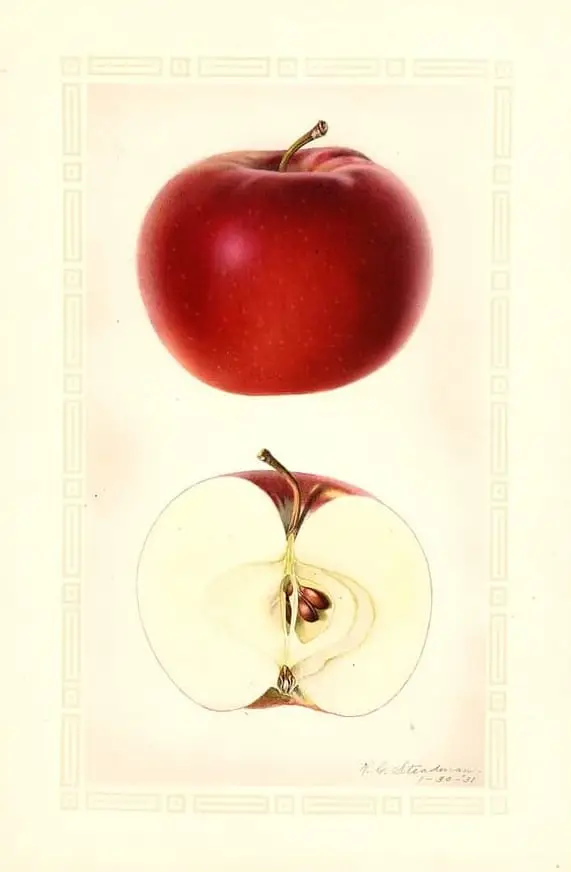
A crab raised at Ottawa from a 1920 seedling of a red-fleshed wild apple; a standard host for testing apple scab races
History
Geneva is an open-pollinated seedling of Malus pumila var. niedzwetzkyana1. It originated in 1920 and was introduced by the Central Experimental Farm in Ottawa, which Leslie also gives as its source; Isabella Preston selected it and named it in 19301,2. Jefferson marks it as not raised from a controlled pollination, which in his catalogue means its parentage is doubtful1.
Its seed parent belongs to a wild apple with reddish-purple skin, flesh, flowers and young leaves, which Hansen met in the wild fruit forest of Turkestan in 1897, and which was named after the Russian botanist Niedzwetzky. Wang and colleagues treat the wild red apple as a form of Malus sieversii, and cite a 2012 study of 3,000 red-fleshed apples which inferred that all of them descend from it3.
In 1946 W. R. Leslie, superintendent of the Dominion Experimental Station at Morden, Manitoba, listed Geneva among the crab apples grown in prairie orchards, as a sister of Scugog, another Ottawa seedling of the same wild apple2.
The fruit
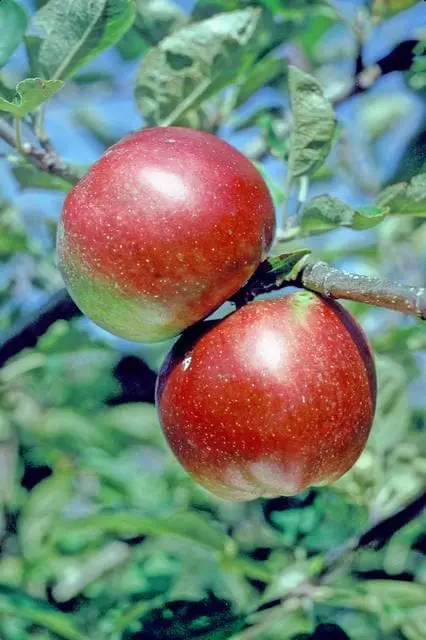
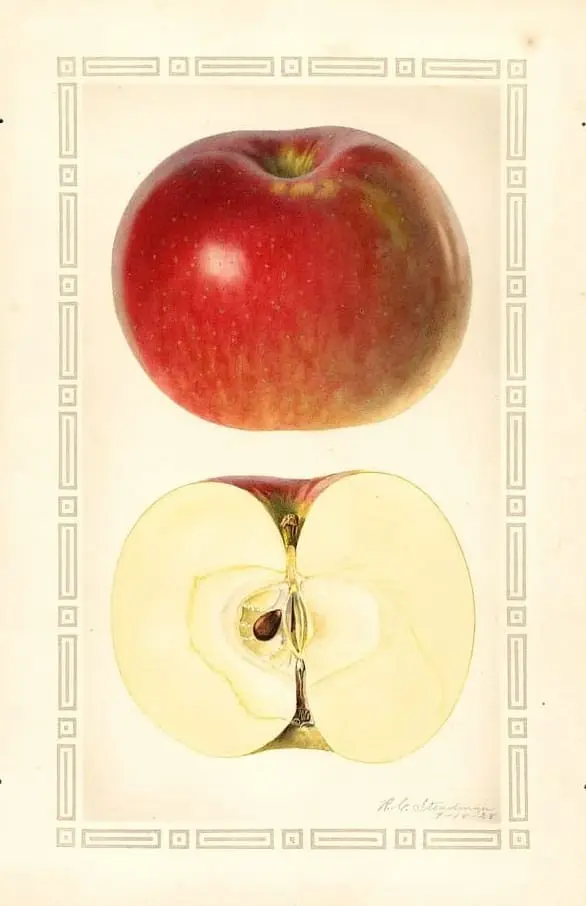
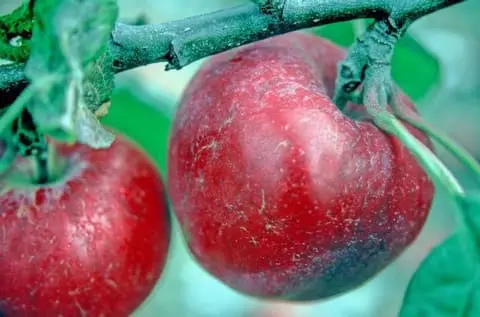
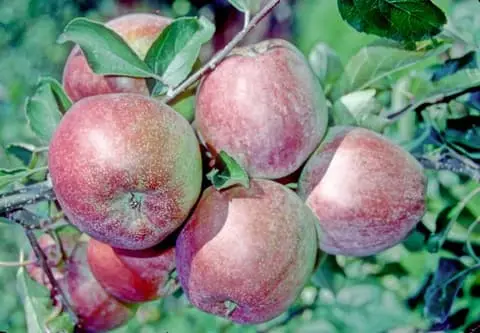
Leslie gave the fruit as “2½ by 2 inches” (about 64 by 51 mm), “carmine and oxblood red”, large and useful for jelly, in season in early September2; Jefferson gives it as red and about 5 cm across1. Wang and colleagues class Geneva as a type 1 red-fleshed apple, red in the flesh, skin, leaves and other tissues3. In such apples six repeats of a short DNA motif in the regulatory region of the MdMYB10 gene promote the making of the red pigments, the anthocyanins; the trait is inherited by Mendel’s rules, and red young leaves let breeders pick out red-fleshed seedlings early3,4.
Growing
At Morden the tree grew upright and spreading and did well, though it was thought less hardy than many of its sisters2. It is diploid6.
Geneva resists apple scab5. It carries the resistance gene Rvi3 (formerly Vh3) and is host 3 in the set of differential hosts grown in many countries to test how well each resistance holds and to follow races of the fungus4,5. The resistance can be overcome: an isolate collected from Geneva in Nova Scotia in 1951 was virulent on it5. Bastiaanse and colleagues mapped at least five resistance loci, all at the lower end of linkage group 4, and found its resistance to be under complex genetic control5.
Uses
Leslie found the fruit useful for jelly2. Breeders seeking apples that carry both red-flesh genes, MdMYB10 and MdMYB110a, have used Geneva and the type 2 apple Pink Pearl as pollen parents3, and its scab resistance makes it a standard test host4,5.
Where the sources disagree
- Flowers. Leslie found them large and deeply coloured2; Jefferson describes pink buds that open white, about 3 cm across1.
- Fruit size. About 64 by 51 mm for Leslie2; about 5 cm across for Jefferson1.
- Genes for scab resistance. Three in an interpretation of 2011, as Bastiaanse and colleagues report it5; four for Flachowsky and colleagues4; at least five loci in Bastiaanse’s own mapping5.
Family tree
Parents, grandparents and great-grandparents, as the entries in the atlas record them.
- Geneva Canada, 1920
- Seed parent Malus pumila var. niedzwetzkyana
Sources
- History, progeny, and locations of crabapples of documented authentic origin, pp. 4 and 36: Geneva, Roland M. Jefferson, National Arboretum Contribution No. 2, Agricultural Research Service, US Department of Agriculture; Internet Archive, 1970. Supports: p. 36, cv. Geneva: "An open pollinated seedling of Malus pumila var. niedzwetzkyana"; "Originated in 1920 and introd. by the Central Experimental Farm, Canada Dept. of Agr., Ottawa, Ontario, Canada. Selected by Miss Isabella Preston and named in 1930"; flowers single, "expanding buds pink, open white, approx. 3 cm. across"; fruit red, about 5 cm in diameter; the name marked with an asterisk, which (p. 4) "indicates the plant did not result from a controlled pollination and the parentage is, therefore, doubtful".
- Variety notes on some tree fruits grown in prairie orchards, p. 14: Geneva, W. R. Leslie, Dominion Experimental Station, Morden, Manitoba; Dominion of Canada Department of Agriculture, Publication 780 (Farmers' Bulletin 135); Government of Canada Publications, 1946-03. Supports: Geneva "(Experimental Farm, Ottawa, sister of Scugog)", and Scugog "(Experimental Farm, Ottawa, seedling of Malus Niedzwetzkyana)"; the tree upright spreading, "growing well at Morden, but considered less hardy than many of its sisters"; "Flowers large, deep colour"; "Fruit 2½ by 2 inches, carmine and oxblood red, large, and useful for jelly making; season early September".
- Malus sieversii: the origin, flavonoid synthesis mechanism, and breeding of red-skinned and red-fleshed apples, Nan Wang and others, Horticulture Research 5: 70, 2018-10-15. Supports: M. pumila var. niedzwetzkyana, met by Hansen in 1897 in the wild fruit forest of Turkestan, with reddish-purple fruit skin, flesh, blossoms and young foliage, named after its discoverer, the Russian botanist Niedzwetzky; red-fleshed apples including M. sieversii f. niedzwetzkyana, and a 2012 study of 3,000 red-fleshed apple resources inferring that all originated from it; type 1 red-fleshed apples red in the flesh, skin, leaves and other vegetative tissues, with six tandem repeats in the promoter of MdMYB10, type 2 red only in the flesh; Geneva (type 1) and Pink Pearl (type 2) crossed as pollen parents to breed red-fleshed apples carrying both MdMYB10 and MdMYB110a.
- The impact of Mendelian genetics on the breeding of apple and sweet cherry (in German), H. Flachowsky, O. F. Emeriewen, M. Schuster, A. Peil, J. Lempe and T. Wöhner, Julius Kühn-Institut; Journal für Kulturpflanzen 74 (11–12): 242–256, 2022. Supports: a set of differential hosts for the scab resistance genes, grown in many countries to test the effectiveness of resistance in different environments; Table 2: Geneva the host h3, with the resistance gene Rvi3 (formerly Vh3); "Die Resistenz von Geneva scheint von vier Genen bedingt zu sein" (its resistance seems to depend on four genes); type 1 red flesh induced by a sixfold repeat (R6) of a 23 bp motif in the regulatory region of MdMYB10, an allele that promotes anthocyanin synthesis and is inherited by Mendel's rules, with red leaves in early growth, so that red-fleshed seedlings can be selected by their leaf colour.
- Scab resistance in 'Geneva' apple is conditioned by a resistance gene cluster with complex genetic control, Héloïse Bastiaanse, Heather C. M. Bassett and others, Molecular Plant Pathology 17 (2): 159–172; PubMed Central, 2015. Supports: Geneva "a scab-resistant, open-pollinated selection of Malus pumila" (citing Jefferson, 1970); a virulent isolate, 651, collected from Geneva in Nova Scotia in 1951; its resistance interpreted as conditioned by three genes (Bus and others, 2011); at least five resistance loci, suggesting both dominant and recessive control, all mapping to the lower end of linkage group 4; Geneva the differential host (3) for monitoring pathotypes of Venturia inaequalis.
- Molecular genetic identification of apple cultivars based on microsatellite DNA analysis. I. The database of 600 validated profiles, S. Baric, A. Storti, M. Hofer, W. Guerra and J. Dalla Via, Erwerbs-Obstbau 62: 117–154, 2020. Supports: Table 2: Geneva Crab, diploid (2n), Canada, 1930.