Apple varieties, United Kingdom
Lane's Prince Albert
Named on a royal visit to Berkhamsted; Bunyard thought it perhaps the most reliable cropper of all cooking apples
History
Lane’s Prince Albert comes from Berkhamsted, but its sources tell its beginnings in different ways. Hogg recorded that it was raised by Messrs H. Lane & Son of Berkhamsted, who showed it at a meeting of the British Pomological Society on 26 October 18572. The Herefordshire Pomona credited John Lane, who raised it from Russet Nonpareil fertilised by Dumelow’s Seedling, and said that it was named on the occasion of a visit to the town by Queen Victoria and Prince Albert3. Bunyard wrote that it was found in a garden in Berkhamsted and introduced by the Lanes in 18574. The National Fruit Collection’s record says that it is thought to have been raised about 1840 by Thomas Squire of Berkhamsted and was introduced by John Lane in 1850; the Royal Horticultural Society gave it a First Class Certificate in 18721.
SNP data published in 2025 identify Hawthornden as one of its parents; the other has not been found5. The same study makes it a parent of Undine, with Jonathan5, and the collection lists it as a parent of ten varieties, among them Shoesmith and Colonel Yate1.
Bunyard made it “the typical representative” of one of the groups in his key to apples: smooth-skinned, distinctly striped apples, most of them cookers4. It holds the Royal Horticultural Society’s Award of Garden Merit6.
The fruit
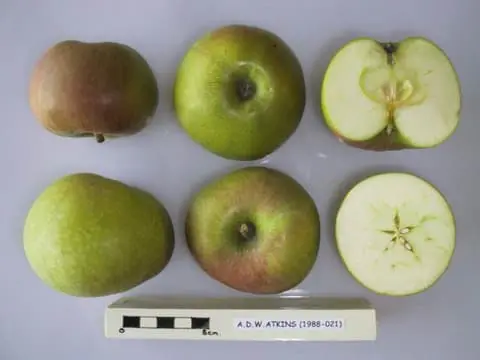
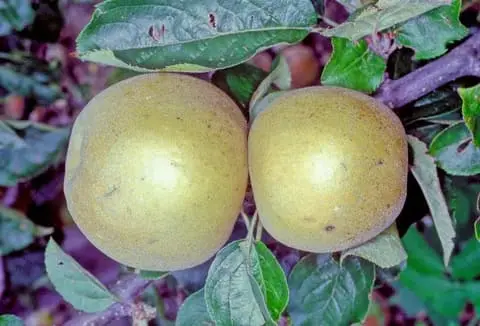
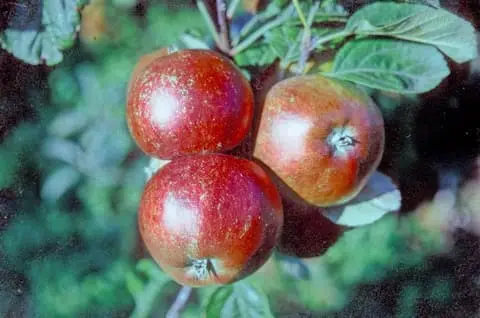
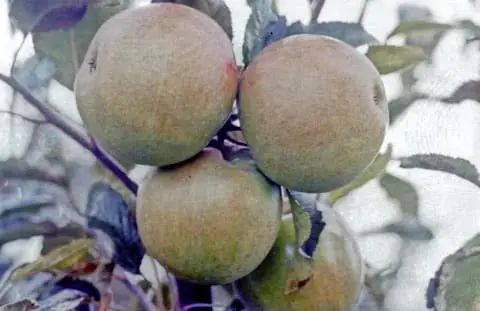
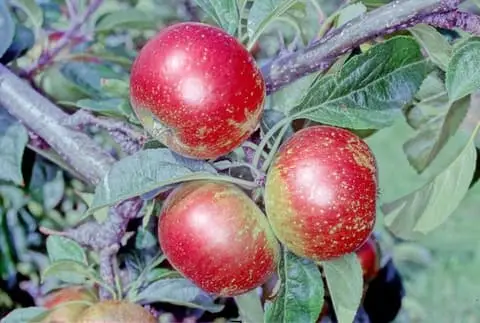
The fruit is large, short-conical or ovate and regular, with broad ribs round the crown2,3; the 1971 National Apple Register, quoted on the collection’s record, gives it as 76 mm wide and 59 mm high1. The skin is smooth and shining, grass green at first and clear pale yellow when ripe, with broken streaks of bright crimson and a pale red or pinkish flush2,4. The flesh is tender, juicy and greenish white, with a brisk acidity2,3,4, and it cooks well1.
Hogg gave its season as October to March, the Pomona as November to January, or as late as March if well kept, and Bunyard as January to March2,3,4. At Brogdale, Kent, it reaches 10 per cent flowering around 6 May and is picked in mid October1.
Growing
Hogg called it “a marvellous bearer” that rarely failed to crop2, and Bunyard thought it “perhaps the most reliable cropper of all cooking apples”4. The Pomona found the tree vigorous and very hardy, quick to come into bearing and making handsome pyramids on crab stock3; Bunyard described its growth as dwarf and spreading4. It is diploid5.
Where the sources disagree
- Who raised it, and when. Hogg credits Messrs H. Lane & Son, who exhibited it in 18572, and the Pomona John Lane3; Bunyard says only that it was found in a garden and introduced by the Lanes in 18574; the collection names Thomas Squire, about 1840, and dates its introduction by John Lane to 18501.
- Parents. Russet Nonpareil and Dumelow’s Seedling according to the Pomona and the collection1,3; Hawthornden and an unidentified parent according to SNP data5.
- Growth. Vigorous in the Pomona3, dwarf in Bunyard4.
- The name Prince Albert. The collection gives Prince Albert among its other names1; the Pomona noted that Smart’s Prince Albert, a dessert apple grown in Kent, is “a different variety altogether”3.
Family tree
Parents, grandparents and great-grandparents, as the entries in the atlas record them.
- Lane's Prince Albert United Kingdom, about 1840
- Parent Hawthornden United Kingdom, by 1780
Offspring in the atlas
- Byfleet Seedling × Bramley's Seedling; United Kingdom, 1915
- Caudal Market × Hambledon Deux Ans; United Kingdom, by 1953
- Colonel Yate × Peasgood's Nonsuch; United Kingdom, 1905
- Corry's Wonder × Beauty of Stoke; United Kingdom, 1917
- Morley's Seedling × Alfriston; United Kingdom, by 1928
- Oxford Sunrise × Cox's Orange Pippin; United Kingdom, by 1942
- Oxford Yeoman × Blenheim Orange; United Kingdom, 1922
- Prince George × Peasgood's Nonsuch; United Kingdom
- Shoesmith × Golden Noble; United Kingdom, by 1930
Sources
- Lane's Prince Albert (accession 1975-308), National Fruit Collection, Brogdale, Kent (Defra). Supports: "Thought to have been raised in about 1840 by Thomas Squire, Berkhamsted"; "introduced by John Lane in 1850"; a First Class Certificate from the RHS in 1872; "very juicy and acid", "Cooks well"; parentage "Russet Nonpareil x Dumelow's Seedling"; listed as mother of five varieties, among them Shoesmith and Colonel Yate, and father of five; synonyms including Prince Albert, Prinz Albert, Profit and Victoria and Albert; from the National Apple Register (Smith, 1971), a large fruit 76 mm wide and 59 mm high, green-yellow with orange stripes, flesh white, very soft and fine; 10% flowering on 6 May and picking in mid October at Brogdale; a culinary apple.
- The Fruit Manual, 5th ed., p. 128: Lane's Prince Albert, Robert Hogg, Journal of Horticulture Office, Internet Archive, 1884. Supports: large and handsome, short conical or ovate, even and regular, with broad obtuse ribs round the crown; skin smooth and shining, grass green turning clear pale yellow, pale red marked with broken streaks of bright crimson in the sun; flesh tender, juicy, briskly flavoured; "A very excellent culinary apple, from October to March"; raised by Messrs H. Lane & Son of Berkhampstead and exhibited by them at a meeting of the British Pomological Society on "October 26th, 1857"; "a marvellous bearer", rarely failing to crop.
- The Herefordshire Pomona, vol. II, plate LII, no. 3: Prince Albert, Robert Hogg and H. G. Bull (eds), Woolhope Naturalists' Field Club, Internet Archive, 1876–1885. Supports: synonym Lane's Prince Albert; raised by Mr John Lane of Berkhampstead "from the Russet Nonpareil fertilised by Dumelow's Seedling"; named "on the occasion of the visit of Her Majesty and Prince Albert to Berkhampstead"; large, short conical or ovate, with broad ribs round the crown; flesh very tender, juicy and briskly acid; in season from November to January, "or even to February or March if well kept"; the tree vigorous, very hardy and a good bearer, forming handsome pyramids on the crab stock and coming quickly into bearing; Smart's Prince Albert, a Kentish dessert apple, "a different variety altogether".
- A Handbook of Hardy Fruits, vol. I, pp. 12 and 80: key to apples, Table II; Lane's Prince Albert, E. A. Bunyard, John Murray, Internet Archive, 1920. Supports: Table II of the key, the "Lanes Group" of smooth-skinned, distinctly striped apples, mostly "cookers", "the typical representative being Lanes Prince Albert" (p. 12); German name Prinz Albert; culinary, January to March; large, round conical; yellowish-green with distinct red stripes and a slight pinkish flush; skin "remarkably smooth"; flesh tender, greenish-white, acid; growth dwarf and spreading, very fertile; "found in a garden at Berkhampstead, and introduced by Messrs. Lane, of that town in 1857"; "Perhaps the most reliable cropper of all cooking apples" (p. 80).
- Cultivar fingerprinting and SNP-based pedigree reconstruction in Danish heritage apple cultivars utilizing genotypic data from multiple germplasm collections in the world, B. Larsen and others, Genetic Resources and Crop Evolution 72: 2397, supplementary Table S5, 2025. Supports: Lane's Prince Albert diploid, with Hawthornden as its one SNP-confirmed parent and the second parent unknown; Lane's Prince Albert a parent of Undine, with Jonathan (Table S5).
- RHS Recommended: Award of Garden Merit. Fruit, vegetables and herbs, Royal Horticultural Society. Supports: 'Lane's Prince Albert' (culinary) among the apples on the list of plants holding the Award of Garden Merit.