Apple varieties, United Kingdom
Keswick Codlin
Found on a rubbish heap at Gleaston Castle; an early codlin that could go into tarts by the end of June
History
Keswick Codlin was found growing on a heap of rubbish behind a wall at Gleaston Castle, near Ulverston1,2. John Sander, a nurseryman at Keswick, propagated it and sent it out under that name1,2. The National Fruit Collection says that it was recorded in 17931, and Bunyard dated its origin to about 17903. In 1813 Sir John Sinclair wrote in the Memoirs of the Caledonian Horticultural Society that a tree planted twenty years before in the bishop’s garden at Rose Castle, Carlisle, had never failed to bear a crop, and he found the apple one “of fine tartness and flavour”2.
Bunyard noted in 1920 that it was much grown in the north of Britain and still valued for cooking and for its reliable cropping3. In the United States, Beach found it long known and quite commonly listed by nurserymen, but grown mainly for home use and nowhere extensively4.
SNP studies show it to be a parent of several varieties: with Hawthornden of Grenadier and Emneth Early, with Manks Codlin of Golden Spire, and with Stirling Castle of Beauty of Moray5. A 2025 study adds Lord Suffield, another child of Keswick Codlin and Hawthornden6, and the two are inferred as grandparents of five more, among them S.T. Wright and Reverend W. Wilks5.
The fruit
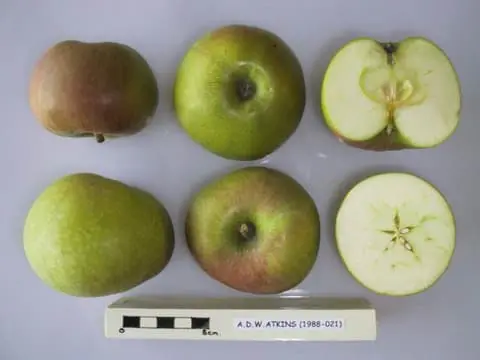
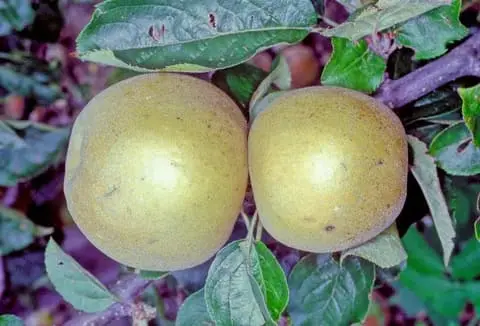
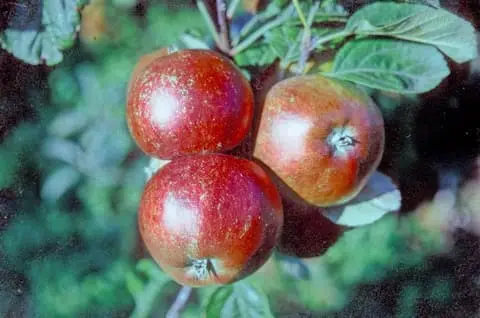
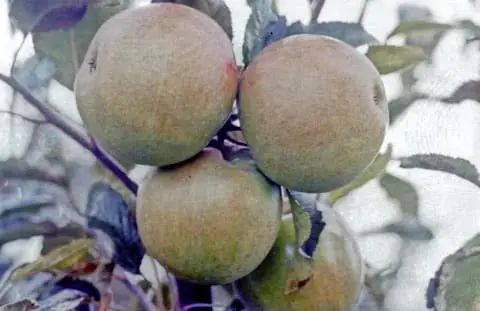
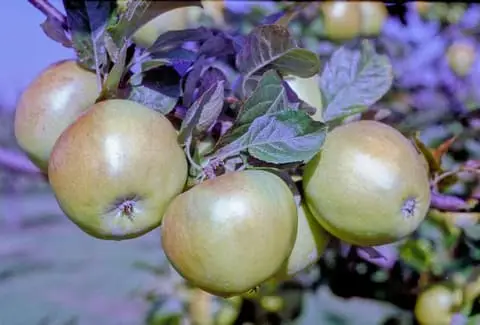
The fruit is above medium size, conical and angular, with ridges round the eye2; the 1971 National Apple Register, quoted on the collection’s record, gives it as 72.5 mm wide and 65.5 mm high1. The skin is pale yellow, deeper yellow on the sunny side with an orange or faint red blush2,3, and Bunyard noted that the fruit nearly always shows a raised line down one side3. The flesh is pale yellowish white, soft and juicy, with a brisk, acid flavour, but turns mealy after a month2,3; the collection finds it rather coarse-textured and somewhat dry1.
Hogg wrote that it could be used for tarts as early as the end of June, but was at its best in August and September2. In New York it came into season late in August or early in September, ripened over several weeks and was not suited to storage4. At Brogdale, Kent, it reaches 10 per cent flowering around 30 April and is picked in mid August1.
Growing
Hogg described a healthy, vigorous tree of middle size and “an immense bearer”, succeeding in almost any soil and situation and suited to espalier training on paradise stock2; Sinclair found that it did best in a strong soil2. Bunyard called its growth medium and compact, and its fertility “immense”3. Beach described the tree as hardy, healthy and long-lived, bearing young and cropping well almost every year4. It is diploid5.
Where the sources disagree
- Date. Recorded in 1793 according to the collection1; about 1790 according to Bunyard3.
- The flesh. Very juicy to Hogg2; somewhat dry to the collection1.
- Vigour. Vigorous to Hogg2; medium and compact to Bunyard3.
- The name White Codlin. The collection gives White Codlin among its other names1; Bunyard listed White Codlin as a name of Dutch Codlin3.
Family tree
Offspring in the atlas
- Beauty of Moray × Stirling Castle; United Kingdom, by 1883
- Catshead × Hawthornden; United Kingdom, 1600s
- Emneth Early × Hawthornden; United Kingdom, by 1899
- Fiessers Erstling × Bismarck; Germany, before 1904
- Fillingham Pippin × Reine des Reinettes; United Kingdom, by 1923
- Golden Spire × Manks Codlin; United Kingdom, about 1850
12 varieties in the atlas descend from Keswick Codlin.
Sources
- Keswick Codlin (accession 2000-053), National Fruit Collection, Brogdale, Kent (Defra). Supports: "Found growing on a heap of rubbish at Gleaston Castle near Ulverston"; "It was recorded in 1793"; "Introduced by nurseryman John Sander at Keswick"; "soft, rather coarse-textured, somewhat dry and acid flesh"; synonyms including Keswick Codling, Keswicker Kuchenapfel, Pinder's Apple and White Codlin; father of Emneth Early; from the National Apple Register (Smith, 1971), a medium-large, broad globose-conical fruit 72.5 mm wide and 65.5 mm high, yellow with red over-colour, soft, yellowish flesh; 10% flowering on 30 April and picking in mid August at Brogdale; a culinary apple.
- The Fruit Manual, 5th ed., p. 122: Keswick Codlin, Robert Hogg, Journal of Horticulture Office, Internet Archive, 1884. Supports: above medium size, conical, angular, the angles forming ridges round the eye; skin rather pale yellow, deeper yellow with an orange or blush tinge next the sun; flesh pale yellowish white, very juicy, tender and soft, brisk and pleasant, but "becomes mealy after being kept for a month"; "It may be used for tarts so early as the end of June; but it is in perfection during August and September"; the tree healthy, vigorous, of middle size and "an immense bearer", succeeding "in almost every soil and situation", suited to espalier training on the paradise stock; found "among a quantity of rubbish behind a wall at Gleaston Castle, near Ulverstone" and sent out by John Sander, nurseryman at Keswick; Sir John Sinclair in the Memoirs of the Caledonian Horticultural Society, 1813: a tree planted "in the episcopal garden at Rose Castle, Carlisle, twenty years ago" that "has never failed to bear a crop", "an apple of fine tartness and flavour", flourishing "best in a strong soil".
- A Handbook of Hardy Fruits, vol. I, pp. 49 and 75–76: Dutch Codlin; Keswick Codlin, E. A. Bunyard, John Murray, Internet Archive, 1920. Supports: White Codlin given as a name of Dutch Codlin (p. 49); German name Keswicker Kuchenapfel; culinary, August to September; medium, conical, regular; yellow with faint red flush; flesh soft, palest yellow, acid; growth medium, compact; "fertility immense"; "Origin, at Gleastone Castle, Ulverstone, about 1790. Introduced by Mr. John Sander, Keswick. Much grown in North Britain"; "Still appreciated for culinary use and its reliable cropping habits"; "Nearly always shows a raised line on one side of the fruit" (pp. 75–76).
- The Apples of New York, vol. II, pp. 116–118: Keswick, S. A. Beach, New York Agricultural Experiment Station, Internet Archive, 1905. Supports: synonyms Keswick Codlin and Keswick Codling; esteemed for culinary use but "not adapted for storage", coming into season "late in August or early in September" and ripening over several weeks; "long been known in this country", "quite commonly listed by nurserymen", but "nowhere extensively cultivated being grown chiefly for home use"; the tree hardy, healthy, long-lived, coming into bearing quite young and yielding good to very good crops almost annually.
- Using whole-genome SNP data to reconstruct a large multi-generation pedigree in apple germplasm, H. Muranty and others, BMC Plant Biology 20: 2, with Additional files 1 and 3 (Tables S1 and S3), 2020. Supports: Keswick Codlin diploid (Table S1); inferred from SNP data as a parent of Grenadier and Emneth Early, each with Hawthornden, of Golden Spire, with Manks Codlin, and of Beauty of Moray, with Stirling Castle (Table S3); Keswick Codlin and Hawthornden inferred as grandparents of five cultivars, among them S.T. Wright and Reverend W. Wilks (text).
- Cultivar fingerprinting and SNP-based pedigree reconstruction in Danish heritage apple cultivars utilizing genotypic data from multiple germplasm collections in the world, B. Larsen and others, Genetic Resources and Crop Evolution 72: 2397, supplementary Table S5, 2025. Supports: no parent identified for Keswick Codlin; Lord Suffield with SNP-confirmed parents Keswick Codlin and Hawthornden (Table S5).