Apple varieties, United Kingdom
John Downie
Raised at Whittington, near Lichfield, and introduced in 1875; probably still Britain's best-known crab apple
History
John Downie was raised by E. Holmes of Whittington, near Lichfield, and introduced in 18751. Holmes named it after his friend John Downie, a nurseryman who had at one time been a partner in the Handsworth Nurseries at Sheffield1. Trees and Shrubs Online, the International Dendrology Society’s reference work, calls it “probably still the best known crabapple in Britain”1. The National Fruit Collection at Brogdale, Kent, keeps it as accession 1974-441, under the genus Malus alone3.
The fruit
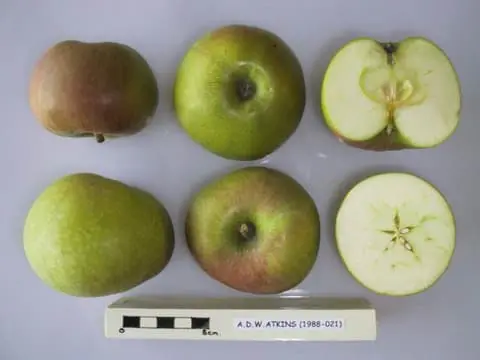
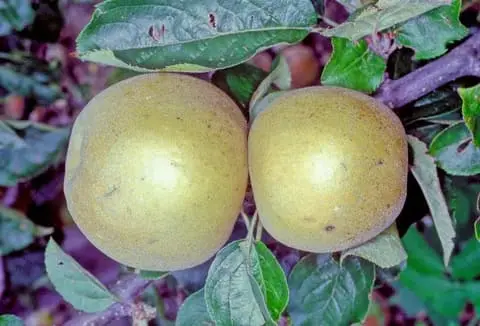
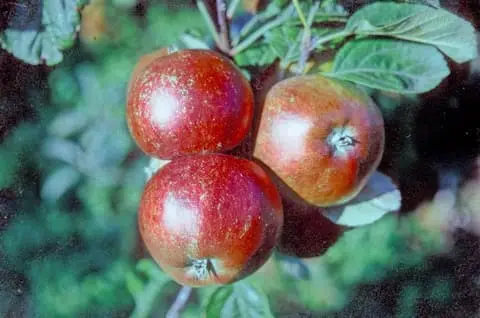
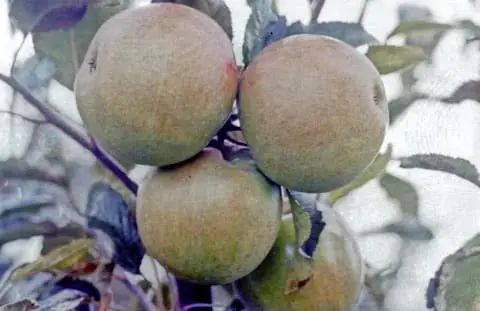
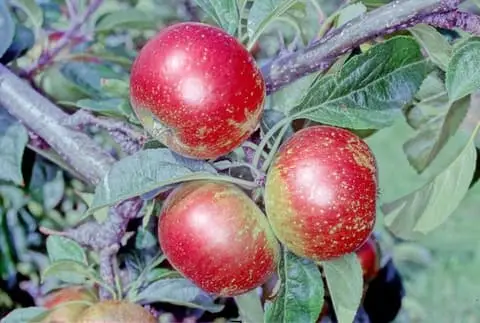
The fruit is conical or ovoid, about 3 cm long, and orange-red, or bright red and orange-yellow1,2. Trees and Shrubs Online classes its fruit season as early, and the fruit tends to drop quickly1. The Royal Horticultural Society places it in its culinary group, the apples with a tart flavour that are best cooked2.
Growing
The RHS describes a vigorous small tree with an oval crown, eventually 8–12 m tall2; Trees and Shrubs Online, a rounded, open tree under 6 m1. Its single white flowers, less than 4 cm across, open early from pink buds1,2. It is hardy throughout the UK and northern Europe, the RHS’s rating H62. It is highly susceptible to scab, more so than many more recent hybrids1, and the RHS lists canker, blossom wilt, brown rot, fire blight and powdery mildew among the diseases it may suffer, and woolly aphid among its pests2. It is diploid4.
Uses
It is grown for its showy flowers and its large, attractive fruit1, which is made into jelly; because the fruit falls so soon, Trees and Shrubs Online warns that “jelly makers need to be vigilant”1. The RHS recommends it as a plant for pollinators2.
Where the sources disagree
Sources
- Malus Cultivars J–K: 'John Downie', Julian Sutton and Nick Dunn, Trees and Shrubs Online (International Dendrology Society), 2021. Supports: raiser E. Holmes, Whittington, Lichfield; date of introduction 1875; "Named for John Downie, a nurseryman (one time partner in the famous Handsworth Nurseries, Sheffield), and friend of the raiser"; "Probably still the best known crabapple in Britain"; showy flowers and large, attractive fruit; susceptible to scab in comparison with many more recent hybrids (disease susceptibility "Highly susceptible"); "It tends to drop its fruit quite quickly, so jelly makers need to be vigilant"; a medium-sized tree (under 6 m), rounded and open; single, pure white flowers from pink buds, under 4 cm, early in the season; fruit under 3 cm, conical, orange-red, early in the season.
- Malus 'John Downie' (C), Royal Horticultural Society, RHS plant profile. Supports: a vigorous small deciduous tree with an ovoid crown and profuse white flowers opening from pink buds; fruit abundant, ovoid, 3 cm long, bright red and orange-yellow; eventual height 8–12 metres and spread 4–8 metres; hardiness H6, hardy in all of the UK and northern Europe (-20 to -15 °C); horticultural group C, apples for culinary use with a tart flavour, best cooked or made into a purée; may be susceptible to aphids including woolly aphid, fruit tree red spider mite and codling moth, and to apple canker, apple scab, blossom wilt, brown rot, fireblight, honey fungus and powdery mildews; RHS recommended for pollinators.
- John Downie (accession 1974-441), National Fruit Collection, Brogdale, Kent (Defra). Supports: held as 'John Downie', accession 1974-441, under the genus Malus alone; material available from the collection.
- Ploidy determination, Malus (study MALUS.PLOIDYDETERMINATION.2008), USDA Agricultural Research Service, GRIN-Global, 2008. Supports: John Downie (PI 589343) diploid (2x), by flow cytometry.