Apple varieties, United Kingdom
Bramley's Seedling
Grown from a pip in a Southwell garden between 1809 and 1815; the original tree was still alive in 2026
History
Bramley’s Seedling grew from a pip sown by Mary Ann Brailsford in the garden of her parents’ home in Church Street, Southwell, Nottinghamshire, between 1809 and 18151. According to the county’s Historic Environment Record, she planted pips from apples her mother was preparing in a flowerpot and later moved the most promising seedling into the garden2.
By 1856 the garden belonged to Matthew Bramley, a butcher3. That year Henry Merryweather, aged 17, saw a gardener carrying some of its apples and asked where they had grown3; two years earlier he and his father had set up as nurserymen near Southwell2. Bramley let him take cuttings on condition that the apple bore his name, Bramley’s Seedling3. Merryweather introduced it in 18654, and showed it to the Royal Horticultural Society’s Fruit Committee on 6 December 1876, where it was highly commended2. In 1884 Hogg called it “a very valuable cooking apple”5, and the Herefordshire Pomona records a first-class certificate awarded at the National Apple Congress at Chiswick in October 18836. By 1920 Bunyard thought it “the most popular and profitable of cooking apples”7.
It remains the most popular cooking apple grown in the UK4. In October 2012 it covered 1,794 hectares in England and Wales, more than any other single apple variety, against 99 hectares for all other cooking apples together8. A 2025 census of growers supplying 92 per cent of the British crop sold to major retailers found 392 hectares, 7 per cent of their apple orchards and the third-largest area after Gala and Braeburn9. In 2016 the BBC reported that about 83,000 tonnes were grown in Britain each year, by more than 300 growers in England, and that, according to the Bramley Apple Information Service, the apple was little known outside the UK except in Japan3.
The original tree was still alive in 20261. By 2016 it had incurable honey fungus, and Professor Ted Cocking of the University of Nottingham had raised clones of it by micropropagation3. In May 2026 Nottingham Trent University sold the garden in which it stands to the owners of the neighbouring cottage1.
The fruit
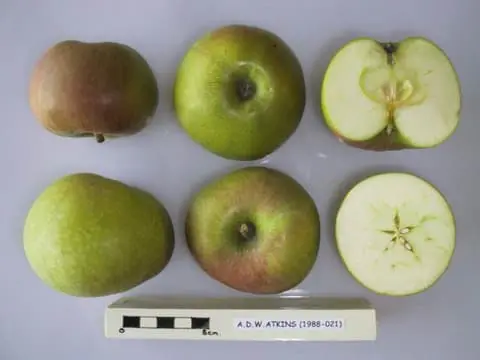
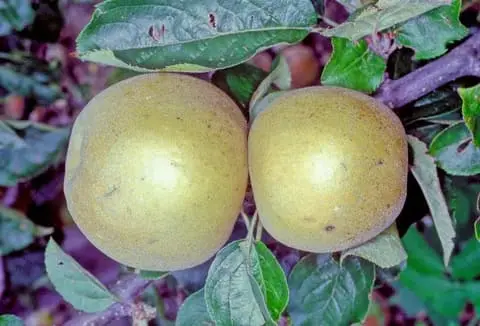
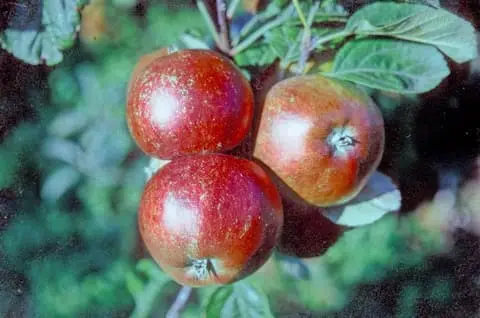
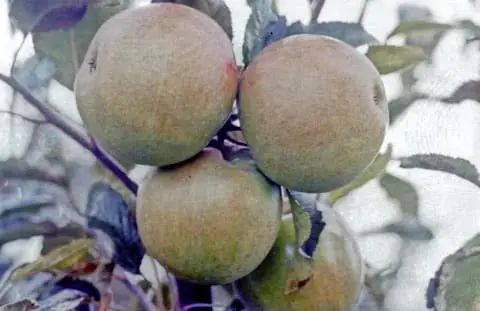
The fruit is large and flattened5,7, about 89 mm wide and 65 mm high4. The skin is greenish yellow with a red flush and broad, broken stripes7,4; Hogg found it “very much covered with a tinge of pale red”5. The flesh is firm, juicy and pale yellow, with a brisk, sharp acidity7,5,4, and it keeps its flavour when cooked3.
At the National Fruit Collection at Brogdale, Kent, it starts to flower around 6 May and is picked in early October4,10. Hogg said it was in use until January, the Herefordshire Pomona gave its season as December to February, and Bunyard as November to March5,6,7. Today it is kept in controlled-atmosphere stores at 4–4.5 °C until March; in a cold air store it lasts only until mid- to late October11.
Growing
A triploid4, it makes a very large, spreading and extremely vigorous tree, which Bunyard advised planting at least 9 metres (“thirty feet”) apart and called “ironclad in constitution, growing wherever apples will grow”7. The Herefordshire Pomona found it very hardy, its blossom apparently able to withstand spring frosts, and a constant, regular bearer6; Bunyard found it very regularly fertile once the tree is established7. In unsprayed trials in Denmark it showed low susceptibility to scab and powdery mildew and little canker12. A red sport, Crimson Bramley, arose in an orchard in Southwell7,4.
Where the sources disagree
- Who raised it. Modern accounts credit Mary Ann Brailsford1,2,4. The Herefordshire Pomona said it was raised from seed by Mr Bramley of Southwell6, and Bunyard described him as “a shoemaker”7, whereas the BBC calls Matthew Bramley a butcher3.
- Dates. The pip was sown between 1809 and 1813 according to the National Fruit Collection4, or between 1809 and 18151. The variety was introduced in 18654, or about 18766,7.
- Awards. Its first-class certificates are dated 1877, from the committee of the Royal Jubilee Exhibition of Apples in Manchester2; October 1883, at the National Apple Congress at Chiswick6; and 1893, from the Royal Horticultural Society4.
- The garden. The Guardian places the tree in Church Street1; the Historic Environment Record puts Mr Bramley’s garden at “No. 73, Easthorpe”2.
Family tree
Offspring in the atlas
- Byfleet Seedling × Lane's Prince Albert; United Kingdom, 1915
- Crimson Bramley United Kingdom, by 1913
- Woolbrook Russet × King's Acre Pippin; United Kingdom, 1903
Sources
- Future of first Bramley apple tree in doubt as cottage where it stands is sold, The Guardian, 2026-05-30. Supports: the tree sown by Mary Ann Brailsford in the garden of her parents' home in Church Street, Southwell, between 1809 and 1815; the original tree, more than 200 years old, still standing; the garden sold by Nottingham Trent University to the owners of the neighbouring cottage, as reported on 30 May 2026.
- The Story of the Bramley Apple, Nottinghamshire Historic Environment Record, Nottinghamshire County Council, Winter 2009/2010. Supports: about 1809 Mary Ann Brailsford planted pips from apples her mother was preparing in a flowerpot and moved the most promising seedling to the garden; Henry Merryweather and his father set up as nurserymen beside Norwood Park, Southwell, in 1854; the tree in Mr Bramley's garden "at No. 73, Easthorpe"; Henry showed the apple to the Royal Horticultural Society's Fruit Committee on 6 December 1876, where it was highly commended; a first-class certificate from the committee of the Royal Jubilee Exhibition of Apples in Manchester in 1877.
- Original Bramley apple tree in Southwell is dying, BBC News, 2016-07-19. Supports: in 1856 Henry Merryweather, aged 17, saw a gardener carrying the apples; the garden then belonged to Matthew Bramley, a butcher, who let him take cuttings for his family's nursery provided they bore the name Bramley's Seedling; the tree's incurable honey fungus; clones made by micropropagation by Prof Ted Cocking of Nottingham University; the apple "stores well and keeps its flavour when cooked"; "About 83,000 tonnes" grown in Britain annually and more than 300 growers in England; according to the Bramley Apple Information Service, little known outside the UK except in Japan.
- Bramley's Seedling, National Fruit Collection (Defra and the University of Reading). Supports: triploid; raised by Mary Ann Brailsford, Southwell, between 1809 and 1813; introduced in 1865 by nurseryman H. Merryweather; first exhibited in 1876; a First Class Certificate from the Royal Horticultural Society in 1893; "The most popular cooking apple grown in the UK"; synonyms Bramley, Bramleys Samling and Triomphe de Kiel; the sport Crimson Bramley; fruit 89 mm wide and 65 mm high, greenish yellow with red flush and stripes, flesh firm, flavour acid (Smith, 1971); 10% flowering on 6 May and picking in early October at the collection.
- The Fruit Manual, 5th ed., p. 29: Bramley's Seedling, Robert Hogg, Journal of Horticulture Office, Internet Archive, 1884. Supports: a large, oblate apple; skin "very much covered with a tinge of pale red", striped with darker red; flesh with a yellowish tinge and "a fine brisk acidity"; "A very valuable cooking apple; in use up till January".
- The Herefordshire Pomona, vol. II, plate LXXIII, no. 8: Bramley's Seedling, H. G. Bull and R. Hogg (eds), Woolhope Naturalists' Field Club, Internet Archive, 1876–1885. Supports: raised from seed by Mr Bramley of Southwell and obtained from him by Mr Merryweather of Southwell, Notts, who issued it to the public "(c. 1876)"; a first-class certificate at the National Apple Congress at Chiswick in October 1883; in season from December to February, keeping and travelling well; a very robust, large and very hardy tree whose blossoms "seem able to withstand the spring frosts", a constant and regular bearer.
- A Handbook of Hardy Fruits, vol. 1, pp. 31–32 and 45: Bramley's Seedling; Crimson Bramley, E. A. Bunyard, John Murray, Internet Archive, 1920. Supports: culinary, November to March; large, flat, round and irregular; greenish-yellow with a red flush and broad broken stripes; flesh firm, juicy, pale yellow and acid; growth extremely vigorous, very regularly fertile once the tree is developed; raised by Mr Bramley, "a shoemaker", of Southwell, and introduced by Messrs Merryweather in 1876; "the most popular and profitable of cooking apples; ironclad in constitution, growing wherever apples will grow"; a very large spreading tree to be planted "at least thirty feet apart" (pp. 31–32); Crimson Bramley, a red bud sport that arose in an orchard in Southwell (p. 45).
- Survey of Orchard Fruit at October 2012, England and Wales, Department for Environment, Food and Rural Affairs (Defra), 2013-05-30. Supports: Bramley's Seedling on 1,794 ha in October 2012, still "the single apple variety covering the greatest area", against 99 ha of other culinary apples (Table 2).
- Orchard and Storage Census Report 2025, British Apples & Pears Limited, 2025. Supports: respondents representing 92% of the picked crop sold to UK supermarkets and other major retailers; Bramley on 392 ha, 7% of apple hectares, third after Gala and Braeburn.
- National Fruit Collection: introduction, National Fruit Collection (Defra and the University of Reading). Supports: the collection is located at Brogdale Farm, near Faversham, Kent.
- Storage conditions recommended for major apple varieties in the UK, NIAB, Apple Best Practice Guide. Supports: Bramley's Seedling stored in air at 2–3 °C until mid- to late October, and in controlled atmosphere at 4–4.5 °C until March.
- Susceptibility of 15 apple cultivars to apple scab, powdery mildew, canker and mites, H. Lindhard Pedersen, J. Vittrup Christensen and P. Hansen, Fruit Varieties Journal 48(2): 97–100, 1994. Supports: unsprayed trials in Denmark, 1987–1990: Bramleys Seedling of low susceptibility to scab and powdery mildew, and with among the lowest incidence of canker.